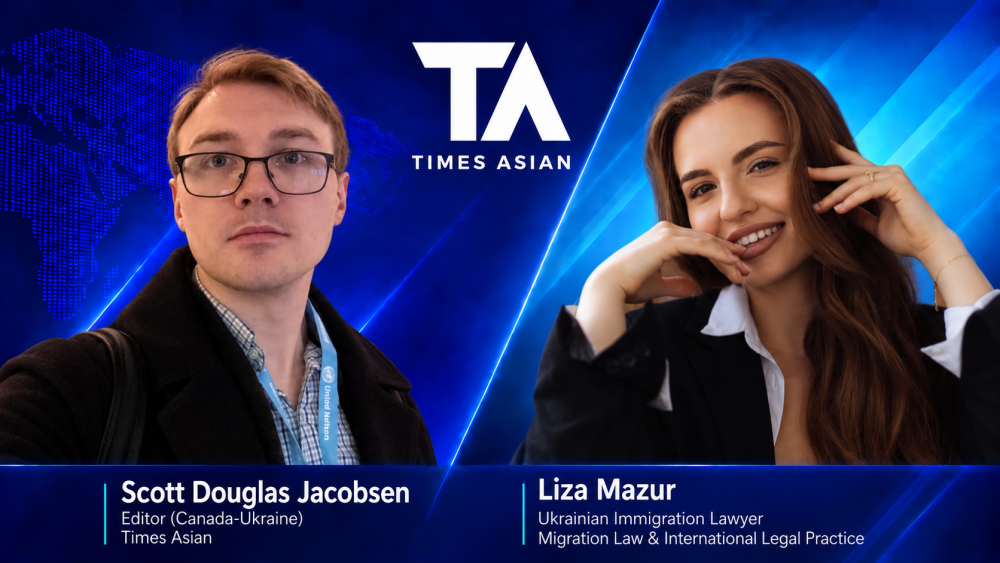
By Scott Douglas Jacobsen
Editor (Canada-Ukraine Affairs), Times Asian
Liza Mazur is a Ukrainian immigration lawyer whose practice includes citizenship, residency, documentation, border procedures, and identity-establishment cases involving people from occupied territories. She also communicates frequently through social media and Ukrainian media, including Kyiv24, discussing migration law, wartime legal obligations, human rights, mobilization, and institutional accountability issues in Ukraine.
In this interview, Scott Douglas Jacobsen and Liza Mazur discuss human rights, migration law, identity documentation, Russian passportization, mobilization, corruption, border procedures, socioeconomic inequality, and media accountability in wartime Ukraine. Mazur explains legal processes affecting citizens from occupied territories and reflects on institutional discretion, public scrutiny, and access to justice.
Scott Douglas Jacobsen: You mentioned violations of human rights. What are some areas in which Ukrainian citizens have had their rights violated?
Liza Mazur: One difficult area concerns people crossing into government-controlled Ukraine from occupied territories.
Some people have lived most or all of their lives in Donetsk, Luhansk, Crimea, or other territories that later came under Russian occupation. Their records may have been created or stored locally, and Ukrainian authorities may no longer have access to all of the original files.
The State Migration Service has national registers, but some older information was also kept in local paper records. When those local offices became inaccessible because of occupation, confirming a person’s identity could become much more complicated.
This became a major issue after Russia began occupying Ukrainian territory in 2014.
There were also serious security concerns for people in occupied territories who had previously worked with the Ukrainian police, security services, military, or other state institutions.
Jacobsen: There have been extensive resistance movements in occupied territories, and that part of the story has not always received as much attention.
Mazur: Yes, there are many stories like that. But here I am talking about civilians.
Some civilians want to leave occupied territory, return to government-controlled Ukraine, and obtain or renew Ukrainian documents. They may go to the nearest available office of the State Migration Service and apply for a passport or a replacement passport.
Some have also received Russian passports while living under occupation. Russian authorities have imposed or facilitated Russian citizenship and passport issuance in occupied Ukrainian territories, which can create further complications when people later deal with Ukrainian authorities.
But Ukraine understands that people living under occupation may have had very limited choices.
The main problem can be confirming who the person is when the necessary information is incomplete or inaccessible.
Under Ukrainian procedure, this is called establishing a person’s identity.
If the usual records are unavailable, the State Migration Service can use other state registers, databases, documents, and information provided by the applicant. If that is still not enough, the authorities can conduct an identity-establishment procedure that may include interviewing witnesses who know the person.
The purpose is to establish reliable information about who the person is, their connection to Ukraine, and their eligibility for Ukrainian documents.
You may need to ask your father, mother, brother, sister, friends, neighbours, or someone else who knows you and is at least 14 years old. At that age, a person can already have a Ukrainian ID card. Separately, under Ukrainian civil law, a person aged 14 to 18 has incomplete civil capacity, with broader independent legal powers than a child under 14. The civil-capacity rule is distinct from the procedural rule allowing a person aged 14 or older to participate as a witness in the identity-establishment procedure.
I was trying to remember the Ukrainian legal term. There is pravozdatnist, which means legal capacity, and there is civilna diiezdatnist, meaning civil capacity.
For this particular procedure, a witness can be a family member, close person, or neighbour who is at least 14 years old, has documents confirming their own identity, and can help confirm who you are.
For example, you might bring your mother, father, sister, or another person who knows you. They can provide information to the Ukrainian authorities confirming your identity.
You should provide any Ukrainian documents you still have from before the occupation that may help establish your identity. That can include your Ukrainian birth certificate, diplomas, driver’s licence, business documents, archival records, or other documents connecting you with Ukraine.
If Ukraine is mentioned in those documents, or they otherwise contain information about your life and identity in Ukraine, they can help establish your case.
The authorities can then search Ukrainian registers, archives, and other available databases to find information confirming your identity and citizenship. Some records from occupied territories may also have been preserved, transferred, or reproduced in other Ukrainian databases.
This is a common, well-documented problem for Ukrainians from occupied territories.
These cases are actually some of my favourite cases to work on. My most recent case involved a client who contacted me through Instagram asking me to help a woman who had been born in Crimea.
She was born there in the 2000s. She is now 26. When she was around 14, Crimea had already been occupied by Russia.
It would probably be more accurate to say that the Russian authorities issued her Russian documents while she was living in occupied Crimea. She had originally been documented as Ukrainian, but she later received a Russian birth record and a Russian internal passport.
Her parents were also recorded in Russian documentation, but she was born in Ukraine and had Ukrainian documentation.
Ukraine still had records relating to her birth. She effectively had two sets of documents, Ukrainian and Russian.
Jacobsen: It is rare for someone to be born twice.
Mazur: Yes. Now it is also very difficult to travel to Ukraine from Russia. Ukraine introduced a visa regime for Russian citizens effective July 1, 2022, so Russian citizens generally need a visa to enter Ukraine.
Visa applications and entry can also involve security screening by Ukrainian authorities. In a case like hers, all of the documents she currently possesses may have been issued in Crimea under Russian occupation, so the Ukrainian authorities need to establish who she is and whether there are any security concerns.
Jacobsen: In Ukraine, at some point everyone starts wondering whether every foreigner is a spy. Chinese, American, Israeli, Iranian, anyone.
Mazur: Yes. The authorities want to know who the person is and why they are coming. Sometimes the authorities may initially treat a person as a possible security risk.
In a case like this, my job as an immigration lawyer is to help establish that the person is Ukrainian. She is currently in Crimea, and the Russian authorities issued her Russian documents.
I need to search, including through attorney requests, for any Ukrainian records that can help prove her identity and Ukrainian citizenship. Even a small piece of documentary evidence can become important.
Then she may be able to apply through a Ukrainian consulate in a third country, such as Turkey or through another designated Ukrainian diplomatic mission where the procedure is available.
If the Ukrainian consulate confirms her identity and citizenship, it may issue what people sometimes call a “white passport.” Officially, it is a Certificate of Identity for Return to Ukraine.
It is a temporary travel document that allows a person to return to Ukraine. It is basically a one-way document for returning home.
Once she enters Ukraine, she can then apply for the appropriate Ukrainian identity and passport documents.
If the consulate is able to issue this certificate after confirming her identity and citizenship, that means the Ukrainian authorities have established sufficient grounds to recognize her as a Ukrainian citizen for the purpose of returning to Ukraine.
Jacobsen: Are more people coming to obtain Ukrainian passports, or are more Ukrainians trying to obtain foreign passports?
Mazur: It depends. For example, there are Ukrainians who currently have Russian passports.
Jacobsen: Not necessarily Russians. I mean someone who is Ukrainian by nationality or has a long-term Ukrainian background. Is that person more likely to seek a foreign passport, or is a foreign national more likely to want a Ukrainian passport?
Mazur: More foreigners do want Ukrainian citizenship or permanent residence because of the rights and opportunities connected with living here. I have had many clients from India, for example. But overall, in my experience, many more Ukrainians are interested in obtaining another country’s passport or citizenship.
Jacobsen: Ukraine’s population is certainly smaller than India’s.
Mazur: Yes.
Jacobsen: I do not think Ukraine’s population has ever been 1.5 billion.
Mazur: No, we do not have requests for billions of Ukrainian passports.
But many Ukrainians want to obtain another citizenship or passport.
There is also another category: Ukrainians who remain in occupied territories, especially Crimea, and now hold Russian passports. For some of them, it is important to restore or confirm their Ukrainian documents and citizenship status.
Receiving a Russian passport under occupation does not automatically mean that Ukraine considers that person to have lost Ukrainian citizenship. Ukraine does not recognize the forced or automatic acquisition of Russian citizenship in occupied territories as grounds for loss of Ukrainian citizenship. Current Ukrainian law also provides specific exceptions concerning conduct such as public support for Russia’s armed aggression or actions threatening Ukraine’s national security or national interests.
So I would describe three main groups.
The first is Ukrainians who want to obtain another country’s citizenship or passport.
The second is Ukrainians in occupied territories who hold Russian documents but want to return to government-controlled Ukraine, confirm their Ukrainian status, obtain Ukrainian documents, and remain in Ukraine.
The third is foreigners who want to live in Ukraine and obtain Ukrainian permanent residence or citizenship. Some may later use Ukraine as part of a broader plan involving Europe, the United States, or Canada, although Ukrainian residence or citizenship does not itself give someone an automatic right to move to those countries.
Canada was also a popular destination for Ukrainians and eligible non-Ukrainian family members because of Canada’s temporary immigration measures for Ukrainians. The Canada-Ukraine Authorization for Emergency Travel, or CUAET, made it considerably easier for eligible Ukrainians and their family members to travel to and stay temporarily in Canada during the earlier period of the full-scale war.
Jacobsen: Did many Ukrainian men avoid mobilization by leaving for Canada?
There seem to be several broad categories. There are men who left Ukraine. There are men who stayed in Ukraine but tried to avoid the TCC or mobilization. There are men who stayed and entered military service because they were required to do so.
Then there is a fourth, somewhat different category: men who voluntarily chose to join the Armed Forces and go to the front because they felt a sense of national duty.
Mazur: Yes.
Jacobsen: How does the law apply differently to those groups of Ukrainian men?
Mazur: The last two categories are more straightforward: people who volunteered and people who are serving according to their military obligations.
There are also men who legally have the right to cross the border during martial law. They can leave Ukraine if they meet one of the statutory exceptions and have the required documents.
The more difficult legal questions concern people who are avoiding mobilization or who left Ukraine in circumstances that may not have complied with the applicable border-crossing rules.
Jacobsen: From your perspective, how should lawyers working during a war interact responsibly with the media, both through their own Instagram and Facebook accounts and when journalists contact them?
Mazur: Beautiful question. Some lawyers are very active on their own social media, including me. This may be one of my strongest areas: communicating with the media and appearing in the media. I want to make sure I understand the question correctly.
Jacobsen: How should lawyers communicate with the media? It is not simply a matter of intellectual self-defence or protecting your reputation.
Mazur: You need to understand what people want to hear.
Jacobsen: Is it about telling them what they want to hear, or telling them what is accurate according to your professional assessment?
Mazur: Both.
Jacobsen: Good.
Mazur: It works both ways. That is a good question because I have also been influenced by social media and by journalists and different media channels. They have helped me improve the way I discuss these topics with people publicly.
For example, a journalist may ask, “What should the government do to help Ukrainians abroad with their documents? What should the government do to encourage young Ukrainians to remain in Ukraine or return to Ukraine?”
You need to give a practical answer.
For example, you could say that the government should make lawful border procedures clearer and reduce unnecessary problems at border crossings.
If a person is legally entitled to cross the border but has forgotten a required document, there should be a clear procedure explaining what the person needs to provide and whether they can return later with the correct documentation.
The situation becomes much more serious if the person does not have a legal right to cross the border. In some circumstances, border officials may identify military-registration issues and involve the relevant authorities, including the TCC. A documentation problem by itself, however, does not automatically mean that a person must be transferred to the TCC; the applicable response depends on the specific legal circumstances and records involved.
You also need to explain these issues correctly in the media. For example, Kyiv24 is a multimedia platform of the Kyiv city community that includes Kyiv Television, the capital’s municipal broadcaster. I have been invited there six or seven times.
They ask me these questions quite often because, during martial law, Ukrainians have important legal obligations.
But obligations cannot simply eliminate human rights. Martial law can permit lawful and temporary restrictions on certain rights, but those restrictions remain subject to Ukrainian constitutional law and applicable international human-rights obligations, while some rights are non-derogable.
If I were speaking directly to the Ukrainian government or in the Verkhovna Rada, I would recommend that the authorities not be unnecessarily strict with Ukrainians, especially younger people. Give them more opportunities to remain connected with Ukraine.
For example, the government changed the border-crossing rules for Ukrainian men aged 18 to 22 inclusive. They can now cross the border during martial law if they have the required passport and military-registration document. The rule does not apply to people holding specified positions in state authorities, government bodies, or local self-government bodies; those individuals may travel abroad only on official business trips.
They can present their military-registration document electronically, including a document generated through Reserve+, when requested by the Border Guard Service.
The authorities should apply these rules clearly and predictably. If there is a problem with someone’s documents, the person should be told what the legal problem is, what decision has been made, and what options exist to correct or appeal it.
It should not automatically become a situation where every documentation problem at the border turns into a confrontation involving the TCC.
Jacobsen: Are you talking about sanctions or penalties?
Mazur: Yes, administrative consequences. If someone has violated a legal requirement, the authorities should explain the violation and issue the appropriate decision according to law. Then the person can appeal it or correct the problem and try again where the law permits.
That is different from treating every person who has a documentation problem as someone who must immediately be taken to the TCC.
You also need to explain these things carefully on social media without making the discussion unnecessarily aggressive. This is one of the main topics people ask about now, so I speak about it frequently.
Going back to your original question about working with the media, you need to have a good relationship with journalists. If you do not want to be friends with them personally, you should at least communicate in a friendly and professional way.
Jacobsen: That is different.
Mazur: Yes, but the two things are connected because, from the journalist’s perspective, they may look similar.
Jacobsen: There are two highly sensitive subjects, for good reasons and bad reasons. One is corruption. The other is anti-corruption. They are obviously related.
From a legal perspective, corruption occurs across societies, but there is a wide spectrum in its prevalence and institutional impact. Historically, it has been a serious problem across many post-Soviet societies.
Russia has deteriorated substantially on many governance measures. Ukraine has also struggled with corruption, although its anti-corruption institutions and civil society have continued to push reforms, including during the full-scale invasion.
For some context, Transparency International’s 2025 Corruption Perceptions Index ranks Ukraine 104th out of 182 countries, with a score of 36 out of 100. Russia ranks 157th, with a score of 22. The index measures perceived levels of public-sector corruption rather than directly counting corrupt acts.
You can make a similar comparison with press freedom. Reporters Without Borders ranks Ukraine 55th out of 180 countries in its 2026 World Press Freedom Index. The United States is 64th. Ukraine still has serious problems, particularly because the war creates enormous security risks for journalists, but its media environment remains substantially more open than Russia’s.
For me as a journalist, I may not necessarily be safer in Ukraine because there is a war, but away from the front lines I can still have considerable freedom to report and interview people.
If you break these indices into their individual components, you get a more useful picture than from the overall ranking alone. In Ukraine, for example, the security component of press freedom is much weaker than several of its political, legal, economic, and social indicators because journalists are working during an active war.
The more important question is not only where a society is at one moment, but where it is moving over the medium and long term.
Ukraine has shown improvement in several institutional areas while still having serious problems to address. Russia has moved much further in the opposite direction.
So, legally and culturally, why are corruption and anti-corruption both such sensitive topics? Corruption is obviously a problem, but anti-corruption investigations can also be evidence that institutions are functioning independently rather than evidence that the entire system has failed.
Mazur: That is a difficult question because it is directly connected with Ukrainian politics, and I cannot really comment on the political side because I am not inside that system.
I can comment on how corruption can appear in migration law and in my own professional experience.
For example, one of my recent clients was a foreign national who was allowed to travel to Ukraine without a visa because citizens of his country had visa-free entry.
When he arrived at the Ukrainian border, he did not have all of the additional documents needed to demonstrate the purpose and conditions of his stay.
He was taken into another room and interviewed by a border officer.
The officer initially wanted to refuse him entry.
My client later told me that he politely explained that he had enough money for his stay and that additional documents were available in Kyiv. After discussing the situation, the officer allowed him to cross the border.
I cannot say from that alone that corruption occurred. A border officer can reconsider a situation after receiving additional information or clarification.
But there are also people who openly describe experiences that they believe involved corruption. They may comment on TikTok, Instagram Reels, or other social media and describe the institution involved, where it happened, and what they say officials did.
These stories are highly visible now because people discuss them publicly.
For me, corruption and anti-corruption are difficult to separate completely because they are connected. When corruption becomes visible, people also expect institutions, journalists, lawyers, and the public to respond to it.
Jacobsen: You are touching on socioeconomic privilege in migration applications and in the way migration law can operate at the border.
I remember when I landed at Ben Gurion Airport last year. It was my first time in the Middle East and my first time in Israel. I was questioned for about four and a half hours before eventually being allowed through.
Later, when travelling through the Allenby Bridge crossing into Jordan, I remember seeing different levels of processing, including what was presented as a VIP service for some Palestinian travellers.
I am not saying that these systems, laws, or cultures are identical. I am talking about a broader theme: socioeconomic status can sometimes affect how easily a person navigates bureaucratic systems and gains access.
Does something similar apply to some of the arrangements Ukrainian men used to leave the country during martial law?
Mazur: Definitely. I would be lying if I said I had never heard about it, because many of my clients now live abroad and have told me how they crossed the border.
Some people use the expression “green border” for crossing outside an official checkpoint.
Jacobsen: White passport, green border. We have a lot of colours now.
Mazur: Yes, almost every colour.
During martial law these issues can become especially sensitive. Sometimes a government official may say that your documents cannot be accepted or that the law does not permit what you are requesting.
You can receive an official refusal.
But people also tell stories about finding someone with influence, paying money, and suddenly having the same documents accepted without difficulty.
If that account is true in a particular case, the problem may not have been the register or the database at all. It may have been the discretionary or corrupt conduct of the people involved.
That is one of the problems people describe in Ukraine: the result may sometimes appear to depend too much on the individual official.
Jacobsen: So, if you do not come from a wealthy family, do not have a well-paying job, or perhaps already have debts, are the laws more likely to be applied to you strictly?
Mazur: Unfortunately, socioeconomic inequality can influence people’s experiences with institutions, in Ukraine as in other countries.
During martial law, someone from a poorer family may feel that mobilization requirements, administrative penalties, and other state obligations fall on them more heavily, while someone with money, connections, or status may have more ways to solve problems.
That does not mean the law formally says one thing for rich people and another for poor people. It means unequal access to lawyers, connections, information, and sometimes corruption can produce unequal outcomes.
Even ordinary interactions with the police can sometimes depend on discretion.
For example, this once happened to me while I was driving. I needed to turn right, there was a traffic jam, and the bus lane was empty.
I was in a hurry, as usual, so I drove into the bus lane.
The police stopped me.
I said, “I am in a hurry. If I have broken the rule, please issue the fine and I will pay it electronically.”
But instead they said something like, “You are in a hurry. Have a nice day,” and let me go without issuing a fine.
Jacobsen: Being a beautiful woman can sometimes operate like being a rich man.
Mazur: Sometimes both can give a person social advantages.
If I had been aggressive with the officers, perhaps the outcome would have been different and they would have issued the fine immediately.
There are also some traffic offences in Ukraine, particularly those recorded automatically or by photo or video systems, for which a person can pay 50 percent of the fine if payment is made within the legally specified period. But that discount does not apply to every kind of traffic fine.
For some traffic fines recorded through automated systems, you can pay 50 percent if you pay within the specified period. For example, if the applicable fine is 340 hryvnias, you may be able to pay 170 hryvnias within the applicable early-payment period. If you miss that period, you pay the full amount.
It even appears in Ukrainian apps as an option to pay 50 percent of the applicable fine during the preferential payment period.
Jacobsen: That does not sound like the right terminology.
Mazur: You can pay the fine at a 50 percent sale.
Jacobsen: Fine, half off. Discount. Big colourful sale.
Mazur: But in our situation, it can feel as though every step has its price. Every step. Especially when we are talking about mobilization and recruitment.
Maybe one of the most important protections is the media. Public attention can sometimes make a real difference.
If there is a serious criminal case involving a wealthy or influential person, people may worry that money, connections, or status could affect the outcome. But once the case becomes highly publicized, public scrutiny can make it more difficult for authorities to handle the case without outside attention.
Jacobsen: Or someone may actually go to prison.
Mazur: Yes. Public attention creates pressure.
Jacobsen: There are two comments that come to mind.
First, from a geopolitical or international perspective, even authoritarian governments care to some extent about how they are perceived abroad. Look at the extensive resources Russia devotes to trying to influence public opinion in European countries that support Ukraine.
Second, there is the individual human dimension.
It can be frightening to be a young man who may be mobilized, especially around the age of 25, which under current Ukrainian rules is generally the threshold at which men who are liable for military service, medically fit, and not deferred or reserved become subject to mobilization; some men under 25 may also be subject to mobilization in specified cases, when you are in the prime of your life.
If you have already lost friends in the war, the incentive to avoid being placed in the same situation can be enormous from the standpoint of basic self-preservation.
That is not a moral judgment. It is an observation about the psychological pressures created by war.
Thank you very much for the opportunity and your time, Liza.
Scott Douglas Jacobsen is a Canadian journalist and publisher who serves as Times Asian’s Editor for Canada and Ukraine Affairs and writes on international affairs.


