
By Mykhailo Tymuliak
Founder, Reporter
The North Voice
Canada, Ukraine, and Norway co-hosted the Pathways to Peace conference in Toronto, bringing together more than 80 countries and organizations. Survivors described Russian indoctrination, militarization, torture, and captivity. Canada announced new funding and AI-based tracking tools to help locate, return, and reintegrate Ukrainian children, prisoners, and civilians.

As Russia launched another deadly attack on Kyiv on Sept. 28, killing at least two people and injuring dozens, more than 80 countries gathered in Toronto to discuss another dimension of Russia’s war against Ukraine: the return of Ukrainian children, civilians and prisoners of war.

The second international conference on the return of Ukrainian children, detained civilians and prisoners of war, Pathways to Peace, is being co-hosted by Canada, Ukraine and Norway.
At the entrance to the conference hall, organizers placed a dinner table with three empty chairs — a symbolic installation representing the people whose return is at the centre of the conference.
Opening the event, Canadian Foreign Affairs Minister Anita Anand announced new measures aimed at helping bring Ukrainian children, prisoners of war and unlawfully detained Ukrainian civilians home.
Anand said the participation of more than 80 countries and international organizations must translate into concrete action, and that Russia’s crimes cannot become an excuse for inaction.

“We cannot allow Russia’s actions to become an excuse for inaction. This conference is not about the number of countries in the room or the amount of commitments announced. It is about what we do with these promises next: finding those who are missing, countering Russia’s crimes, opening pathways home, and reuniting families. We will continue this work until more Ukrainians return home. That is the only measure of our success,” Anand said.
“They were being raised as Russian soldiers”: Life under occupation in Crimea
Among the most striking testimonies at the conference came from two young Ukrainians from occupied Crimea, Daria and Matvii, who managed to reach Ukrainian-controlled territory only a few months ago following a lengthy operation by Save Ukraine.
Daria was just six years old when Russia occupied Crimea. She left the occupied peninsula four months ago after Save Ukraine spent a year preparing her departure.
“I was too young to understand what was happening. But a year later, I went to school under the Russian flag and anthem. All the textbooks were replaced. They began to suppress everything about the Ukrainian people and the Indigenous peoples of Crimea — Ukrainian books simply disappeared from the libraries. Every day we were told that Russia was our homeland, that Crimea had always been Russian, and that we were a Russian ethnic group,” Daria said.
She said children were shown films about the Second World War from an early age and taught that Ukrainians and the West were “the same Nazis and enemies.”
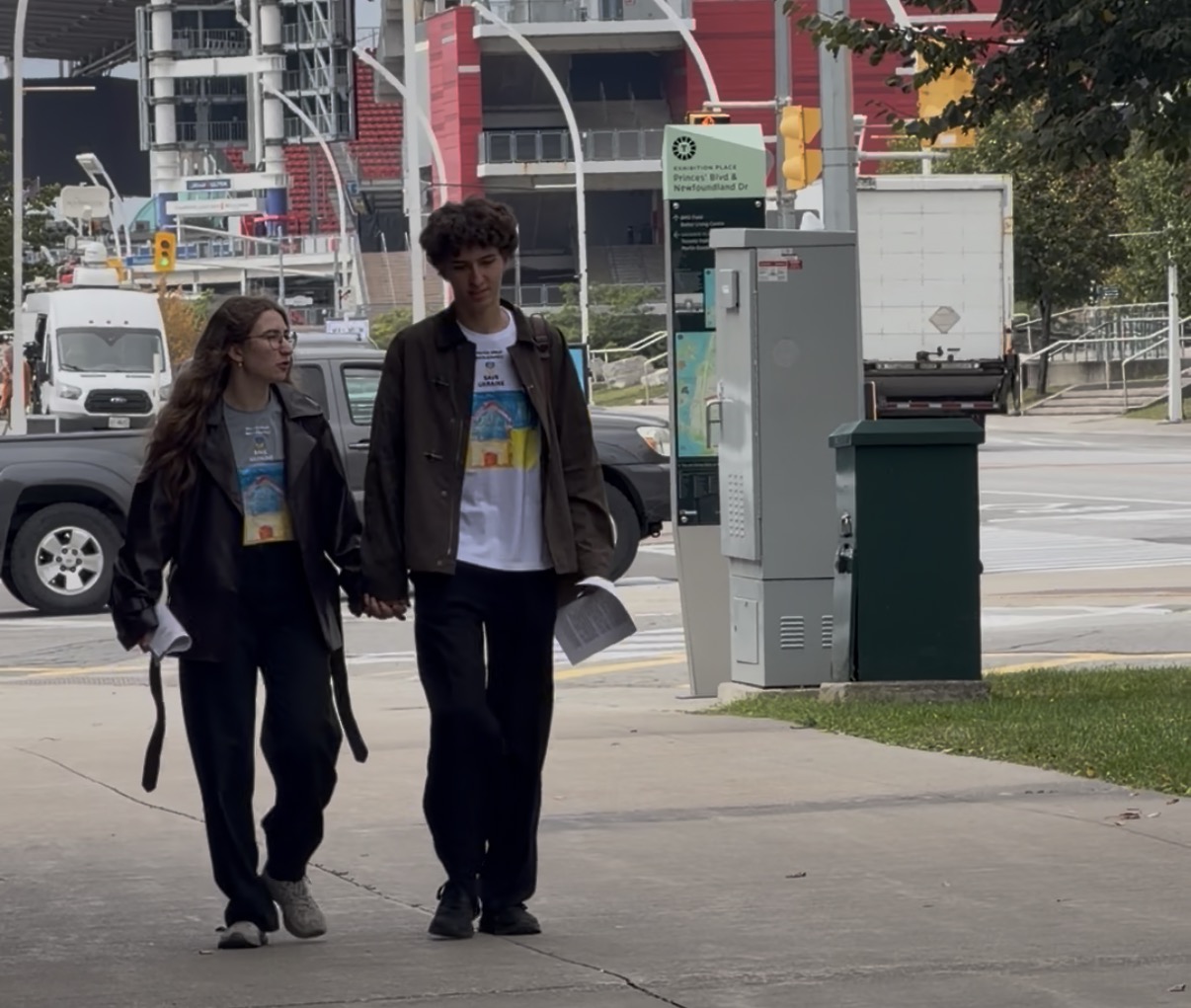
“In fact, no one physically kidnapped me, unlike thousands of Ukrainian children. But they stole the most important things from me — my language, my identity, my country, and my future. From the age of 10, we were taught tactical medicine, while the boys were taught how to handle weapons — they were simply teaching us to become Russian soldiers, ready to go and kill for the sake of one person — Vladimir Putin,” Daria said.
Daria now studies psychology in Kyiv and hopes to help children who have experienced the trauma of war.
Her husband, Matvii, described a similar experience. The two met at a Save Ukraine centre and married three weeks ago in Kyiv.
Matvii was also six when Crimea was occupied and attended school in Yalta.
“Russian soldiers constantly came to our school. One of them openly told children aged 8 to 16 how he had just returned from the war, killed people, and that if you were a real man, you would also go kill Ukrainians at the age of 18 because they ‘are not a nation and not people.’ We were taken to active military units, which were later hit by drones, simply putting 13-year-old children in danger,” Matvii recalled.
To avoid mandatory conscription into the Russian military after turning 18, Matvii enrolled at a university in Moscow. He later managed to leave Russia on his second attempt, travelling through Belarus with the assistance of human rights activists.
Both Daria and Matvii speak Ukrainian, a language they largely taught themselves. They said Ukrainian security officials were surprised during their screening process that they continued to speak Ukrainian fluently after years under Russian occupation.

“Propaganda for 16 hours a day and torture”: A Ukrainian Marine’s account
Another powerful testimony came from Ukrainian officer Yulian Pylypei of the 36th Separate Marine Brigade, who fought in the defence of Mariupol at the beginning of Russia’s full-scale invasion.
After months of heavy fighting, Pylypei was captured and spent more than 29 months in Russian captivity, including time in a solitary-confinement cell at a penal colony in Russia’s Mordovia region.
Speaking in English, the officer described what he said were systematic beatings, torture and degrading conditions in Russian detention facilities.
“The day begins with two inspections — in the morning and in the evening. I am 100% sure that during them you will be beaten. The only question is how many blows you will receive — 3 or 23, and with what: a rubber baton, a ‘Typhoon-52’ electric shocker, or a dog that will leave a scar on your face. During closed interrogations, without painkillers, they cut my legs, tried to suffocate me with plastic bags, and beat me with wooden hammers,” Pylypei said.
He described living in a solitary-confinement cell measuring roughly 2 by 2 metres in Mordovia. According to Pylypei, prisoners were forced to wear orange uniforms and stand for much of the day, unable to sit down or use the bathroom without permission. He said violations were punished with beatings.
“Above you, there is a video camera hanging 24/7, and next to the door there is a loudspeaker. For 16 hours a day, at an insane volume, they play Russian patriotic songs: about nuclear ash, about the return of Alaska and the Baltic countries, about ‘victory.’ It is so loud that you cannot hear your own thoughts. Sometimes it was better for me to endure being beaten for 10 minutes straight than to listen to that music,” the Marine said.
Pylypei also raised concerns about the lack of international access to Ukrainian prisoners held in Russia.
“No international organization has had access to Ukrainian prisoners in Russian prisons during all this time. None! At the same time, Russian prisoners of war in Ukraine are under constant monitoring by the international community and have full access to all services. We need to act now. My final request: if international law still exists and we believe in it, bring my boys — my Marines, the soldiers of the Azov Regiment, civilians, and children — home,” Pylypei said.

AI, tracking technology and new Canadian funding
During the conference, Anand also announced the use of new technologies to help locate and identify Ukrainian children who have been unlawfully transferred or deported by Russia.
“When children are subjected to indoctrination, taught another language, forced to live with new families, and have another culture and religion imposed on them — it is practically impossible for them to identify themselves on their own. That is why artificial intelligence, tracking mechanisms, and new optical technologies are at the forefront of our work. We must use AI for a noble purpose — to return Ukrainian children to their families,” Anand said.
The Canadian government also announced $863,000 in new funding to support Ukrainians affected by the war.

The funding includes:
$500,000 for the All Survivors Project to support survivors of sexual violence;
$363,000 for Ukrainian civil society organizations supporting families of prisoners of war and unlawfully detained civilians.
Canada is also providing $4 million to partners working to locate and return Ukrainian children and address the effects of Russian indoctrination, militarization and recruitment.
According to the Canadian government, Canada’s direct support specifically focused on the return and reintegration of Ukrainian children now totals nearly $7 million.
For the survivors who spoke in Toronto, however, the conference was about more than diplomatic commitments and funding announcements.
Their testimonies put human faces to the thousands of Ukrainian children, civilians and prisoners of war whose fate remains unresolved — and to the families still waiting for their loved ones to come home.

Mykhailo Tymuliak is founder and reporter at The North Voice and a former Kontakt reporter covering Ukrainian diaspora perspectives and Ukraine’s struggle against Russian aggression.
Photo Credits: Mykhailo Tymuliak.


