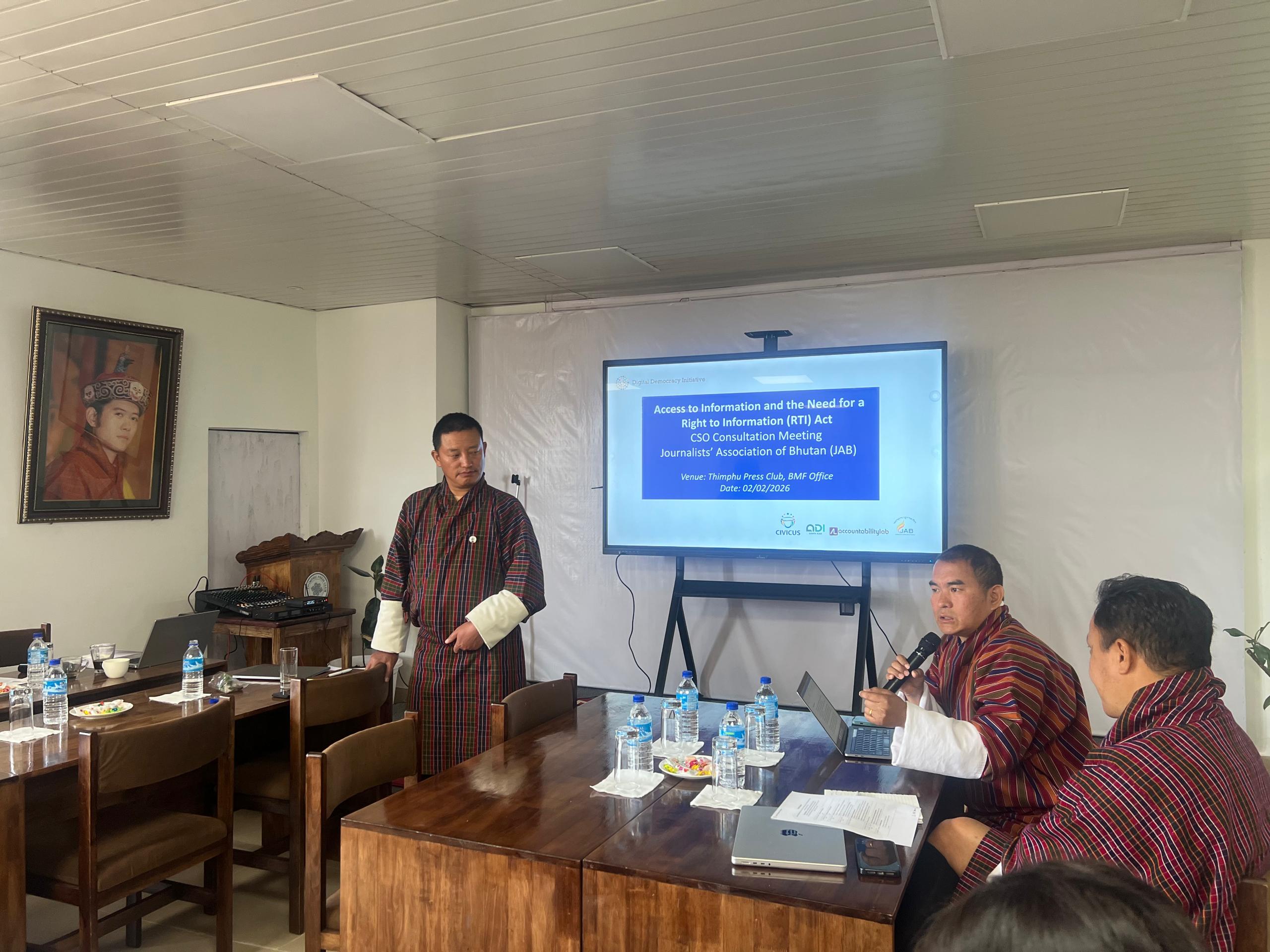
Thimpu. Bhutan’s Constitution guarantees citizens the right to information, but in practice, access to public records remains elusive—an unresolved gap that civil society groups and former lawmakers say is weakening transparency and public trust.
Those concerns were at the centre of a consultation organised by the Journalists’ Association of Bhutan (JAB), which brought together 21 civil society organisations (CSOs), former members of parliament and other stakeholders to revisit the country’s long-delayed Right to Information (RTI) Bill. Supported by the Digital Democracy Initiative (DDI) under the South Asia Project through Accountability Lab, the February 2 meeting sought to revive a long-dormant national conversation on Bhutan’s unfinished journey towards an enforceable information law.
Opening the consultation, JAB’s Executive Director, Rinzin Wangchuk, welcomed participants with a reminder that the issue at hand transcends professional boundaries. While journalists face daily obstacles in accessing information, he noted that the challenge is equally faced by citizens and civil society organisations attempting to engage meaningfully with public institutions.
“This consultation,” Rinzin Wangchuk said, “is about understanding whether access to information works in practice—and if not, what we must do collectively to change that.”
The meeting followed JAB’s first consultative discussion with media professionals held on December 30 last year. That discussion, which included journalists, media-related institutions and CSO representatives, concluded that despite constitutional guarantees, access to public information remains difficult in practice.
Participants agreed that the challenge affects not only journalists but citizens as well, particularly at the local government level, and that wider consultations beyond the media were essential.
A constitutional right, elusive in practice
Bhutan’s Constitution guarantees the Right to Information under Article 7(3), placing a clear obligation on successive governments to enact enabling legislation. Yet, more than a decade after drafting began in 2007, Bhutan still does not have an RTI Act.
Participants were reminded that access to information is often described as the key to democracy—not as an abstract principle, but as a practical tool that allows citizens to participate in governance, hold institutions accountable, combat corruption and ensure laws are applied fairly.
Without access to timely and accurate information, transparency remains rhetorical and accountability selective.
How a Bill lost its way
The consultation revisited the complex legislative history that led to the RTI Bill’s current limbo. The first elected government initiated drafting but hesitated to table the Bill, citing concerns about readiness, implementation capacity and the absence of complementary laws on privacy and secrecy.
The second elected government, elected in 2013, made enactment of RTI a campaign pledge. In 2014, the National Assembly passed the RTI Bill after extensive clause-by-clause debate. However, momentum stalled in the National Council, which declined to deliberate on the Bill, citing lack of clarity, insufficient consultation and procedural shortcomings by the responsible ministry in presenting the Bill.
The Assembly’s refusal to withdraw the Bill led to an unprecedented impasse between the two Houses. With fears that the Bill would fail in a joint sitting and become procedurally “dead,” the RTI law quietly slipped into legislative obscurity.
When the Information, Communications and Media (ICM) Bill was tabled in 2016, opposition MPs objected, arguing that regulating the media without first guaranteeing access to information undermined press freedom itself. By then, the RTI Bill was widely regarded as lapsed, with no clear roadmap for revival.
Media constraints mirror a broader problem
Findings from the 2025 JAB Media Landscape Assessment, shared during the consultation, added urgency to the discussion. Nearly 80 percent of Bhutan’s registered journalists reported serious difficulty accessing public information. Bureaucratic rules, inconsistent media focal points and a culture of excessive caution among civil servants have constrained information flow.
Young journalists, in particular, face compounded challenges due to limited professional networks and institutional gatekeeping.
These constraints, participants noted, have tangible consequences: delayed reporting, information gaps, misinformation, declining media credibility and weakened public trust. Bhutan’s sharp fall in global press freedom rankings—from 65th in 2022 to 152nd in 2025—was cited as a troubling indicator of deeper transparency issues.
Yet, CSO representatives stressed that the problem extends far beyond newsrooms, affecting citizen access to services and public accountability across sectors.
When access depends on personal networks
CSOs shared experiences of being denied information in sensitive sectors such as health, environment and governance. In many cases, access depended less on legal entitlement and more on personal relationships within institutions.
“There is no consistency,” one participant observed. “What you receive depends on who you know, not what the law says.”
This reliance on informal channels, participants agreed, is neither fair nor sustainable. It discourages both information seekers and civil servants, who fear disciplinary action in the absence of clear legal protection.
From principle to process
Despite varied perspectives, there was broad consensus on one point: constitutional guarantees alone are insufficient without an enabling law.
Participants called for a structured and transparent process to revive the RTI Bill—either through a renewed government initiative or via parliamentary mechanisms. Any revival, they argued, must begin with nationwide consultations involving citizens, CSOs, regulators, local governments and the media.
Rather than starting from scratch, several speakers suggested revisiting the earlier draft through a balanced review committee to address gaps, incorporate safeguards and reflect current institutional realities.
Concerns around national security, privacy and administrative burden were acknowledged, but participants emphasised that these risks can be mitigated through clear exemptions, definitions and appeal mechanisms—precisely what an RTI law is meant to provide.
Beyond the media narrative
A recurring theme was the need to reframe RTI as a citizen-centred right, not a media demand. Public awareness campaigns, institutional training and clear guidelines for officials were highlighted as essential to shift perceptions and reduce fear within the public sector.
Calls were also made for an independent oversight and appeals mechanism to ensure accountability and build confidence in the system.
“This is not about confrontation,” one former parliamentarian noted. “It is about creating clarity—so that both citizens and officials know where they stand.”
An unfinished reform
As the consultation drew to a close, JAB’s Chairperson Needrup Zangpo, who moderated the discussion, reminded participants that the day’s insights would feed into a broader engagement process. In the coming days, JAB plans further discussions with regulators, government media focal persons, local government leaders and Members of Parliament. The consolidated findings will be shared with Parliament to inform future deliberations on the RTI Bill.
More than a decade after its drafting began, the RTI Bill remains a symbol of Bhutan’s unfinished democratic reform—not rejected, but deferred.
For the participants gathered in Thimphu, the question is no longer whether Bhutan needs a Right to Information Act, but how much longer the country can afford to wait.


