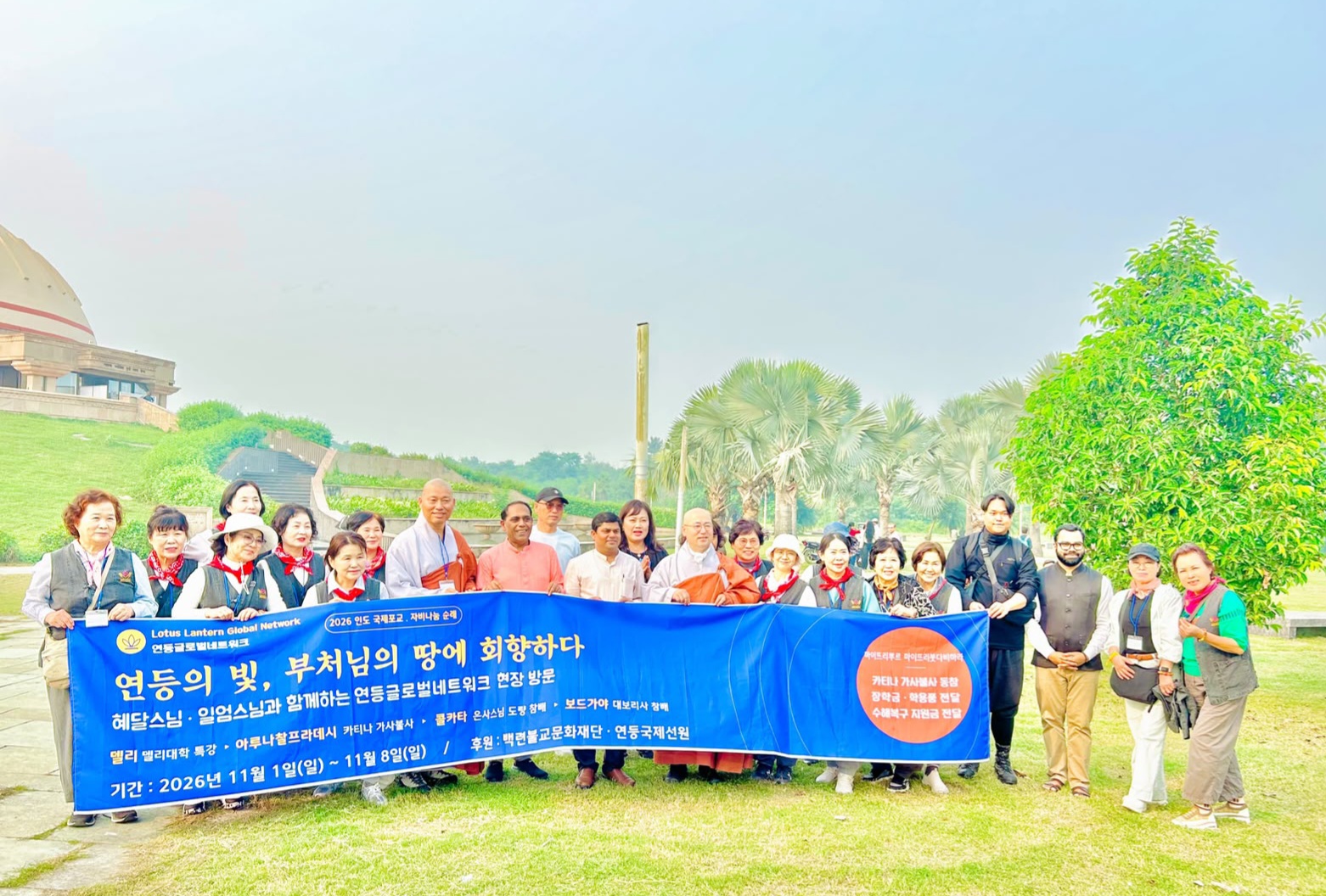
By Arvind Singh – An academic lecture on Buddhist meditation and Vipassanā, highlighting the historical, philosophical, and contemporary significance of Buddhist connections between India and Korea, was organized at Mahatma Jyotiba Phule Dhyan Kendra, Gautam Buddha University (GBU), Greater Noida. The programme brought together Buddhist scholars, monastics, faculty members, researchers, and students to engage in an academic and practical exploration of Buddhist meditation traditions and their enduring contribution to India–Korea cultural and spiritual relations.
The academic event was jointly organized by the School of Buddhist Studies and Civilization, Gautam Buddha University, and VIA India, under the coordination of Dr. Manish Meshram and Dr. Gyanaditya Shakya, Head of the Department. The principal attraction of the programme was a special lecture by the distinguished Korean Buddhist scholar-monk Ven. Hyedahl, also known as Bhikkhu Sasanakitti Mahathero, who currently serves as the Abbot of the Lotus Lantern International Meditation Centre in South Korea.
The visiting scholar delivered his lecture under the title “India-Korea Dhamma Dialogue: One Religion, Two Lands-Buddhist Relations between India and Korea through Meditation and Vipassanā.” The lecture examined the historical transmission of Buddhism from India to Korea, the development of Korean Buddhist meditation traditions, and the continuing relevance of meditation and Vipassanā as practical approaches to mental cultivation, inner peace, and human well-being. The academic discourse was followed by a guided meditation session conducted by Ven. Hyedahl according to the Korean Buddhist tradition.
In his lecture, Ven. Hyedahl highlighted the historical and spiritual relationship between India and Korea through the transmission and development of Buddhism across Asia. Explaining the geographical and cultural journey of Buddhism, he observed that the teachings of the Buddha travelled from India to China and subsequently reached the Korean Peninsula during the fourth century CE. This transmission represented an important phase in the expansion of Buddhist thought, philosophy, monastic institutions, and contemplative practices beyond the Indian subcontinent.
He particularly emphasized the significance of the Korean Buddhist term Seon, which refers to meditation and represents an important contemplative tradition within Korean Buddhism. Drawing attention to the relationship between Indian Buddhist meditation and its subsequent development in East Asian Buddhist cultures, he explained how meditation became an integral dimension of Buddhist spiritual practice in Korea. The historical interaction between India and Korea through Buddhism, he noted, has contributed not only to the development of religious and philosophical traditions but also to the strengthening of cultural understanding, mutual respect, and friendly relations between the two countries.
Discussing the practical dimensions of Buddhist meditation, Ven. Hyedahl explained that meditation is not restricted to monastic environments or particular circumstances. Rather, it is a universal practice that can be undertaken by individuals irrespective of their social conditions, geographical location, or everyday challenges. Referring to the difficulties experienced during the COVID-19 pandemic, he observed that meditation can provide valuable psychological and spiritual support during periods of uncertainty, anxiety, and personal distress.
He further elaborated on Vipassanā as a Buddhist meditative practice that facilitates mindfulness, awareness, and deeper understanding through sustained observation and mental cultivation. According to him, the proper practice of meditation and Vipassanā strengthens concentration, develops mindfulness, and helps individuals cultivate emotional balance and clarity of mind. These qualities enable practitioners to respond more thoughtfully to everyday situations and move towards a life characterized by happiness, peace, and tranquillity.
Concluding his lecture, Ven. Hyedahl guided the participants through a practical meditation session based on the Korean Buddhist tradition. This experiential component provided an opportunity for faculty members, researchers, and students to engage directly with contemplative practices and appreciate the practical dimensions of the Buddhist meditation traditions discussed during the academic lecture.
The programme was also graced by the presence of distinguished Korean Buddhist monk Ven. Irum, who shared his reflections on the contemporary relevance of Buddhist meditation. He particularly highlighted the significance of a book authored by Ven. Song-Chol and drew attention to the importance of Buddhist teachings in understanding the relationship between meditation, mental well-being, and spiritual development.
In his address, Ven. Irum observed that meditation and Vipassanā offer meaningful approaches to reducing stress and cultivating genuine happiness and inner peace. He emphasized that these practices should not remain confined to occasional religious or spiritual activities but should be incorporated into everyday life. Regular engagement with meditation, he suggested, can help individuals develop a more balanced perspective towards life’s challenges and cultivate a deeper sense of contentment.
Welcoming the distinguished visiting scholar and introducing his academic and monastic background, Dr. Gyanaditya Shakya, Head of the Department and Programme Coordinator, described Ven. Hyedahl’s contribution to Buddhist meditation and international Buddhist engagement. He informed the gathering that Ven. Hyedahl, also known as Bhikkhu Sasanakitti Mahathero, is associated with the Lotus Lantern International Meditation Centre in South Korea, where he serves as its Abbot.
Dr. Shakya emphasized that Buddhism has historically played a significant role in establishing and strengthening cordial relations between India and Korea. He observed that the transmission of Buddhist teachings from India to Korea represents an important chapter in the history of Asian cultural and intellectual exchanges. Such historical connections continue to provide a meaningful foundation for academic collaboration, interreligious understanding, cultural interaction, and the promotion of shared Buddhist heritage. He further highlighted the relevance of academic engagements of this nature in providing opportunities for students and scholars to interact with Buddhist practitioners and intellectual traditions from different countries.
Prof. Shweta Anand, former Dean of the School of Buddhist Studies and Civilization, highlighted the growing significance of meditation and Vipassanā in contemporary society. She observed that Buddhist contemplative traditions offer valuable insights into the cultivation of mental discipline, emotional stability, and inner well-being. She also appreciated the initiative taken by the organizers and congratulated Dr. Gyanaditya Shakya and Dr. Manish Meshram for successfully organizing the academic lecture and facilitating an important international academic interaction.
Delivering the vote of thanks, Dr. Manish Meshram, Coordinator of the academic lecture, highlighted the various academic and practical activities undertaken by the Meditation Centre of Gautam Buddha University. He emphasized the Centre’s contribution to promoting Buddhist meditation, mindfulness, and contemplative practices among students, faculty members, and the wider university community.
He expressed his sincere gratitude to the visiting Buddhist scholar Ven. Hyedahl and distinguished guest Ven. Irum for their valuable presence and contribution to the programme. He also acknowledged the encouragement and institutional support extended by the Hon’ble Vice-Chancellor, Prof. Rana Pratap Singh; Dean, Prof. Rajeev Varshney; Head of the School of Buddhist Studies and Civilization, Dr. Gyanaditya Shakya; and former Dean, Prof. Shweta Anand. He further conveyed his appreciation to Kavita, Devesh Tiwari, Navneet Singh, faculty colleagues, students, and all participants for their cooperation and active involvement in the successful organization of the event.
An important component of the programme was the felicitation of the visiting Korean Buddhist dignitaries. The coordinators honoured Ven. Hyedahl and Ven. Irum by presenting them with mementoes of Gautam Buddha University as a gesture of respect and appreciation. In a further expression of India-Korea Buddhist friendship and hospitality, Dr. Chintala Venkata Sivasai, Dr. Priyadarsini Mitra, Dr. Sobharam, and Dr. Siddaramu B., along with students of the School of Buddhist Studies and Civilization, welcomed and honoured more than 22 guests visiting from South Korea by presenting them with traditional Buddhist khatas.
The ceremonial proceedings included the offering of flowers before the statue of the Buddha and the traditional lighting of the lamp, symbolizing the illumination of knowledge, wisdom, and compassion. The programme also featured Buddhist chanting by students of the School of Buddhist Studies and Civilization, creating an appropriate spiritual atmosphere for the academic gathering.
The academic lecture by Ven. Hyedahl represented a meaningful initiative towards strengthening the historical and contemporary relationship between Indian and Korean Buddhist traditions. By bringing together scholarly reflection, monastic experience, and practical meditation, the programme demonstrated how Buddhist heritage can serve as an important foundation for international academic dialogue and cultural cooperation.
The discussion of Seon and Vipassanā also provided an opportunity to understand the shared foundations and distinctive developments of Buddhist meditation traditions across Asia. More significantly, the programme highlighted the continuing relevance of the Buddha’s teachings in addressing contemporary concerns relating to stress, mental restlessness, emotional imbalance, and the search for happiness and inner peace.
Through such international academic engagements, the School of Buddhist Studies and Civilization and the Meditation Centre of Gautam Buddha University continue to contribute to the promotion of Buddhist studies, contemplative education, and intercultural understanding. The event reaffirmed the enduring significance of the India-Korea Buddhist connection, demonstrating that the shared legacy of the Dhamma remains a valuable resource for fostering friendship, intellectual exchange, and spiritual well-being in the contemporary world.


