By Raju Lama
The Tamang community is one of the prominent indigenous communities of Nepal, with a rich cultural heritage, distinctive language, traditional practices, and religious beliefs.
The religious identity of the Tamang people has historically been shaped by indigenous Bon traditions, Tibetan Buddhism, and elements of local spiritual practices. Bon tradition, in particular, represents an important part of their ancestral religious heritage, reflecting their relationship with nature, ancestral spirits, local deities, and the spiritual world.
Over time, Buddhist philosophy and rituals have also become deeply integrated into Tamang society. This article explores the Bon tradition, cultural practices, religious beliefs, rituals, festivals, and the changing religious identity of the Tamang community.
1. Introduction
The Tamang community is one of the major indigenous nationalities of Nepal, particularly concentrated in the hilly and mountainous regions surrounding the Kathmandu Valley and other parts of the country. The Tamang people possess a unique cultural identity expressed through their language, traditional dress, music, dance, festivals, social customs, and religious practices.
Religion plays an important role in shaping Tamang society. Their traditional religious worldview is closely associated with Bon beliefs, nature worship, ancestral traditions, and shamanistic practices. Later, Tibetan Buddhism, particularly the Nyingma tradition, became an important part of their religious and cultural identity.
The relationship between Bon and Buddhism is an important feature of Tamang religious life. Rather than understanding them as completely separate traditions, it is useful to examine how both have influenced the community’s worldview, rituals, and everyday practices.
2. Understanding Bon Tradition in the Tamang Community
Bon is an ancient religious tradition associated with the Himalayan and Tibetan cultural region. It includes beliefs concerning nature, spirits, ancestors, protective deities, and the relationship between human beings and the spiritual world.
Among the Tamang people, traditional Bon-related beliefs are reflected in various rituals and spiritual practices. These practices express respect for natural forces, mountains, forests, rivers, land, and ancestral spirits.
The Bon tradition emphasizes the importance of maintaining harmony between human beings, nature, and supernatural powers. It also provides traditional explanations for illness, misfortune, natural events, and the spiritual well-being of individuals and communities.
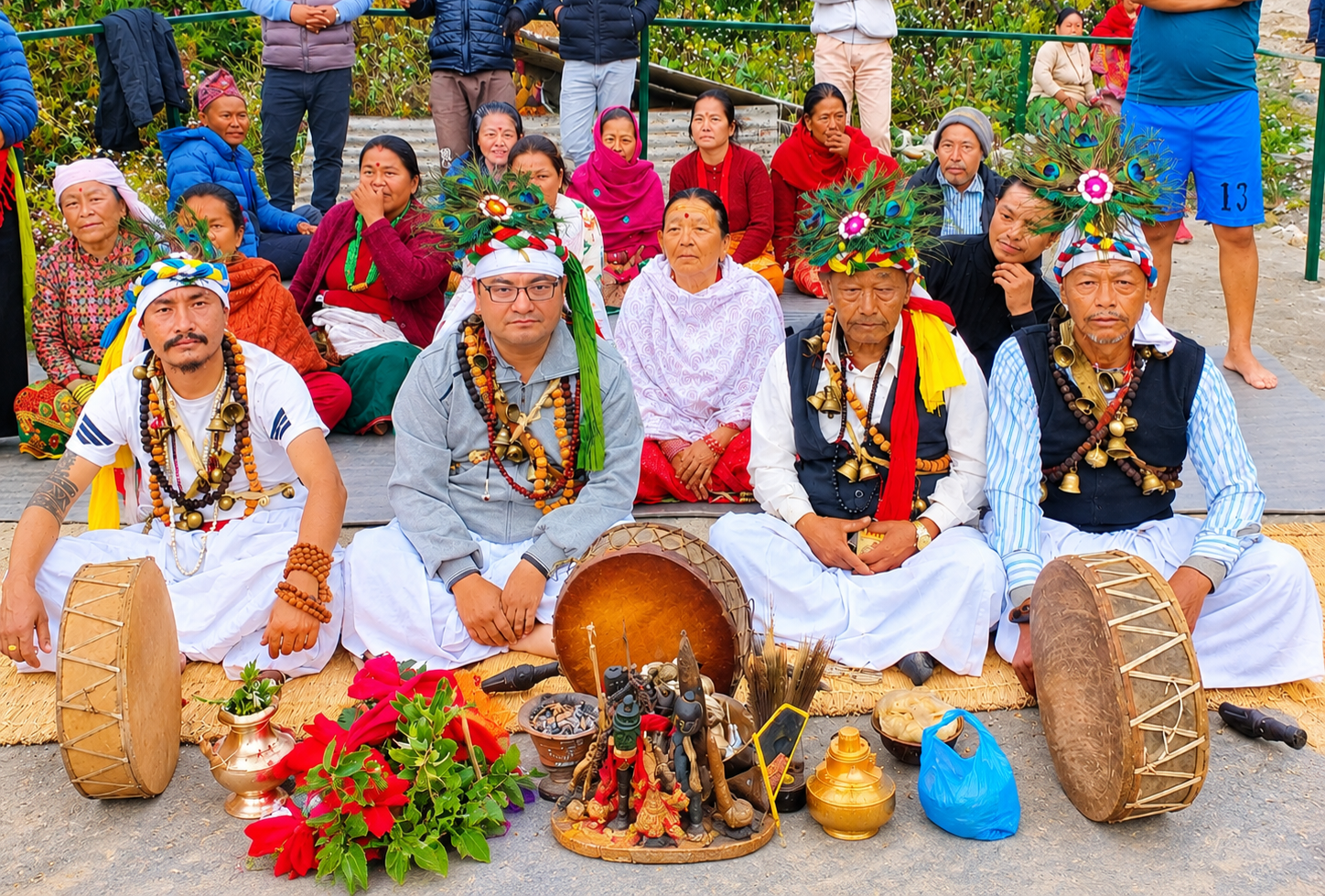
The Bombo, traditionally known as a shaman or spiritual healer, plays an important role in preserving these indigenous religious practices.
3. Major Religious Institutions of the Tamang Community
Three important traditional institutions contribute to the cultural and religious life of the Tamang community.
Bombo (Shamanic Tradition)
The Bombo is a traditional spiritual specialist who performs healing ceremonies, communicates with spirits, and conducts rituals for protection and spiritual balance. Bombo practices are closely associated with indigenous religious beliefs and traditional shamanism. They play an important role in maintaining the connection between the community, ancestors, nature, and the spiritual world.
Lama (Buddhist Tradition)
The Lama is a Buddhist religious specialist who performs religious ceremonies, prayers, blessings, and important life-cycle rituals.
Lamas have significant responsibilities during birth ceremonies, marriage rituals, funerals, and religious festivals. Buddhist teachings concerning compassion, karma, spiritual liberation, and the cycle of rebirth influence their religious activities.
Tamba (Cultural Historian)
The Tamba is an important traditional cultural institution of the Tamang community. Tambas are traditionally regarded as oral historians, genealogists, storytellers, and guardians of cultural knowledge. They preserve ancestral histories, traditional songs, myths, clan identities, and cultural practices.
They also play an important role in marriage ceremonies and other social rituals.Together, Bombo, Lama, and Tamba represent important dimensions of Tamang spiritual, religious, historical, and cultural life.
4. Cultural Practices and Traditional Customs
Tamang culture is characterized by a strong sense of community, respect for elders, family relationships, and the preservation of ancestral traditions.
Traditional music and dance are important elements of cultural identity. The Damphu, a traditional percussion instrument, is especially significant in Tamang musical performances.
Tamang songs and dances communicate stories of love, history, migration, social relationships, nature, and everyday life.
Traditional clothing, ornaments, language, food habits, and community gatherings also contribute to the preservation of Tamang identity.
The culture is transmitted from one generation to another through oral traditions, festivals, family practices, and community celebrations.
5. Religious Rituals and Ceremonies
Religious rituals are deeply connected with different stages of human life in Tamang society.
Birth Rituals
The birth of a child is considered an important family and social event. Traditional naming, purification, blessings, and prayers are performed according to family and community customs.
Buddhist Lamas may conduct religious ceremonies to bless the newborn and seek protection and well-being.
Marriage Rituals
Marriage is an important social institution that establishes relationships between families and communities.
The Tamba traditionally plays an important role in conducting marriage-related customs, reciting ancestral histories, and maintaining cultural traditions.
Family members, relatives, and community elders participate in the ceremony.
Death Rituals
Death rituals are among the most significant religious ceremonies in Tamang society.
Buddhist Lamas perform prayers and rituals to guide the consciousness of the deceased towards a favourable spiritual destination. Traditional beliefs concerning ancestors and the afterlife may also influence funeral practices.
These ceremonies demonstrate the importance of religious beliefs in understanding life, death, rebirth, and spiritual liberation.
6. Major Festivals of the Tamang Community
Sonam Lhochaar
Sonam Lhochaar is one of the most important festivals of the Tamang community. It marks the beginning of the Tamang New Year according to the traditional lunar calendar.
The celebration includes traditional music, Damphu performances, cultural dances, community gatherings, traditional food, and religious prayers. It is also an occasion to strengthen cultural identity and pass traditional knowledge to younger generations.
Buddha Jayanti
Buddha Jayanti celebrates the birth, enlightenment, and Mahaparinirvana of Gautama Buddha.
Many Tamang Buddhists participate in prayers, monastery visits, religious gatherings, and acts of compassion and charity.
Janai Purnima
Janai Purnima is also significant in some Tamang communities, particularly in connection with traditional shamanic practices and pilgrimage.
Some Tamang shamans participate in religious journeys and spiritual ceremonies associated with this occasion.
7. Relationship Between Bon and Buddhism
The relationship between Bon and Buddhism is one of the most interesting aspects of Tamang religious identity.
Bon represents older indigenous spiritual beliefs, including nature worship, ancestral reverence, local deities, and shamanistic healing practices.
Buddhism introduced and strengthened philosophical and religious ideas concerning karma, compassion, rebirth, meditation, and liberation. Over time, these traditions developed alongside one another within Tamang society.
Research on Tamang religious practices demonstrates that Buddhist Lamas and traditional shamans can have different but complementary responsibilities within the same community.
Therefore, Tamang religion should not be understood only through the framework of Buddhism. Its indigenous Bon-related beliefs and traditional spiritual practices are equally important for understanding its historical and cultural development.
8. Nature Worship and Environmental Values
Respect for nature is an important element of traditional Tamang spirituality. Mountains, forests, rivers, land, and other natural places are associated with spiritual significance in various traditional beliefs.
Rituals such as Bhumi Puja and other local worship practices express respect for the land and natural surroundings.
These beliefs reflect an understanding that human life is closely connected with the natural environment.
Traditional spiritual values can therefore contribute to environmental awareness, conservation, and respect for natural resources.
9. Challenges in Preserving Tamang Cultural and Religious Heritage
Despite its richness, Tamang cultural heritage faces several challenges in contemporary society.
Some of the major challenges include:
• Declining use of the Tamang language among younger generations.
• Reduced transmission of traditional songs, stories, and oral histories.
• Modernization and changing lifestyles.
• Limited documentation of indigenous Bon-related rituals and beliefs.
• Decreasing numbers of traditional cultural knowledge holders.
• Misunderstanding and misrepresentation of indigenous religious practices.
Preserving traditional knowledge requires active participation from families, community organizations, researchers, cultural institutions, and younger generations.
Documentation, cultural education, traditional festivals, and the promotion of the Tamang language can contribute significantly to heritage preservation.
10. Importance of Bon Tradition in Contemporary Tamang Society
Bon-related traditions continue to provide valuable insights into the historical identity and cultural development of the Tamang community.
They represent ancestral knowledge, indigenous spirituality, traditional healing practices, and the community’s relationship with nature.
Understanding these traditions is important not only for the Tamang people but also for the broader study of Nepal’s religious diversity and indigenous heritage.
The preservation of Bon-related knowledge alongside Buddhist practices helps maintain the cultural richness and historical continuity of Tamang society.
11. Conclusion
The Tamang community represents a rich example of cultural and religious diversity in Nepal. Its religious identity has developed through the interaction of indigenous Bon traditions, Buddhist philosophy, and traditional shamanistic practices.
Bon tradition provides an important foundation for understanding the ancestral beliefs, nature worship, spiritual practices, and cultural history of the Tamang people. Similarly, Buddhism has contributed significantly to their religious ceremonies, moral values, festivals, and understanding of life and death.
The institutions of Bombo, Lama, and Tamba have played important roles in preserving the community’s spiritual, religious, historical, and cultural knowledge.
In the modern world, protecting these traditions is essential for maintaining indigenous identity and cultural diversity. The Bon tradition should therefore be recognized not merely as a historical religious practice but as an important component of Tamang cultural heritage.
Ultimately, the cultural and religious identity of the Tamang community reflects the coexistence of ancestral wisdom, indigenous spirituality, and Buddhist philosophy.
References
1. Hall, A. R. (1982). Religion in Tamang Society: A Buddhist Community in Northern Nepal. PhD Thesis, SOAS University of London.
2. Holmberg, D. (1989). Order in Paradox: Myth and Ritual Among Nepal’s Tamang. Cornell University Press.
3. Holmberg, D. (2011). “Ritual Paradoxes in Nepal: Comparative Perspectives on Tamang Religion.” The Journal of Asian Studies.
4. Lama, S. (2021). “Dynamics of Religious Transformation of the Tamang Community of the Sub-Himalaya: Historical Perspective.” Karatoya: North Bengal University Journal of History, 14, 42–52.
5. Tamang, M. K. (2010). Performance of Birth, Marriage and Death Ritual: A Study on Tamang Culture.
6. Peters, L. G. (2004). “The Janai Purnima Pilgrimage of the Tamang Shamans of Nepal: An Experiential Study.” In Pilgrimage and Healing.


