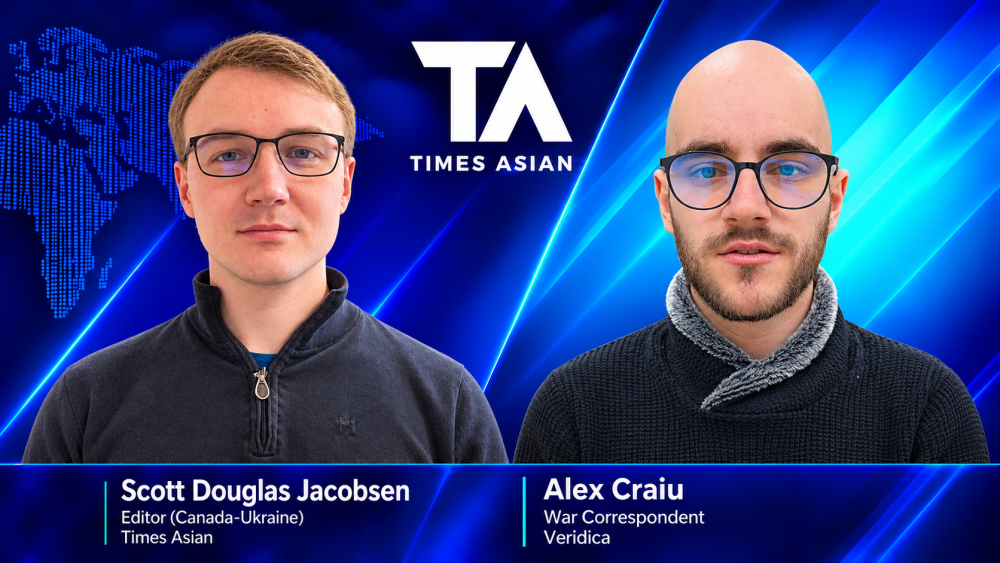
By Scott Douglas Jacobsen
Editor (Canada-Ukraine), Times Asian
Scott Douglas Jacobsen interviews Alex Craiu about his three-year entry ban from Transnistria and earlier detention while reporting. Craiu discusses restrictions on journalists, solidarity across Romanian and Moldovan media, delayed responses, Romanian-language education, and experiences of xenophobia. Their conversation explores censorship, linguistic identity, and pressures facing independent reporting in Moldova.
Alex Craiu is a Romanian journalist, war correspondent, and videographer reporting from Ukraine for Veridica. Trained in documentary production and cinematography in the United Kingdom and California, he completed a BBC internship in London in 2017. His reporting examines civilian life, conflict, politics, and conditions in Moldova’s separatist Transnistrian region.
Scott Douglas Jacobsen: All right, today we are here with Alex Craiu. He is a Romanian journalist and Veridica’s Ukraine correspondent. He was refused entry into Transnistria on October 29, 2026. He was informed of a three-year entry ban imposed by the region’s de facto security ministry. You told me about the context before. What happened previously, briefly, and what happened in this updated case?
Alex Craiu: My experience with the separatist region of Transnistria, which is legally Moldovan territory with Russian troops stationed there, goes back to 2022, when I first entered the region. In total, I made two separate trips. The one that was supposed to take place last week would have been my third trip to Transnistria.
On my first trip, I was interrogated and detained by the authorities under suspicion of espionage. That was because I photographed a Soviet mosaic in Cuciurgan, near the Ukrainian border. I was detained and taken to Tiraspol, which is the capital of the self-proclaimed republic of Transnistria.
I was interrogated for three hours. They took my phone and asked for my iPhone passcode. They took the phone into a different room, so I don’t know what they went through. In the end, they couldn’t find any evidence that I was a spy, so they let me go.
Jacobsen: Everyone thinks everyone is a spy.
Craiu: Right. This is a classic Russian accusation that is brought against innocent people as well.
In my mind, there was also the possibility that this could have been a tactic to throw me in prison and probably exchange me for somebody else. At that point, many different scenarios went through my mind, considering that during the interrogation I was asked questions entirely irrelevant to the situation, such as, “What is your view on the Russian-Ukrainian war? Who do you support in the war?” These had nothing to do with my activity in Transnistria or my presence there.
I was not banned at that point. I feel they’ve had an eye on me ever since.
During my second trip, in April last year, I made a video report on the everyday lives of people in Transnistria. It was a general overview of what it is like to live in a separatist region. I explored some of the social issues. I interviewed people on the street who said Moldova was the only party getting in the way of them living a good life, that Moldova wouldn’t let them live, and that it was bothering them.
I also interviewed people who said the opposite. They said they wanted to unite with Moldova and live in peace as one country. It was balanced because I covered both sides.
However, to show the region’s reality, I explored controversial issues such as low wages and low pensions. I interviewed someone who said their pension was about $70 a month, which is insufficient to buy groceries and pay bills.
As I explored these controversial issues, I knew I was potentially getting myself into big trouble with the authorities. We published the video report after I left the separatist region of Transnistria. The report appeared on Veridica on April 29, 2025.
Why do I mention this? It matters because last Thursday, October 29, 2026, when I tried to enter Transnistria for the third time, I was given a document stating that, under a specific law I cannot recall off the top of my head, I am banned. I will be refused entry into Transnistria for three years, starting May 19, 2025. This is 20 days after the report appeared on Veridica.
Personally, I see a direct connection between the video we made, the article we wrote about it, and their decision to ban me 20 days later. That is where we stand.
Jacobsen: How is the Romanian news covering it? Is it being sensationalized? Are they reporting it accurately? Both?
Craiu: No, it is not sensationalized in any way. They are reporting it factually, as is the Moldovan side.
When it comes to Romania, I think our public broadcaster, which is very factual and fact-based, kind of like the equivalent of the BBC, made a report on it. I was invited onto the show and talked about it. It is very accurate in terms of facts, and they go off the information I provided.
They also did a great job contacting organizations I don’t have access to. Of course, they have the advantage of being the public broadcaster, so they get priority responses from these organizations fighting for journalists’ rights in Moldova and Transnistria.
I found that Moldovan media were more interested in the story for two reasons. First, because I am a Romanian journalist now banned from Transnistria, which is less typical than Moldovan journalists being banned from Transnistria.
Jacobsen: Why does it happen?
Craiu: It seems that the default criterion for receiving an entry ban in Transnistria is having worked for a publication in Moldova.
Jacobsen: Interesting.
Craiu: Yes. I will give you a specific example. Some people work for TVR Moldova. TVR stands for Televiziunea Română, which is Romanian Television, the Romanian public broadcaster. They also have a channel in Moldova, TVR Moldova.
They broadcast news in Romanian because Romanian is the official language of Romania and the Republic of Moldova, even though in some parts of Moldova a majority of people speak Russian and prefer it.
My impression is that people who position themselves as anti-Russian and pro-European tend to speak Romanian and watch Romanian news. The ones who are pro-Russian reject anything Romanian. They do not watch TVR.
Why is this important? It seems that if you work for TVR or a publication that writes in Romanian and criticizes the authorities in Tiraspol, you get banned.
I spoke to people who work for TVR. Another channel, PRO TV Chișinău, is a Romanian-language television station operating in the Republic of Moldova. The people I spoke to are banned from entering Transnistria.
It is not unusual for journalists to be banned from Transnistria. Why was this story particularly interesting to them? For two reasons. First, because I am a Romanian journalist with a Romanian passport, unlike Moldovan citizens, who are banned from Transnistria more often because they are being watched.
The authorities in Tiraspol are watching what is going on in Moldova, which is closer to them in a way. By monitoring these channels, they have greater awareness of the Moldovan journalists they want to ban. Not so much Romanian journalists, because that is farther away, and they are not particularly interested in that. It is unusual to see Romanian journalists banned from Transnistria.
Secondly, and this is very interesting, most people who are banned from Transnistria are refused entry but are not given a specific reason or any document. They are just turned away at the checkpoint and told that entry into the separatist region is not permitted.
I have a document. I spoke to my colleagues in Moldova who are also banned, and they said it was interesting that I had this paper because they have none.
I spoke to someone in the leadership of a Romanian-language school in Tiraspol. I believe it is the only one left in Tiraspol. The authorities are trying their best to close that school and discourage Romanian lessons because they believe everyone should speak Russian.
She told me that her son is also banned for life from entering Transnistria. Likewise, he was not given any documents or papers whatsoever. He was just told that he was banned for life, although his mother lives there and is continually fighting to protect the rights of Romanian-speaking people in the region. The Russian authorities and the separatist authorities heavily suppress those rights. There are two components: the Russian authorities and the pro-Russian separatists.
Jacobsen: Has anything been overlooked? Is there any nuance you’d add to today’s commentary about your experience?
Craiu: Let me think about this. Knowing what Transnistria is, I didn’t think this would become as big a story as it did when it made headlines in Moldova.
The media support was incredible and much bigger than I had expected. The solidarity between journalists was definitely… I am just hearing something.
The support of fellow journalists was much greater than I thought, and that solidarity really pleased me. What disappointed me, on the other hand, was that we are still waiting for a response from the Ministry of Foreign Affairs of Romania and the Ministry of Foreign Affairs of Moldova. They have not promptly answered our requests for comment on this matter.
As journalists, we always appreciate authorities handling our requests promptly, especially on a matter being discussed on national news and public television. We would expect them to take a position and comment.
The authorities in Romania or Moldova have no control over it. However, a comment is always appreciated. As of now, we are still waiting for that comment.
Jacobsen: Did you feel any explicit discrimination because you spoke Romanian, Ukrainian, or poor Russian?
Craiu: Interestingly, if we go into the topic of discrimination, I did not necessarily feel that this time around because I was only at the checkpoint. It is not proper to call it a border crossing because this is not an international border.
The people at the checkpoint spoke Romanian, so this time around it was all right.
However, what I found, and I do not know how relevant this is, was that this time when I visited Moldova, the discrimination was even in traffic. I can count at least two or three separate road-rage incidents where discriminatory language was used against me because my car is registered in Romania. This was on the streets of Chișinău.
They called me “Romuski pederas,” which means- I do not know if you can use this, but “pederas,” you know the root of that word. So, “Romanian faggot.” That is what they called me, just because of some misunderstandings in traffic. I had other people shouting similar slurs at me.
I have a feeling that the pro-Russian part of society, which we know exists in Chișinău and other cities in the Republic of Moldova, has a profound anti-Romanian sentiment. They are profoundly anti-Romanian.
The separatist movement in Transnistria emerged before the Soviet Union collapsed. Fear that Moldova would unite with Romania was a major factor. These people did not want to be part of Romania. They felt Russian and closer to Russia than to Romania.
There are pro-Russian narratives that Moldova is trying to force everybody to speak Romanian, which is the state language anyway, so fair enough. Their refusal to speak Romanian, in my view, is ideological above everything else.
On this trip to Chișinău, more than last time, and I have been to Moldova probably four or five times, I felt that many people were refusing to speak Romanian to me. It was quite obvious that I was Romanian because our accents are different. Romanians speak Romanian with a different accent from Moldovans, so it’s easy to tell us apart.
It was quite clear that I was not a fluent Russian speaker. They carried on speaking Russian to me, even when I spoke Romanian and asked them to speak Romanian. Unfortunately, many people refused to speak Romanian.
It was interesting to see this time around that many people were discriminating against me and using derogatory terms just because I was a Romanian who happened to get on their nerves in traffic or something like that. That does not justify using discriminatory language against somebody. This is just xenophobia, in my opinion.
Jacobsen: Thank you very much for the opportunity and your time, Alex.
Scott Douglas Jacobsen is a Canadian journalist and publisher who serves as Times Asian’s Editor for Canada and Ukraine Affairs and writes on international affairs.


