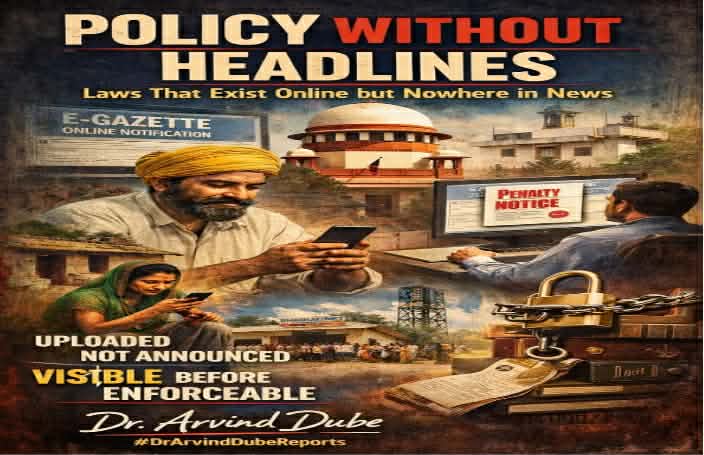
India is quietly changing the way it governs its people. Laws are no longer announced; they are uploaded. Regulations today do not need press conferences, parliamentary debate that reaches citizens, or even basic media explanation. A notification placed on the e-Gazette or a government portal becomes enforceable the moment a timestamp appears. From that instant, the law is treated as known, binding, and operational, even if the public has never heard of it.
This shift has created a new governance reality that rarely enters public discussion. It can only be described as policy without headlines. These are laws that exist completely in legal terms, are enforced administratively, and carry penalties, yet never pass through the public sphere. Citizens do not encounter them through newspapers, television debates, or official briefings. They discover them later, through penalty notices, cancelled licences, compliance failures, or retrospective explanations that begin with a familiar sentence: the notification was already available online.
The legal foundation for this system is well established. Indian courts have consistently held that publication in the Official Gazette constitutes sufficient notice to bring a law into force. With the shift to the electronic Gazette, this doctrine has been extended into the digital age. The Supreme Court has gone further by holding that the precise time of upload determines enforceability. Once a notification is uploaded and time-stamped, it takes effect immediately. Public awareness is not a legal requirement unless the parent statute specifically demands additional modes of notice.
This doctrine makes administrative sense, but it carries serious democratic consequences. It allows the state to complete its obligation through a technical act, while shifting the entire burden of awareness onto citizens. The law becomes valid instantly, while communication becomes optional. Legality is satisfied; visibility is not.
The unequal impact of this system becomes obvious when viewed against India’s digital divide. Nearly two-thirds of the population lives in rural areas where internet access is fragile, intermittent, and overwhelmingly mobile-based. High-speed fixed broadband, which allows sustained engagement with government portals and lengthy regulatory documents, remains rare outside urban centres. Even where fiber has reached Gram Panchayat buildings, last-mile usability for ordinary citizens remains limited.
Rural internet use is practical and task-based. People go online to make payments, speak to family, check weather updates, or access essential services. They do not browse ministry websites or monitor regulatory portals. Notifications are usually issued in English, embedded in long PDFs, and scattered across multiple websites. Expecting villagers, farmers, transporters, or small traders to track these silent changes is unrealistic. Yet governance now assumes exactly that.
This assumption quietly redistributes risk. The state uploads; the citizen bears the consequence. Large corporations and urban professionals rely on compliance teams and legal alerts. Rural citizens depend on delayed information, word of mouth, or local officials who themselves may not be informed in time. When enforcement begins, ignorance is dismissed as negligence, even though the system was never designed for equal access.
The effects are visible across sectors. Changes in taxation, environmental compliance, transport rules, business licensing, data obligations, and local regulations often surface in rural areas only when notices are issued. By then, the law has already hardened. Appeals become technical. Officials point to timestamps and URLs. The citizen is told the rule was in the public domain. What is never acknowledged is that public domain does not mean public awareness.
This model also removes political cost from governance. Laws that never become news generate no immediate debate. There are no headlines, no parliamentary questions, no televised discussions, and no pressure on ministers to explain decisions. Opposition mobilisation does not happen because no visible issue has formed. By the time the impact reaches the public, the policy is already settled in administrative terms. The moment for scrutiny has passed.
Journalism is structurally sidelined in this process. Newsrooms respond to events. Silent uploads across hundreds of portals do not trigger coverage. Reporters arrive later, explaining penalties and disputes after harm has occurred, rather than questioning policy design before enforcement. The watchdog role is weakened not by choice, but by design.
By Arvind Dube


