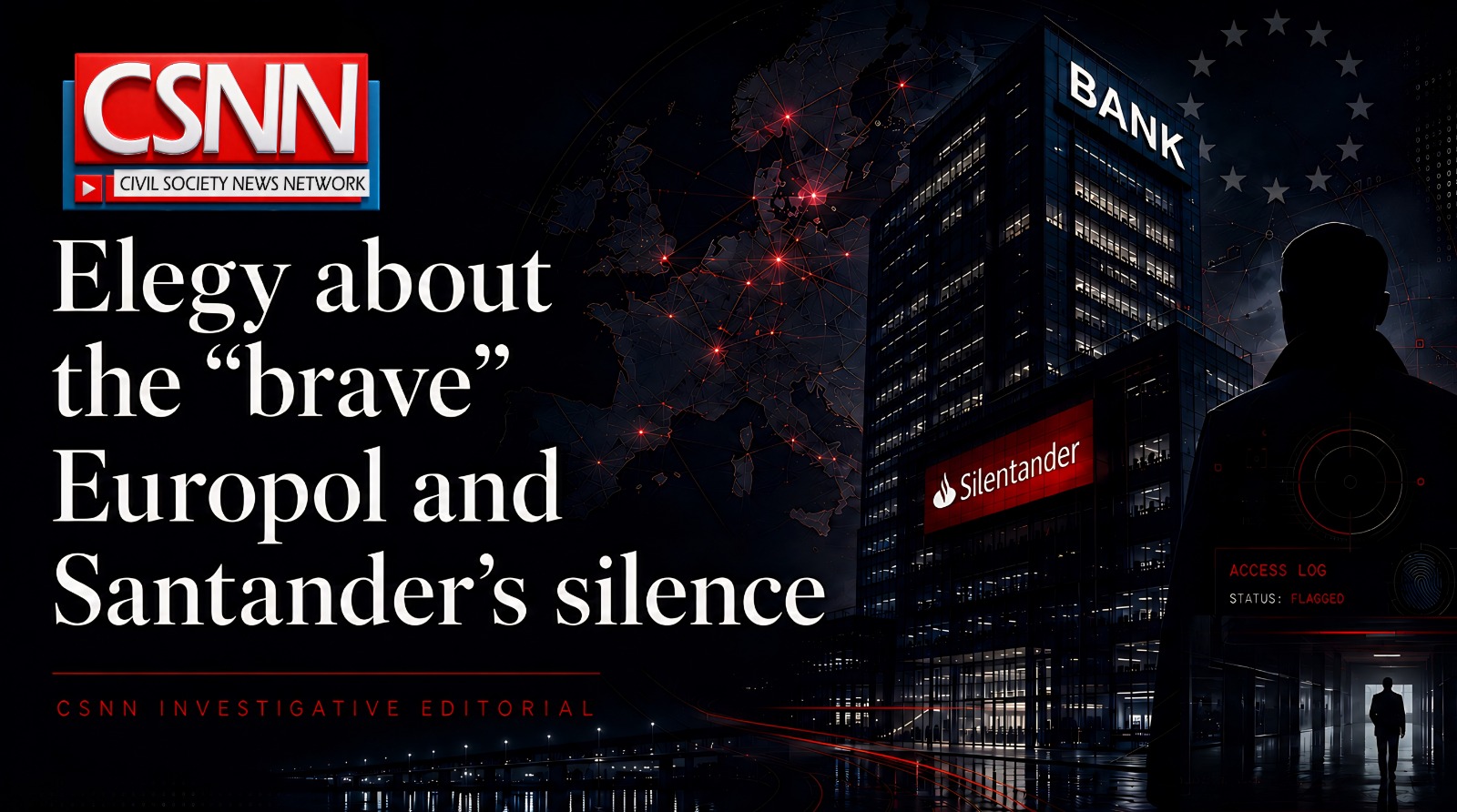
CSNN is an international civil society media platform, focused on journalism carried out in the public interest, institutional analysis, and the reliable transmission of information concerning governance, international relations, civil society, security, transparency and accountability.
Within this activity, CSNN receives numerous pieces of information, source materials and documents concerning serious violations of law, organised mechanisms of abuse, and cases of significant financial scale, often reaching hundreds of millions of euros or dollars.
In the direct environment of CSNN there are also high-class experts who are able to identify cyber threats, analyse systemic vulnerabilities and counteract cybercrime. As part of authorised security audits, conducted exclusively at the request of interested institutions, they are also able to reveal critical weaknesses in physical security — including in the protection of boardrooms, decision-making areas and internal infrastructure.
There is no need to explain more broadly what consequences could result from the use of similar knowledge, access and competences by persons operating within organised criminal structures.
Criminals realised long ago that through “work” in a bank there is access to banking structures and that this gives enormous operational, informational and technical possibilities.
In many banks, there are already such people working, possessing specialist competences, who are directly connected with international gangs. However, there are even more people who have been taken over or recruited by criminals, and then introduced into a model of cooperation with external hackers and cybercriminal structures.
It is no longer only security market experts, but also state authorities in Poland who indicate that hackers are getting employed in organisations which they infiltrate and from which they not only steal data.
https://www.bankier.pl/wiadomosc/Hakerzy-wchodza-przez-HR-Gawkowski-Sluzby-zidentyfikowaly-nowa-metode-infiltracji-9125048.html
CSNN received in the past serious information concerning possible internal threats in Santander Bank Polska. The source was a citizen of Ukraine, presenting himself as a person having knowledge about a structure preying on banking institutions and using their internal weaknesses.
This person feared for his life, because he possessed extensive knowledge, at the same time becoming a threat to the persons involved in this procedure. In exchange for protection, he declared readiness to provide specific documents, source materials and data enabling further verification of the case.
To make his claims credible, he provided a number of detailed pieces of information, including data concerning five persons functioning as internal access points in the bank’s headquarters in Poland.
We informed a representative of Europol about the case.
In accordance with the accepted agreement, we were not to inform anyone else, in order to preserve secrecy, protect the source and not lead to a leak of information to the mentioned organisation.
To our astonishment, Europol, instead of initiating direct contact with Santander’s headquarters, sent its representative to its “Daddy across the Great Water” for advice and support.
But Daddy is dealing with his own affairs and is not interested in the problems that occur in the EU. The lack of real interest in such a serious signal is so deep that the bottom can no longer be seen.
For several months, we received information that the case was ongoing and was moving to increasingly higher levels. In the end, it moved so high that it ceased to exist as a real action.
During this time, the bank lost enormous money, and our informant, who needed protection, disappeared completely. It is not excluded that finally.
We conclude that Europol was terrified that it was supposed to deal with an international criminal group, behind which it is not known who stands.
And even more so that someone from them was supposed to appear in the Dragon’s Cave, as they called Santander’s headquarters.
We tried to contact directly the management board of Santander at the headquarters in Spain. We could not conduct this matter through the headquarters in Poland, since it was precisely there that people effectively operated as internal “moles”. Attempts to reach Spain brought no result.
Well. Everyone is free to pay for being robbed.
Nor can anyone be forbidden from rewarding those who intelligently destroy the good name of their own rewarder.
After all, it is enough to lull vigilance with “extraordinary profits”, significantly higher than the real possibilities of other banks. Except that the final cost of this may turn out to be shocking.
By Emanuele Mosca
Special Ambassador for Legal and Strategic Affairs – CSNN
Italy Bureau | Civil Society News Network (CSNN)


