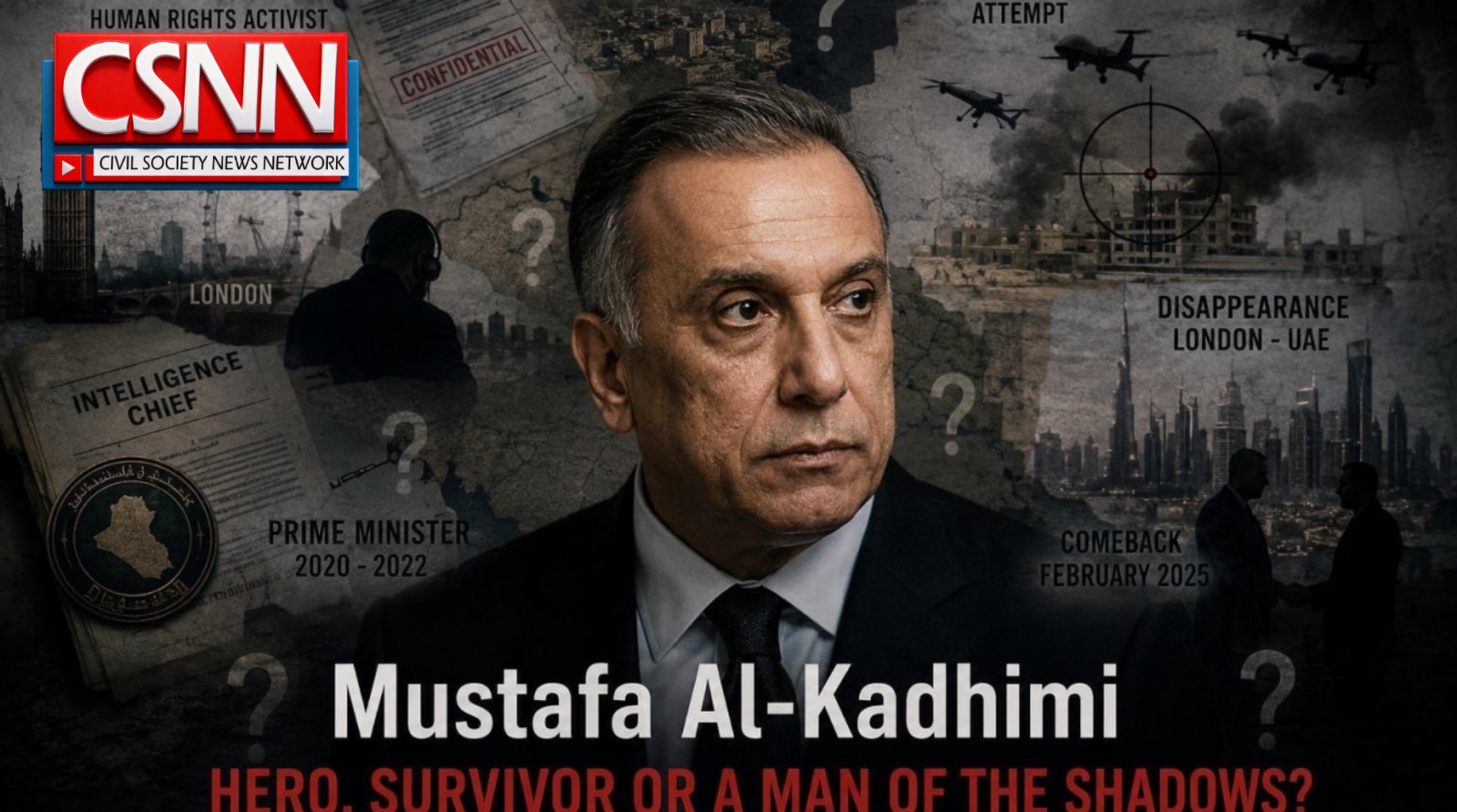
When the Associated Press reported in February 2025 that Mustafa Al-Kadhimi had returned to Baghdad after more than two years away, the scene felt less like the return of a former prime minister and more like the reopening of a file Iraq never truly closed. The man who left office in October 2022, after presiding over one of the most turbulent periods in modern Iraqi history, had spent the following years moving quietly between London and the UAE, far from sustained public visibility. Then suddenly, he was back in Baghdad, a city that rarely allows the return of a man who survived a drone assassination attempt unless there is a need for him… or a fear of him.
This was not a ceremonial visit by a retired statesman. It was the return of a figure whose name had remained present in calculations made both inside Iraq and far beyond it, even during his absence. From the moment he landed, one question resurfaced across Baghdad’s political circles: Did Mustafa Al-Kadhimi return because he personally chose to? Or because Iraq, with all its contradictions and fractures, once again found itself searching for a man who resembles its own political reality? Or perhaps because regional and international actors, as well as internal power circles, wanted him back near the center of the game?
A man who represents no complete victory for any side… but also no existential defeat for any side. And in Iraq, perhaps more than anywhere else in the Middle East, men of this weight do not simply “return” on their own. Their return usually reflects intersecting interests, collective fears, or a growing sense that the next phase requires a figure capable of moving between contradictions without exploding under them. Al-Kadhimi built his entire political identity precisely inside that gray zone: neither fully Iran’s man nor fully Washington’s man; neither a traditional Shiite Islamist leader nor a direct enemy of Iraq’s Shiite establishment; a man without a militia, yet fluent in the language of power and security; a man without a mass movement behind him, yet with doors open in nearly every major capital.
Mustafa Abdul Latif Mushtat Al-Gharibawi, better known as Mustafa Al-Kadhimi, was born in Baghdad in the late 1960s in the predominantly Shiite district of Kadhimiya. Yet unlike most Shiite politicians who rose after 2003, he did not emerge from Iraq’s dominant Islamist parties. He was not a member of Dawa, the Supreme Council, Badr, or the Sadrist movement. He was never known as a militia commander or a religious mobilizer. Socially Shiite by background, yes, but politically he belonged to no traditional Shiite ideological structure. What initially appeared to be a minor detail later became both his greatest political advantage and the source of endless suspicion surrounding him.
In the mid-1980s, he left Iraq as an opponent of Saddam Hussein’s regime, moving through Iran, Germany, Sweden, and eventually Britain. Yet even in exile opposition circles, he avoided the armed and ideological frameworks that later dominated post-2003 Iraq. Instead, he gravitated toward journalism, human rights work, international networks, and political documentation. Various biographies mention his work with opposition media initiatives, Radio Free Europe/Radio Liberty, and projects documenting Iraqi political history and state crimes.
This phase shaped the core of his personality: a man of networks more than organizations, a man of closed rooms more than mass rallies. He was never a revolutionary firebrand or a battlefield commander. He was calm, cautious, calculated, a personality skilled at building relationships and understanding how power actually functions behind institutions and governments. Those who knew him in London during the 1990s often described him as highly discreet, careful with words, and reluctant to engage in ideological polarization. Those traits would later make him exceptionally suited for intelligence work and gray-zone politics.
After Saddam Hussein’s fall in 2003, Al-Kadhimi returned to an Iraq being reconstructed under American occupation. Exiled parties were dividing power, militias were emerging, and Iranian influence was rapidly expanding inside Iraq’s new institutions. Yet Al-Kadhimi did not enter politics through parliament or party structures. He entered through memory itself. He headed the Iraqi Memory Foundation, an organization dedicated to documenting the crimes of Saddam’s regime and preserving archives related to the Baath Party’s abuses.
On paper, it sounded like historical and human rights work. In reality, in Iraq, it became a gateway into understanding the architecture of fear, power, and state machinery itself. A man who spends years navigating intelligence archives, interrogation records, testimonies, and the anatomy of dictatorship inevitably develops a deeper understanding of how states survive, and how they collapse.
Later, he moved further into international political journalism, leading Newsweek Iraq and writing for Al-Monitor, gradually becoming what many observers viewed as a “translator” between Iraq and the outside world. He understood Washington’s language. He knew how Gulf capitals thought. He could communicate with Europeans without appearing fully aligned with any axis. Slowly, international actors began noticing him as a different kind of Iraqi figure: pragmatic rather than ideological, institutional rather than sectarian.
But that very ambiguity also fueled suspicion. For many Shiite factions and Iran-aligned armed groups, Al-Kadhimi became increasingly difficult to categorize. He moved easily between Western media, intelligence circles, Gulf officials, and Iraqi elites without openly antagonizing anyone. A man with strong American relationships, accepted by Gulf capitals, yet never fully integrated into Iran’s regional project, nor openly hostile to it.
Then came the defining turning point in 2016, when Prime Minister Haider al-Abadi appointed him head of the Iraqi National Intelligence Service.
Here, Mustafa Al-Kadhimi truly entered the world of shadows. Iraq at the time was fighting an existential war against ISIS, which had seized nearly a third of the country since 2014. Baghdad itself had become a battlefield for competing regional and international powers: the United States leading the anti-ISIS coalition, Iran expanding militia influence, Turkey projecting power northward, and Gulf states cautiously re-entering Iraqi affairs.
Inside this landscape, Al-Kadhimi became a quiet channel connecting multiple sides simultaneously. Reuters and The Washington Post later reported on his role in strengthening intelligence coordination with the United States and coalition partners while attempting to modernize parts of Iraq’s intelligence apparatus. To Washington, he appeared unlike many Iraqi politicians: pragmatic, modern, relatively moderate, and institution-oriented. To Iran-aligned factions, however, another image was forming: Who exactly was this man? Why was he trusted by Americans and accepted by Gulf capitals? Was he simply an intelligence chief… or a political project quietly cultivated inside deeper international circles?
Then Iraq exploded in October 2019. Mass anti-government protests erupted against corruption, unemployment, sectarianism, and Iranian influence. More than 600 protesters were killed according to international human rights reports, while thousands more were wounded. Iraq’s post-2003 political order entered a legitimacy crisis. Prime Minister Adel Abdul Mahdi resigned. Several candidates failed to form a government.
Then Mustafa Al-Kadhimi emerged as the compromise solution. And here lies perhaps the central paradox of his entire career: he did not rise because he was the strongest man in Iraq, but because he was the least rejected.
The Kurds did not oppose him. Sunni factions viewed him as flexible and balanced. Washington felt comfortable with him. Gulf states did not resist him. Even Tehran, despite deep suspicions, lacked sufficient consensus to block him outright. Meanwhile, parts of the Iraqi protest movement saw him as perhaps the final opportunity to prevent total collapse.
In May 2020, he became prime minister during arguably Iraq’s most dangerous post-2003 moment: collapsing oil prices during COVID-19, severe budget deficits, anti-government unrest, open U.S.-Iran confrontation following the January 2020 killing of Qassem Soleimani and Abu Mahdi al-Muhandis, and armed factions often more powerful than state institutions themselves.
From his first days in office, Al-Kadhimi attempted to project the image of a “state-restoration” leader. He spoke of restricting weapons to the state, rebuilding Iraq’s Arab relationships, and preventing Iraq from becoming a battlefield between Washington and Tehran.
But he quickly discovered Iraq was not governed solely from the prime minister’s office. It was governed through a deeply entrenched network of parties, militias, regional influence, patronage systems, and oil dependency. When his government moved against members of Kataib Hezbollah in June 2020, the limits of his actual power became obvious. The state could conduct arrests… but not fundamentally alter the balance of force. When he launched the “White Paper” economic reform program in October 2020, containing more than 200 proposed reforms aimed at restructuring Iraq’s oil-dependent economy, he collided with the entrenched interests of Iraq’s political class and bureaucracy.
The World Bank and IMF welcomed aspects of the reforms, but ordinary Iraqis saw little transformational change. Corruption persisted. Services remained weak. Unemployment stayed high. More than 90% of Iraq’s state revenues still depended on oil exports.
Yet paradoxically, Al-Kadhimi achieved more externally than internally. Under his leadership, Baghdad hosted secret Saudi-Iranian talks beginning in 2021, negotiations Reuters and Financial Times later described as foundational to the eventual restoration of Saudi-Iranian relations in 2023. He also organized the Baghdad Conference for Cooperation and Partnership, attended by regional and international leaders including French President Emmanuel Macron, in an attempt to reposition Iraq as a bridge rather than merely a battleground.
This only deepened divisions over his legacy. Supporters viewed him as a moderate statesman attempting to restore Iraq’s regional relevance and reduce polarization. Critics viewed him as a man of international relationships rather than domestic transformation, a prime minister of compromises rather than structural change.
Then came the night that permanently altered his image. On November 7, 2021, explosive drones targeted his residence inside Baghdad’s Green Zone. He survived, but the message was unmistakable: even Iraq’s prime minister was no longer untouchable.
As reported by Reuters, CNN, and The Washington Post, suspicions surrounding Iran-backed factions, though no group officially claimed responsibility. From that point onward, Al-Kadhimi became an even more enigmatic figure. To some, he became the statesman who challenged chaos and nearly paid with his life. To others, he became a man who attempted to rebalance American and Gulf influence inside Iraq under the banner of “state authority.”
After leaving office in October 2022, he disappeared, or at least appeared to. He lived quietly between London and the UAE. Yet he never became an opposition firebrand, nor did he retire politically. Instead, he seemed to reposition himself silently. London offered access to international networks and strategic distance. The UAE kept him close to Gulf financial and political power centers.
During that period, speculation never fully stopped: his American ties, his Gulf channels, his Iraqi contacts, and the possibility of a future return if Iraq once again entered severe political paralysis.
To this day, no Iraqi faction has publicly admitted requesting his return. Yet political analyses increasingly suggest that several circles quietly welcomed his continued presence: figures inside state institutions and security agencies, Sunni and Kurdish actors, independents and technocratic circles, and Western and Gulf governments that still see him as a manageable balancing figure.
At the same time, influential Iran-aligned Shiite factions continue viewing him with deep suspicion, fearing his return could represent an attempt to strengthen state institutions at the expense of militia influence.
But perhaps the most revealing truth is not who supports him. It is that, despite everything, he remains usable to almost everyone.
He has no mass political machine. No militia. No dominant parliamentary bloc. No millions chanting his name in the streets.
Yet he possesses something potentially more valuable in Iraq’s fragmented system: the ability to become the acceptable option when every other option begins to fail. And perhaps that is why the real question is no longer: Does Mustafa Al-Kadhimi want to return to power? But rather: Could Iraq, terrified of another collapse and exhausted by endless polarization, eventually find itself forced to turn once again toward the man who never truly left the game… even when he seemed absent?
By: Zina Belgacem, Journalist & UN Correspondent CSNN New York Bureau


