Executive Frame
In the age of artificial intelligence, the decisive question is not only technological capability, but the conditions under which human beings, institutions and civil society may preserve orientation, judgement, autonomy and responsibility.
───
CSNN Long-Term Platform Perspective
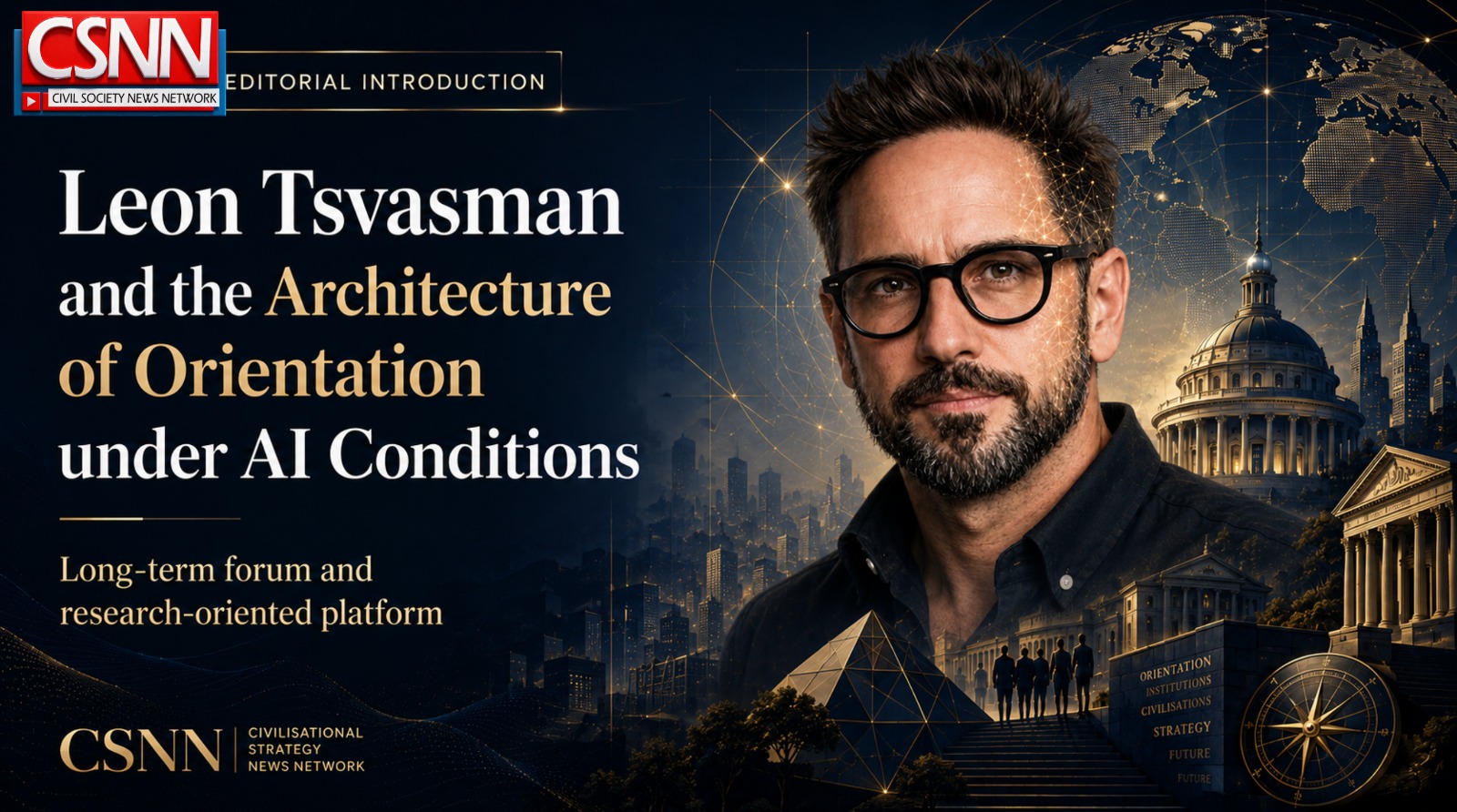
For Civil Society News Network, the work of Dr Leon Tsvasman opens the possibility of building a long-term forum and research-oriented platform around the architecture of orientation, admissibility, subject autonomy and civilisational design under AI conditions.
For CSNN, this means the possibility of creating not only publications, but an entire environment of discussion: dossiers, article series, interviews, expert commentaries, academic responses, public meetings, seminars, research partnerships and future formats of a forum or think tank.
This may include:
• institutional dossier and source materials;article series;expert interviews;academic responses;public meetings;research partnerships;seminars;forum formats;a think-tank pathway.
───
AI as a Civilisational Condition
Artificial intelligence is no longer only a question of technology, innovation, automation or regulation. It is increasingly becoming a civilisational condition — one that changes how societies produce meaning, how institutions establish legitimacy, and how the human subject preserves the capacity for orientation, judgement and responsible action.
In a world where symbolic production becomes cheap, mediation accelerates, and algorithmic systems begin to co-shape the conditions of public life, the decisive question is no longer only: what can artificial intelligence do? The earlier and more important question is: what conditions must be preserved so that human beings, institutions and civil society do not lose the capacity to recognise, evaluate, legitimate and act responsibly?
This is not another debate about AI as a tool. It is a deeper question of whether societies can preserve orientation, judgement and responsible action under conditions of technological mediation.
───
The Significance of Dr Leon Tsvasman’s Work
It is precisely at this point that the significance of Dr Leon Tsvasman’s work emerges.
This is not a matter of another debate about AI as a tool. Nor is it a simple commentary on current technological disputes. Leon Tsvasman’s work should be read at a deeper level: as a long-developed architecture of orientation, subject autonomy, admissibility and viable civilisational design under conditions shaped by artificial intelligence.
There are thinkers who comment on the crises of their time, and there are thinkers who try to identify the order from which such crises arise. Leon Tsvasman belongs to the second category. His work is not a topical stream of reflections on artificial intelligence, but an attempt to describe the deeper layer at which societies must recover orientation, criterion, epistemic integrity and the capacity for responsible action before technical capability hardens into an unexamined order.
What makes his work especially significant is not only the breadth of fields it touches — cybernetics, media and communication theory, constructivism, artificial intelligence, education, culture, governance, civil society and systems theory. Its importance lies above all in the coherence with which these areas are reorganised around a more primary question: how can human beings and institutions preserve judgement, legitimacy and meaningful orientation when AI systems begin to shape not only the tools of action, but also the conditions under which action becomes possible?
───
Sapiognosis, Sapiopoiesis and Sapiocracy
The strongest entry point into Tsvasman’s framework is the triad of Sapiognosis, Sapiopoiesis and Sapiocracy.
Sapiognosis may be understood as orientation beyond the excess of information, opinion and symbolic redundancy. It does not simply mean more knowledge. It names the capacity to maintain criterion, relevance and viable knowing under complexity.
Sapiopoiesis refers to the generative culture of subject-potentiality. It concerns the formation of meaning, autonomy and human agency beyond simple adaptation to systems, roles, impulses and algorithmic environments of behaviour.
Sapiocracy, in turn, points to the institutional and civilisational dimension. It is not about the rule of abstract wisdom, nor about an elitist model of governance. It concerns the design of public, educational, cultural and institutional conditions in which epistemic integrity, subject autonomy and admissible order can be structurally supported.
This triad is further developed through concepts that have direct relevance for the present historical moment: admissibility; Post-Actuality; epistemic infrastructure; Infosomatics; the Orientation Layer; Creator Fiction; and Kunstflow.
These are not decorative terms. They should not be treated as abstract language detached from reality. Their significance lies in their attempt to name what becomes scarce in an age of abundant content, fluid symbolic production and the growing plausibility of synthetic systems: judgement, criterion, responsibility, admission into public reality, and the capacity of the subject to preserve autonomy under conditions of high mediation.
───
Admissibility as a Constitutional Question
For civil society, the concept of admissibility is especially important.
In the standard language of regulation, we often ask how a system should be governed after deployment, how risk should be limited, how legal compliance should be ensured, and how effects should be controlled. Tsvasman moves the question earlier. He asks not only how AI systems should be regulated after being introduced into social practice, but whether a given system, process, decision architecture or form of technological delegation should be admitted into consequential reality at all.
This is a constitutional question in the broad sense. It concerns legitimacy before action, not merely compliance after integration. It concerns what may acquire real agency within the public, institutional and social order. It concerns the boundary between technical feasibility and public admissibility.
In this sense, AI cannot be treated only as a tool. It becomes a pressure on the conditions of judgement, responsibility, trust and autonomy. If technological systems begin to influence the tempo of decision-making, the visibility of information, social mediation, the architecture of attention and the boundaries of institutional responsibility, then admissibility becomes one of the key questions of civil society.
───
Education, Culture and Civilisational Imagination
For universities and academic environments, Tsvasman’s work opens a broad field of research. It may be relevant to political theory, cybernetics, philosophy of technology, AI governance, media studies, pedagogy, cultural theory, futures research and institutional design.
At the same time, it allows education itself to be reformulated. Education under conditions of artificial intelligence cannot be understood only as the transfer of information, skills or instructions. Increasingly, it must become a condition for the formation of orientation, criterion, judgement and subject autonomy. It is not enough to teach human beings how to use systems. We must ask whether, in relation to those systems, the human being remains capable of independently recognising meaning, consequence and responsibility.
For culture, Tsvasman’s work is equally important because it does not reduce civilisational transformation to public policy or technical governance. Concepts such as Creator Fiction and Kunstflow indicate that the future viability of civilisation also requires narrative, aesthetic and perceptual forms capable of making new civilisational possibilities thinkable and experienceable.
Not every future can be designed by regulation alone. Not every form of responsibility is born from procedure. Part of the future must first be seen, narrated, experienced and recognised as a possibility. In this sense, civilisational imagination is not an addition to governance. It may be one of its deeper conditions.
───
The Possibility of a Long-Term CSNN Platform
For Civil Society News Network, therefore, the work of Dr Leon Tsvasman opens the possibility of building a long-term forum and research-oriented platform around the architecture of orientation, admissibility, subject autonomy and civilisational design under AI conditions.
Such an initiative should not be a one-off event. Nor should it be reduced to a standard panel on AI, a technology conference, or an expert commentary on current trends. Its proper form should be a gradually developed editorial, academic and institutional space in which researchers, civil society actors, public institutions, creatives, students and experts can address distinct aspects of this architecture with seriousness and continuity.
For CSNN, this means the possibility of building not only publications, but an entire environment of conversation: a dossier, a series of articles, interviews, expert commentaries, academic responses, public meetings, seminars, research partnerships and future formats of a forum or think tank.
The aim is not to turn an original body of work into a slogan. The aim is to make it accessible without diluting it, academically discussable without domesticating it, and practically relevant without reducing it to consultancy vocabulary.
In the age of artificial intelligence, public life needs stronger architectures of orientation. It needs a language capable of naming not only technological risks, but also the deeper conditions of legitimacy, autonomy and responsibility. It needs concepts that do not stop at the surface of tools, but reach the layer in which criteria of action, forms of trust and boundaries of admissibility are shaped.
Dr Leon Tsvasman’s work offers one of the rare attempts to formulate such an architecture at a level equal to the seriousness of the challenge. For this reason, CSNN treats this field as an important direction for further editorial, research and institutional work — not only in relation to the future of artificial intelligence, but also in relation to the future of civil society itself.
───
Editorial Note
This article forms part of Civil Society News Network’s developing interest in the work of Dr Leon Tsvasman and the broader question of orientation, admissibility, subject autonomy and civil society under conditions shaped by artificial intelligence.
The purpose of this editorial line is to build a space for serious reflection on how institutions, media, culture, education and civil society may preserve the capacity for responsible action under conditions of deep technological transformation.
───
Published by Civil Society News Network
Independent civil society journalism, institutional analysis and public-interest editorial work.
Article link:
https://civilsocietynewsnetwork.org/2026/05/25/leon-tsvasman-architecture-orientation-ai-conditions/


