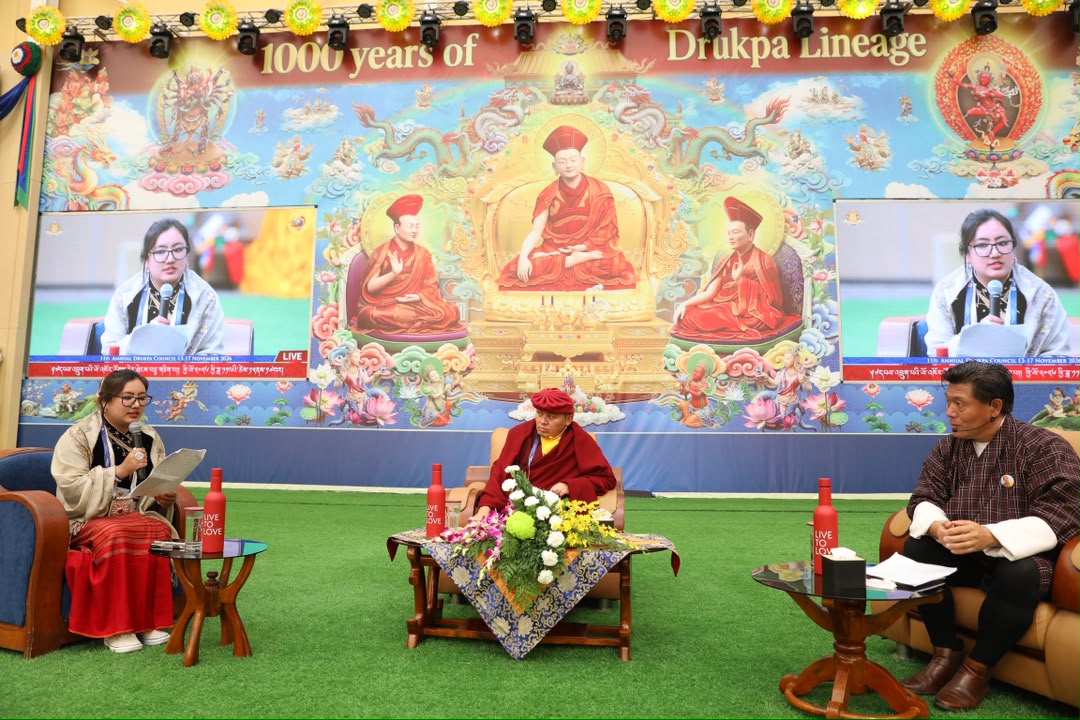
KATHMANDU, November 13 – As world leaders gathered in Antalya, Turkey, for the 31st UN Climate Change Conference (COP31), hundreds of Buddhist masters, monks, nuns and followers of the Drukpa Lineage met in Kathmandu, Nepal, yesterday to discuss a threat already reshaping life in the Himalayas: climate change.
The 11th Annual Drukpa Council (ADC) is a very different gathering from COP31, which runs from November 9 to 20. Yet the two share a concern: how to turn climate commitments into action that reaches mountain communities.
The timing is hard to ignore. In August, a flash flood on the Nepal-China border swept down the Bhote Koshi and Trishuli valleys in Rasuwa, destroying bridges, roads and hydropower projects and hitting pilgrims travelling to Mount Kailash. Reported death tolls vary, but hundreds died and many more went missing. Scientists at the International Centre for Integrated Mountain Development (ICIMOD) pointed to a likely ice-rock avalanche as the trigger.
Bhutan’s own warning
Bhutan had its own warning less than two weeks ago. On the night of October 29, a glacial lake outburst flood (GLOF) from Shintaphu Lake in Laya, Gasa, sent floodwaters down the Mo Chhu river. It washed away the facilities at Gasa Tshachu, one of Bhutan’s best-known hot springs, and damaged a section of the Punakha-Gasa highway.
No human lives were lost because the area had been evacuated beforehand, but herders were less fortunate: reports say at least 128 yaks and 12 horses were killed. ICIMOD estimated that the lake held 6 to 7 million cubic metres of water before it burst. Flood advisories were issued across the border in India, where thousands were evacuated.
It was the second time in five years that the Tshachu had been washed away. A flash flood in August 2021 swept away its ponds, bridges and concrete structures.
Another threat looms in Lunana, where the thin moraine dam separating Thorthomi and Raphstreng lakes is at risk of collapsing. If it fails, a combined GLOF could release an estimated 53 million cubic metres of water, roughly eight times the volume of the Shintaphu flood.
Nepal and Bhutan have jointly proposed a dedicated COP31 agenda item on mountains and climate change, seeking shared satellite data, monitoring of glacial lakes and stronger cross-border early warning systems.
At a press conference yesterday evening, “High altitude, high stakes: Mountain nations on the climate front line,” senior officials from Bhutan, Nepal, the International Cryosphere Climate Initiative and ICIMOD warned that glaciers are collapsing and the 1.5°C limit is slipping away, with mountain communities bearing the cost. What COP31 will deliver remains an open question.
For the Drukpa Lineage, whose communities are spread across Bhutan, Nepal, India and beyond, these events are not abstract. They describe the world its followers live in.
Compassion in action
For the Lineage, protecting nature is not a new cause. It comes from Buddhist teachings on compassion and the interconnectedness of all life.
“Caring for mother nature is one of the greatest forms of Buddhist practice,” said His Eminence Drukpa Thuksey Rinpoche, a revered spiritual leader and regent of the Drukpa Kagyu lineage. “Compassion is not only expressed through prayer and meditation, but through our everyday actions of respecting the environment and caring for all living things.”
Thuksey Rinpoche, who completed a master’s degree in Buddhist philosophy at Tango Buddhist University, joined Dr Tashi Dorji, a senior rangelands specialist at ICIMOD, for a panel titled “The Changing Himalayan Climate: Bridging Science, Buddhism and Resilience” yesterday.
“Environmental responsibility is not a one-off act of planting a tree; it must become a way of life. Living simply, saving water and electricity, reducing plastic waste, and educating children about climate change are all expressions of compassion, loving-kindness and respect,” he said.
Coming from Ladakh, one of the region’s most climate-vulnerable areas, Thuksey Rinpoche has seen climate change affect lives, livelihoods and landscapes across the mountains. His work links education, youth leadership, conservation and animal welfare, including the award-winning Druk Padma Karpo School, the Naropa Fellowship for young leaders and Live to Rescue Ladakh, which shelters abandoned animals.
Kung Fu nuns
The most visible face of the Lineage’s engagement with society is its community of Kung Fu nuns, who are hosting this year’s gathering at Druk Amitabha Mountain, their hilltop nunnery overlooking the Kathmandu Valley.
Internationally known for their martial arts, the nuns are also recognised for their work in environmental protection, gender equality, disaster relief and community service. They took part in relief efforts after the 2015 earthquake and later disasters in Nepal, including this year’s floods.
At the opening of the council, together with the Vietnam Buddhist Sangha and Live to Love, the nuns contributed NPR 10.5 million (approximately USD 100,000) towards Nepal flood relief. The Lineage shares a close connection with the Sangha, whose delegation to the council is led by Venerable Thich Thanh Phong.
Science, Buddhism and communities
The gathering takes place in a country that faced devastating floods only months ago. The Hindu Kush Himalaya, a region spanning eight countries and often called Asia’s water tower, holds vast reserves of ice and snow that feed major river systems. Millions of people downstream depend on them for drinking water, agriculture and energy. Rising temperatures, shifting rainfall and accelerating glacier loss are straining this system, and lakes forming behind retreating glaciers, such as Shintaphu, add a sudden danger to the slower threat of water scarcity.
Dr Tashi Dorji said the changes go well beyond melting ice. “We are witnessing changes in snowfall, water availability, forests, grasslands and mountain livelihoods. These changes are interconnected,” he said. “Science helps us understand them, anticipate risks and identify solutions.”
But science alone is not enough, he added. “We must also recognise the knowledge and values mountain communities have developed over generations. Science can help us understand what is happening, Buddhist wisdom can guide how we respond, and empowered communities must translate both into action.”
Beyond borders
No government can answer these challenges alone. The Shintaphu flood crossed from Bhutan into India, and the Rasuwa flood began near the Nepal-China border. Effective responses need cooperation across borders and sectors.
Founded in 2009, the ADC has traditionally focused on Buddhist teachings, religious practice and strengthening ties within the Lineage.
Putting climate action at the centre of this year’s gathering is not a departure from its purpose but an extension of compassion to animals, ecosystems and the natural world.
As the world debates climate action in Antalya, Kathmandu is a reminder that change must also start in communities, in the choices people make and the responsibility they take for the natural world.
Contributed by Rinzin Wangchuk, Executive Director of the Journalist Association of Bhutan


