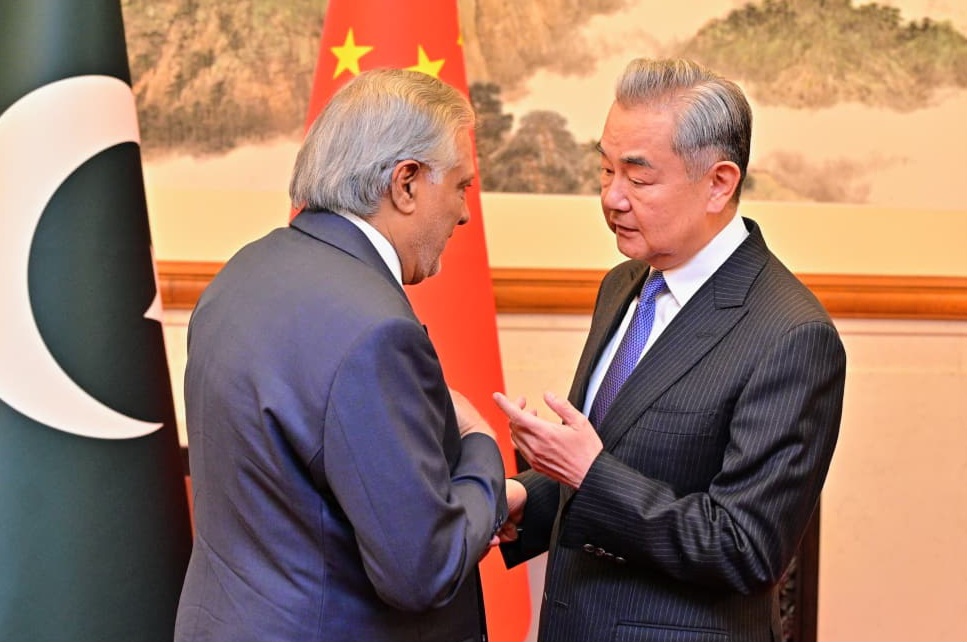
Beijing. Pakistan and China have released a joint five points proposal for peace in the Middle East, after Pakistan’s foreign minister flew to Beijing on Tuesday to seek Chinese support for the country’s faltering efforts to negotiate an end to end the war.
The one-day meeting between Ishaq Dar and his Chinese counterpart, Wang Yi, came as Pakistan continues to push for the role of peacemaker between the United States and Iran, even as the war shows little sign of relenting.
According to a statement from China’s foreign ministry, the trip was intended to “strengthen”cooperation between China and Pakistan on the ongoing conflict in Iran and “make new efforts toward advocating for peace”.
So far, China has maintained a meticulous distance from the ongoing conflict in the Middle East and the Gulf, though it has ties with the regime in Tehran and is the largest buyer of Iranian oil.
While Beijing condemned the initial US and Israeli strikes on Iran, it has since held a position largely of neutrality and focused its efforts on calling for a ceasefire, while negotiating directly with Tehran for the safe passage of its own oil tankers through the strait of Hormuz.
In a statement after Tuesday’s meeting, Pakistan and China jointly called for an immediate ceasefire and for the safety of waterways, including the blockaded strait, to be protected, and released a five-point initiative for peace.
The joint statement agreed that dialogue and diplomacy were “the only viable option to resolve conflicts” but there appeared to be little substantive progress in bringing the significant participants to the table to end the war.
This week Trump claimed that negotiations with Iran were going “extremely well” while Tehran has maintained there are no direct talks happening at all.
In recent weeks, Pakistan has put itself at the centre of efforts to bring about a ceasefire to end the war with Iran and has been pushing for Islamabad as the location for peace talks.
Playing on its relationships with both sides, Pakistan’s prime minister, Shehbaz Sharif, and army chief, Syed Asim Munir, have been communicating with the US president, Donald Trump, and the Iranian president, Masoud Pezeshkian, as well as dozens of other global leaders, and messages between the two warring countries have passed through Pakistani intermediaries.
On Sunday, Islamabad hosted talks with the foreign ministers of Saudi Arabia, Turkey and Egypt, in an effort to find a regional solution to ending the conflict, yet the absence of the US and Iran from the negotiations was seen to undermine their diplomatic heft.- the guardian


