In today’s geopolitical landscape, journalism is no longer confined to the mere dissemination of information; rather, it has emerged as a powerful tool for maintaining peace and stability. Moving beyond traditional “war journalism,” which often amplifies conflict, the concept of “peace journalism” is now widely recognized across the globe. In the SAARC region, the SAARC Journalist Forum (SJF) has set a unique example by institutionalizing peace journalism and fostering regional unity among member countries.
What is Peace Journalism?
Peace journalism is an approach that analyzes the root causes of conflict and seeks to reduce violence and disputes. Instead of fueling tensions, it emphasizes solutions and promotes understanding. Given the social, political, and geographical realities of SAARC countries, the importance of this form of journalism is immense.
Importance of Peace Journalism: Peace journalism promotes tolerance and mutual respect in society. It plays an effective role in reducing rumors, hate speech, and division. Particularly in conflict-prone situations, it helps build understanding among people and contributes to preventing violence.
In a world increasingly marked by conflict, violence, and division, journalism’s role extends far beyond reporting—it actively contributes to peacebuilding and social stability. The concept of peace journalism was popularized by renowned Norwegian peace researcher Johan Galtung, who emphasized that news reporting should not escalate conflicts but instead open pathways for resolution.
Unique Role of SAARC Journalist Forum (SJF):
Over the years, the SAARC Journalist Forum has been actively working to protect democracy, ensure human rights, and promote peace across South Asia.
Key initiatives reflecting the ideals of peace journalism include: International Seminars and Conferences:
SJF has organized multiple international conferences in Nepal, India, Bangladesh, and Sri Lanka, spreading the message of peace among journalists. These events emphasized the principle: “We want peace, not war.”
Human Rights and Democracy:
SJF consistently advocates for journalist safety and press freedom in South Asia. It engages with policymakers to strengthen democratic institutions and ensure the rights of ordinary citizens.
Regional Solidarity:
By connecting journalists from India, Pakistan, Bangladesh, Nepal, Sri Lanka, Bhutan, and the Maldives, SJF acts as a bridge to reduce regional hostility and enhance cooperation.
Recognition from Sri Lanka:
The contributions of SJF in promoting peace have recently been recognized by Sri Lanka through a special honor awarded to its leadership. This recognition is not merely a personal achievement but a testament to the growing global relevance of peace journalism and the impactful work of SJF. Such acknowledgment inspires journalists across South Asia to adopt more responsible and humane practices.
Major International Conferences in Delhi (February 2026):
In February 2026, SJF organized several significant international events in New Delhi aimed at promoting peace journalism and regional cooperation:
1. Media Conclave: Security and Development (Shyam Lal College, University of Delhi), held on February 7, 2026, this conclave focused on the role of media in ensuring regional security and development. Discussions emphasized responsible reporting that supports stability rather than undermining national security.
2. International Peace Conference (Bharati Vidyapeeth, New Delhi):
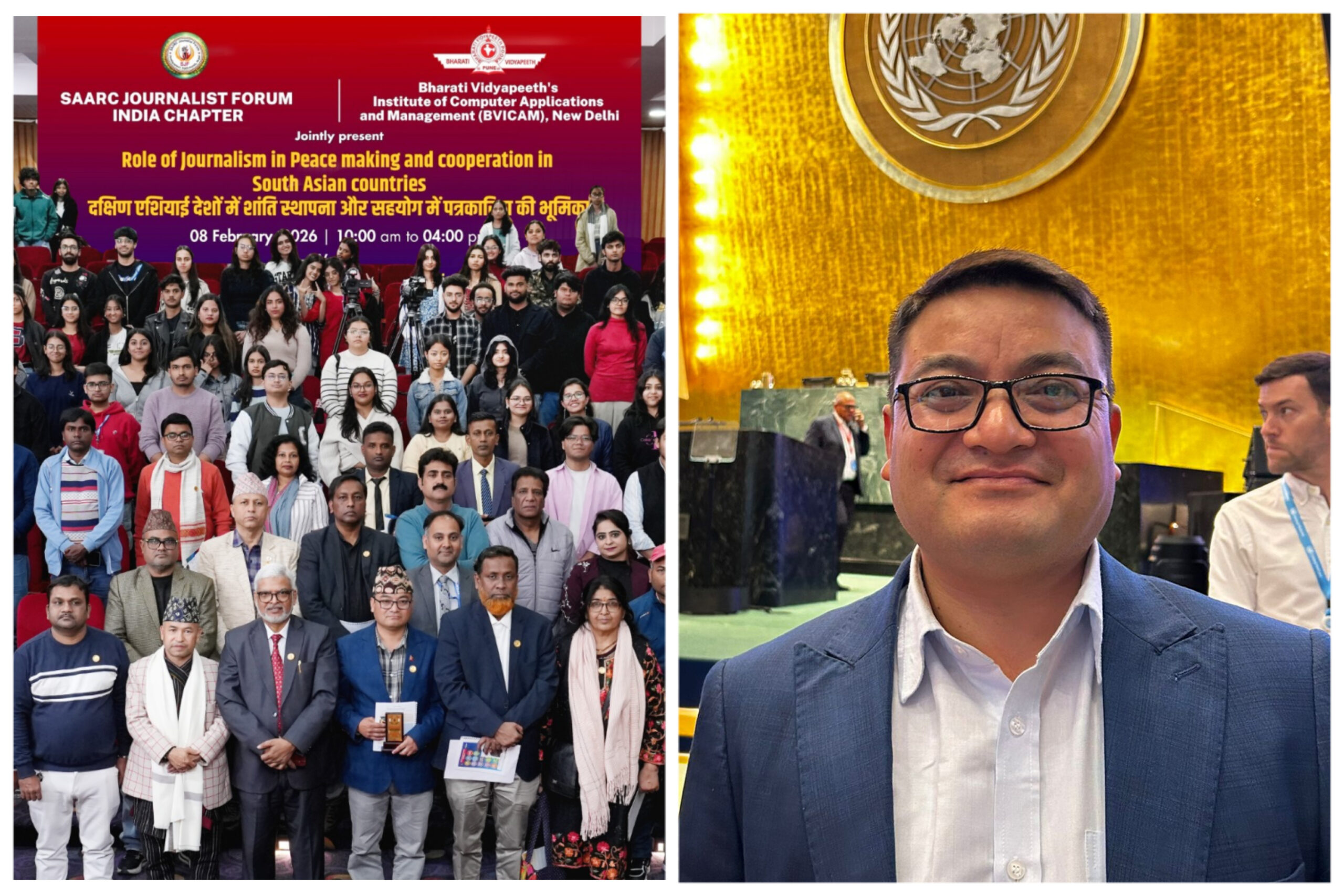
Held on February 8, 2026, under the theme “Role of Journalism in Peacekeeping and Cooperation in South Asian Countries,” this conference highlighted journalism as a tool for peacebuilding and regional collaboration.
3. South Asian Heroes Award:
On February 6, 2026, distinguished media personalities were honored for their contributions to peace. This recognition significantly boosted morale among journalists working in peace journalism.
Key Outcomes of the Conferences
Encouraging solution-oriented reporting instead of provocative narratives:
– Strengthening SJF’s role in regional peacebuilding
– Ensuring journalist safety and press freedom
– Raising awareness against misinformation and hate speech on social media
These events reinforced the idea that sustainable development in South Asia is impossible without peace—and journalists are key architects of that peace.
Reflection of Regional Leadership on the Global Stage:
The participation of Raju Lama, International President of SJF, in global platforms such as the United Nations symbolizes the representation of South Asian journalists at the highest level. It highlights the growing international recognition of the region’s media in promoting peace.
His presence emphasized that journalists are not merely reporters of conflict but can act as mediators and facilitators of peace.
Policy-Level Engagement:
Participation in global forums like the UN provides opportunities to engage directly with international policymakers on issues of peace and human rights. This will contribute to strengthening press freedom and journalist protection in the SAARC region.
A Matter of Pride for South Asia: Recognition from Sri Lanka and participation in global forums demonstrate that under the leadership of Raju Lama, SJF is evolving from a regional body into a global force for peace advocacy.
Conclusion:
There is no alternative to mutual trust and cooperation among South Asian nations for achieving peace and development. Through its writing and organizational efforts, the SAARC Journalist Forum is building that trust.
The courageous role played by SJF in promoting peace journalism serves as a powerful inspiration for future generations of journalists. If journalists choose to promote peace instead of conflict, a prosperous and secure South Asia can truly be achieved.
Md. Abdur Rahman
Secretary General
SAARC Journalist Forum (Central Committee)
Kathmandu, Nepal
Website: www.sarcjournalistforum.org


