By Raju Lama
International President, SAARC Journalist Forum
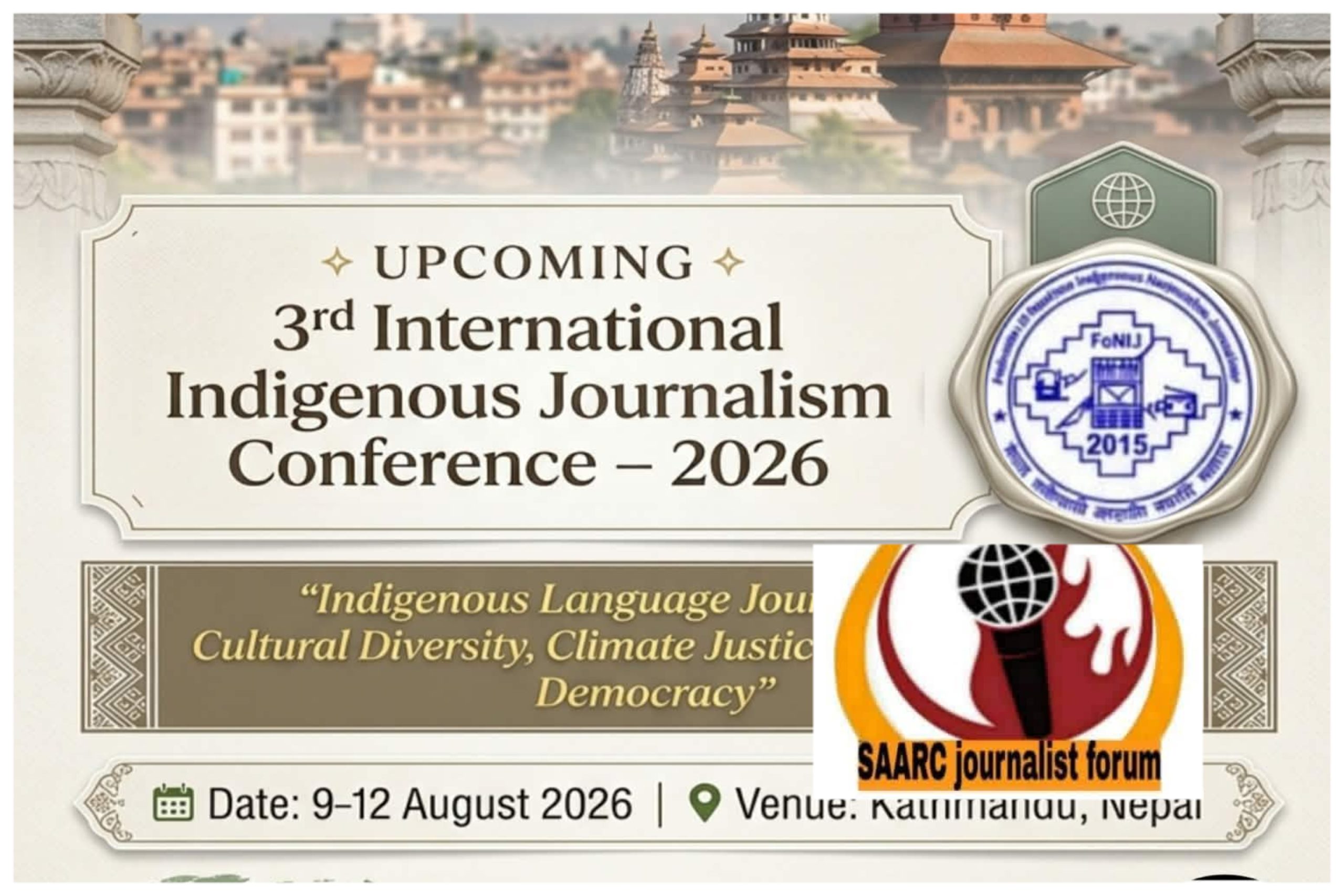
New York, United States — The 3rd International Indigenous Language Journalism Conference 2026 is set to bring together journalists, editors, media professionals, researchers, Indigenous leaders and policymakers from around the world in Kathmandu from August 9 to 12.
The conference, being organized by the Federation of Nepalese Indigenous Nationalities Journalists (FoNIJ) in coordination with the Newa National Forum of Journalists and SAARC Journalist Forum, comes at an important moment for Indigenous communities and minority-language media. Organizers expect participation from journalists representing approximately 40 countries.
The central theme—“Indigenous Language Journalism for Cultural Diversity, Climate Justice and Inclusive Democracy”—highlights the growing recognition that journalism in Indigenous and minority languages is not simply a cultural activity. It is an essential component of democratic participation, social inclusion, cultural preservation and access to information.
Journalism as a Voice for Indigenous Communities
For generations, Indigenous communities around the world have faced challenges in getting their stories, concerns and aspirations represented accurately in mainstream media.
Indigenous-language journalism can help address this gap by allowing communities to tell their own stories in their own languages. It can preserve traditional knowledge, document cultural practices and provide information about issues such as land rights, climate change, education, migration, development and human rights.
The need for more inclusive journalism is particularly important in an era of rapid digital transformation. Social media and digital platforms have created new opportunities for Indigenous journalists, but they have also introduced challenges involving misinformation, language inequality, digital exclusion and the loss of traditional forms of communication.
Research on Indigenous media representation has also pointed to concerns about under-representation and negative framing of Indigenous issues, reinforcing the importance of strengthening Indigenous-led journalism and newsroom capacity.
The South Asian Dimension
South Asia is home to extraordinary linguistic, cultural and Indigenous diversity. From Nepal’s mountains and hills to India’s Northeast and central regions, Bangladesh’s Indigenous communities, Sri Lanka and other parts of the region, journalism can play a critical role in documenting communities whose voices have historically received limited attention.
In this context, the SAARC Journalist Forum has an important regional responsibility. SJF’s stated mission includes organizing journalists across South Asia to promote press and expression freedom and protect the rights and dignity of journalists. Its objectives also include bringing journalists together across the SAARC region and promoting professional excellence.
The Indigenous Language Journalism Conference provides an opportunity to extend that mission into the field of Indigenous and minority-language journalism.
The Role of SAARC Journalist Forum
The participation of SJF should not be viewed simply as institutional cooperation. It represents an opportunity to build a stronger regional network of journalists committed to inclusive journalism.
1. Connecting Indigenous Journalists Across South Asia
SJF can help establish stronger professional links among Indigenous journalists from Nepal, India, Bangladesh, Bhutan, Sri Lanka, Pakistan and other parts of South Asia.
A regional network could facilitate exchange of reporting techniques, investigative methods, digital skills and experiences in covering Indigenous communities.
2. Promoting Language Diversity in Journalism
Language is fundamental to identity. SJF can advocate for greater recognition of journalism in Indigenous and minority languages and encourage mainstream media organizations to provide space for multilingual reporting.
The objective should not be to replace mainstream journalism but to create a more inclusive media ecosystem in which Indigenous-language journalism and national and international media complement each other.
3. Strengthening Press Freedom
Indigenous journalists frequently operate at the intersection of journalism, community rights and social conflict. They may face pressure, discrimination, limited resources or restricted access to information.
SJF can provide a regional platform for discussing journalist safety, press freedom and professional standards while ensuring that Indigenous journalists are not marginalized within the broader journalism community.
4. Climate Justice and Indigenous Knowledge
Climate change is one of the defining challenges facing Indigenous communities.
Indigenous peoples often possess generations of knowledge about forests, water, agriculture, biodiversity and environmental stewardship. Journalism can help bring this knowledge into national and international climate conversations while maintaining accuracy, consent and respect for community ownership.
The conference’s focus on climate justice therefore creates an important bridge between Indigenous journalism and global environmental reporting.
5. Building Cross-Border Media Cooperation
South Asian Indigenous communities often face issues that transcend national borders, including climate change, migration, environmental degradation and cultural preservation.
SJF can encourage cross-border reporting projects that allow journalists to investigate these issues collaboratively rather than viewing them solely through national perspectives.
Digital Media: A New Opportunity
Digital journalism offers Indigenous-language media an unprecedented opportunity. A small newsroom can now publish news, podcasts, video reports and social-media content to audiences around the world. Artificial intelligence, translation technologies and digital archives may also help preserve endangered languages and expand access to information.
But technology must serve communities rather than erase linguistic diversity. AI-generated translation, for example, can be useful but should not replace Indigenous journalists and community knowledge. Human editorial judgment, cultural context and linguistic expertise remain essential.
From Conference to Action
The most important question is what happens after the conference. Kathmandu should become more than a meeting place. It can become the starting point for a long-term international network of Indigenous-language journalists.
The conference could contribute to practical initiatives such as:
* An international network of Indigenous-language journalists;
* Regional training programs in digital and investigative journalism;
* Fellowships for Indigenous journalists;
* Cross-border investigative reporting projects;
* Digital archives for Indigenous-language journalism;
* Journalist-safety mechanisms;
* Partnerships between Indigenous and mainstream media;
* Programs supporting women and young Indigenous journalists;
* Training on climate, human rights and conflict-sensitive reporting; and
* Greater representation of Indigenous voices in international media.
A New Media Partnership for the Global South
The Indigenous Language Journalism Conference also offers a broader lesson for journalism in the Global South. Media diversity should not be measured only by the number of news organizations or digital platforms. It should also be measured by whose voices are heard, whose languages are represented and whose stories are allowed to shape public debate.
The SAARC region can demonstrate that regional journalism organizations have a responsibility to defend not only the freedom of journalists but also the diversity of the communities they serve. For SJF, participation in this international conference can therefore become part of a wider commitment to press freedom, cultural diversity, peace journalism and inclusive democratic communication.
Conclusion
The 3rd International Indigenous Language Journalism Conference comes at a critical time for journalism. As the world becomes increasingly interconnected, linguistic and cultural diversity must not disappear from the media landscape. Indigenous journalists are not merely reporters of their communities; they are important custodians of language, culture, history and public memory. Kathmandu can provide an important platform for these voices to connect with the wider world.
For the SAARC Journalist Forum, the challenge is clear: to transform regional solidarity into practical cooperation, strengthen Indigenous and minority-language journalism, protect journalists’ rights and ensure that every community has the opportunity to participate in the democratic information system. A free press must be diverse. A democratic media must be inclusive. And journalism cannot truly serve humanity unless every language and every community has the right to be heard.


