By Madalitso Wills Kateta
When Cyclone Freddy ripped through Southern Malawi in March 2023, it did not just flood villages and wash away roads. It knocked out hydropower stations, snapped transmission lines, and left communities in the dark for days.
For Cathy Banda, a food vendor at Muloza market in Mulanje, that destruction meant spoiled fresh fish, meat, and losses to her businesses.
“Electricity means business opportunities,” Banda said in an interview. “When electricity goes, businesses especially those that sell fresh foods make losses.”
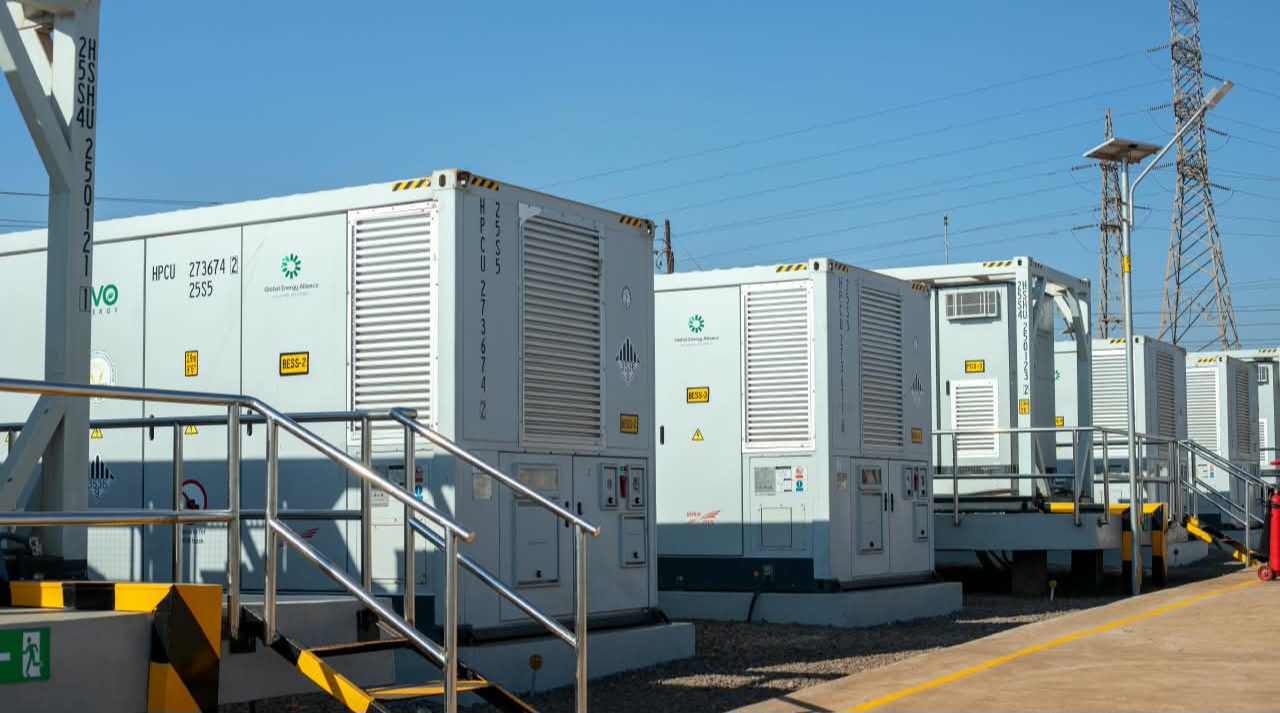
Almost three years later, Malawi is betting on a US$20 million worth of Battery Energy Storage System (BESS) that can stop that from happening again. In July 2025, the government of Malawi and the Global Energy Alliance (GEA) broke ground on Malawi’s first utility-scale battery energy storage system with a 20 MW of power capacity with 40 MWh of storage. It’s the first project of its kind in the country — and one of the first in a region where climate change is making an already fragile power grid even more unreliable.
Malawi’s electricity problem starts with water. About 70% of the country’s power comes from hydropower plants on the Shire River. When the rains fail, Lake Malawi drops. When the rains are too much, cyclones flood the dams and take the plants offline.
The result is load-shedding that can last 8 to 12 hours a day. For businesses it means lost revenue. For clinics it means dead cold chains. For the 80% of Malawians not connected to the grid at all, it means another reason to stay in the dark.
Climate models project more intense droughts and more destructive cyclones for Southern Africa in the next decade. Without storage, every weather shock becomes a power shock.
“This project is not just infrastructure; it is a signal of what the future of energy in Africa can look like,” says Carol Koech, Vice President for Africa at Global Energy Alliance. “Reliable power is not just about electricity. It is about jobs, functioning hospitals, and businesses that can grow.”
The system will charge when solar and hydro are producing excess power, usually midday. At night, during peak demand, or when a plant trips offline, it will discharge — smoothing voltage, preventing blackouts, and buying ESCOM, the national utility, critical hours to restore service.
Battery storage is not a new technology. South Africa, Kenya, and Zambia already have utility-scale systems. But in Malawi, no commercial lender would touch it. The risks were too high, the returns too uncertain, the grid too small. The breakthrough came through a $20 million catalytic grant, structured to de-risk the project enough for private investment to follow.
“For decades, we have been at the mercy of the clock and the weather, but today we begin an era of energy independence on our own terms. Today, we are not just commissioning a facility of steel and lithium; we are commissioning the engine of our development,” said Minister of Energy Jean Mathanga at the BESS launch.
The battery storage system integrated into the national power grid is designed to withstand heat, humidity, and flooding, with cooling systems and a 10-12 year lifespan. ESCOM officials say the immediate benefit will be grid stability as with more solar coming online, the grid will be able to absorb fluctuations. They say the battery storage system can respond in milliseconds — far faster than a hydro turbine can ramp up.
“For years, grid instability forced us to curtail renewable energy we had already generated and to fall back on costly diesel at the expense of our consumers and our climate commitments. The Kanengo BESS changes that calculus entirely. By storing and deploying power instantaneously, we are stabilising feeder voltages, reducing system losses, and unlocking about 100 MW of renewable generation that was previously constrained,” said ESCOM CEO engineer William Kayipa.
However, the question Malawians keep asking is — will my lights stay on? Perhaps the honest answer would be — partly. 40 MWh is not enough power for the whole country. At full discharge, it could supply about 10,000 households for 4 hours, or keep critical loads running much longer.
For small businesses, even a few hours of avoided outage matters. In Lilongwe’s Masonga market, welding shop owner Gift Gondwe complains of losing about K52,000.00 every time power cuts mid-job.
“If this battery means the electricity will be stable and my job won’t be disrupted I can finish more jobs every week and efficiently care for my family,” said Gondwe.
However, while the BESS is expected to reduce Malawi’s energy woes, some environmental advocates believe such projects need to be approached with caution. Malawi currently contributes less than 0.1% of global emissions, despite paying the price of the climate crisis. The activists say such projects don’t come without risks as batteries degrade faster in heat. Malawi’s temperature averages 30°C for much of the year. However, according to Koech thermal management and indoor housing will protect the cells, but long-term performance will need monitoring.
According to Koech, training is key to the project and Malawian engineers are a greater part of the project operations so that in 10 years the project is not considered as a foreign project, but a Malawian asset.
“The program was designed that after 10 to 12 years, there has to be a performance review and it is fully managed by Malawian engineers,” said Koech.
While lithium-ion batteries will eventually need recycling or safe disposal — a system Malawi does not currently have, Koech said the project was designed with a consideration of all the environmental factors. And there is the bigger question of scale. While 20 MW is a pilot, Malawi needs 200 MW or more of storage in the next decade, plus more solar and transmission upgrades to truly buffer the grid against climate shocks according to estimates.
Back at Muloza market, trader Banda is watching the project closely. Her business still relies on a petrol generator that drinks fuel and breaks down. She is hopeful that if the battery means that there are fewer blackouts, her businesses will thrive.
“We have adapted to darkness and making losses for too long, if this battery energy storage system means an end to blackouts, we shall be cushioned from the unpredictable losses due to blackouts,” said Banda.
For the whole country however, this is just a test. Can a climate-vulnerable country use new technology and new finance to build a power system that bends instead of breaks? The battery will not stop the cyclones. But maybe, for the first time, there will stop the cyclones from stopping people’s livelihoods.


