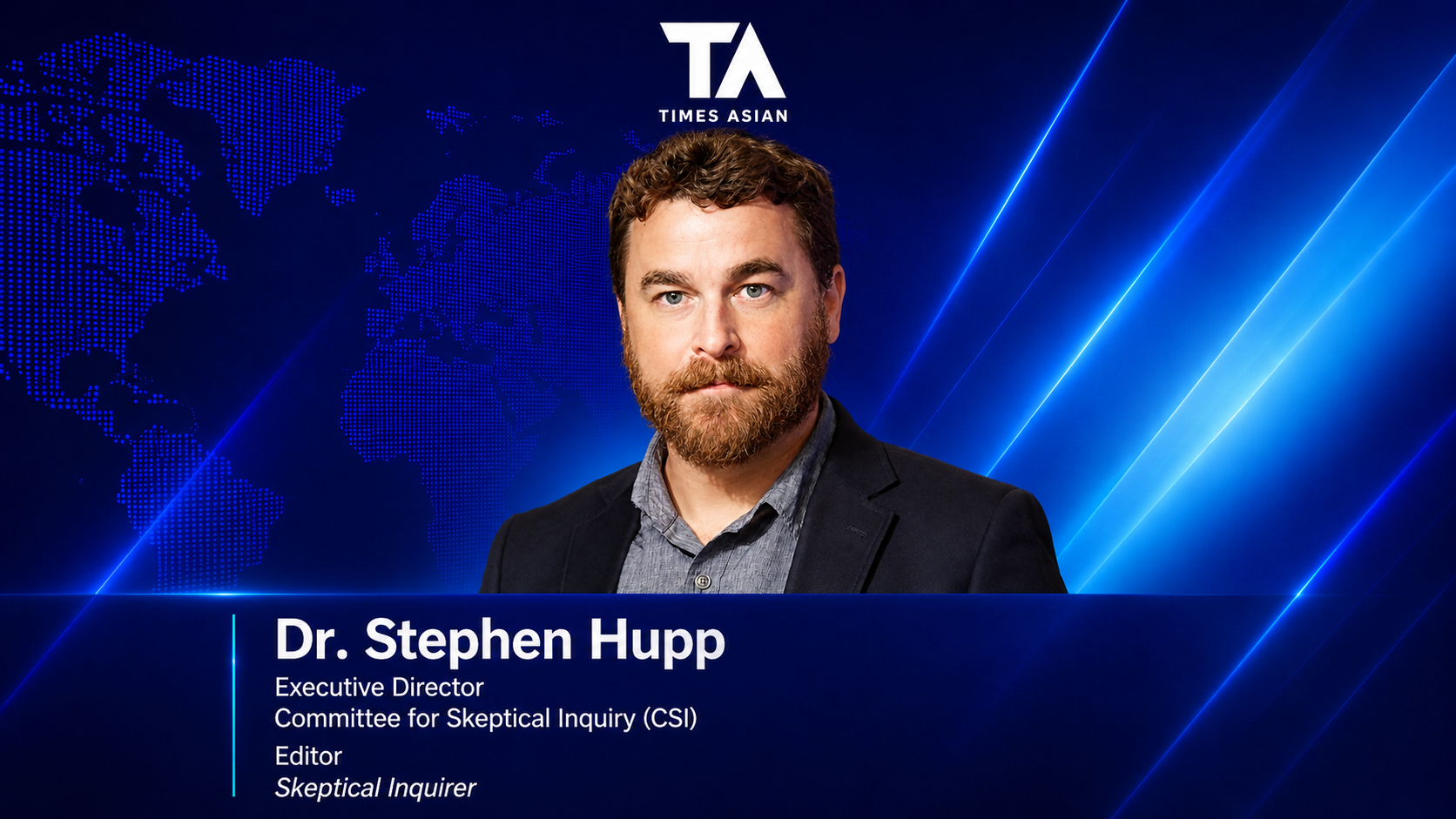
Dr. Stephen Hupp is a professor of psychology at Southern Illinois University Edwardsville. He earned his PhD in clinical psychology from Louisiana State University and serves as the executive director of the Committee for Skeptical Inquiry and as the editor of Skeptical Inquirer. His work emphasizes critical thinking, empirical scrutiny, public understanding of science, and the responsible evaluation of extraordinary claims through education, scholarship, and skeptical outreach for diverse audiences in classrooms, publications, conferences, and broader civic life. Visitcsiconference.org to learn more about CSICon to be held June 11-14 in Buffalo, New York.
In this exchange, Scott Douglas Jacobsen and Dr. Stephen Hupp present skepticism as a core part of the scientific method rather than a separate posture. Hupp argues that real science builds controls to reduce bias, while pseudoscience seeks confirmation. He also distinguishes secular humanist skepticism from scientific skepticism, while emphasizing their overlap. The conversation concludes by rejecting the stereotype of skeptics as cynics and affirming wonder grounded in evidence, method, and reality for public understanding today.
Scott Douglas Jacobsen:Is there any genuine distinction between science as a process and body of knowledge and skepticism as an attitudinal stance? Or are they sufficiently overlapping, like a Venn diagram, where they are deeply interlinked?
Dr. Stephen Hupp:You really cannot have science without skepticism. Skepticism is part of science. One of the strengths of science is that scientists go to great lengths to prove themselves wrong.
Whereas someone we might characterize as a pseudoscientist spends their time trying to prove themselves right. They are not building controls into their experiments that would account for other biases that creep in. That is what science is about: controlling for the other biases that affect results so that, by the end, if there is a meaningful connection, you are more or less compelled to accept the conclusion.
Controlling for everything else is really an act of skepticism. It means being cautious that participants, I am a psychologist, so I work with human participants, might want the results to turn out a certain way. Researchers might want the results to turn out a certain way. Doctors might want the results to turn out a certain way.
So we need to build skepticism into the process to ensure we control for those kinds of biases.
Jacobsen:What distinguishes secular humanist leaders or heroes, if you will, from non-secular figures, political or religious ones? Your Bill Nyes, your Mary Roaches, your Neil deGrasse Tysons, et cetera.
Hupp:There is a lot of overlap. Of course, many people can be both. But we have two wings of the broader skeptical community: the secular humanist wing and the scientific skepticism wing. The secular humanist wing spends more time being skeptical about religious claims. Scientific skepticism sometimes addresses religious claims, but usually only where they can be examined empirically.
So, a common topic in scientific skepticism would be claims about faith healing. Throughout the decades, there have been famous people who claimed they could heal others through faith. Peter Popoff is the classic example. He was receiving information from his wife through an earpiece during services.
James Randi, with help from Banachek, famously helped expose the faith-healing operation Peter Popoff was running. We also have Eugenie Scott coming to our conference, which is fantastic. She recently wrote inSkeptical Inquirer about another faith-healing investigation, this time involving W.V. Grant, and how he was shown to be cheating, essentially.
Her group was the Bay Area Skeptics, a local skeptics organization. She describes it as the first local group inspired by CSICOP, the Committee for the Scientific Investigation of Claims of the Paranormal, now known as the Committee for Skeptical Inquiry. The larger movement inspired them, and they began their own investigations in San Francisco.
So she wrote a really fun article, and it will be great to have her talk about it at the conference.
There is a stereotype that both scientific skeptics and secular humanists, or people who identify as both, are cynics. That is a genuinely malicious misconception. It is important to dispel that belief. To borrow the spirit of James Randi, skepticism is not reflexive debunking for its own sake. It is the application of proportionate doubt, proper method, and scrutiny to empirical claims.
Jacobsen:So, how does this conference help advance that movement and challenge those negative stereotypes?
Hupp:Bill Nye is a great example. He is one of our keynote speakers and a truly positive figure. He really embraces skepticism, but in a way that highlights what he calls the “passion, beauty, and joy” of science, the PB&J of science. And when he talks that way, you can really hear the influence of Carl Sagan, whom Bill Nye has said inspired him deeply and from whom he even took an astronomy class at Cornell. Sagan, especially throughCosmos, showed that scientists and skeptics are not enemies of wonder. Quite the opposite: they are trying to ground wonder in reality. We get more joy from a world that is genuinely astonishing and supported by evidence than from a fabricated sense of wonder that has no evidential basis.
Jacobsen:Thank you very much for the opportunity and your time, Stephen.


