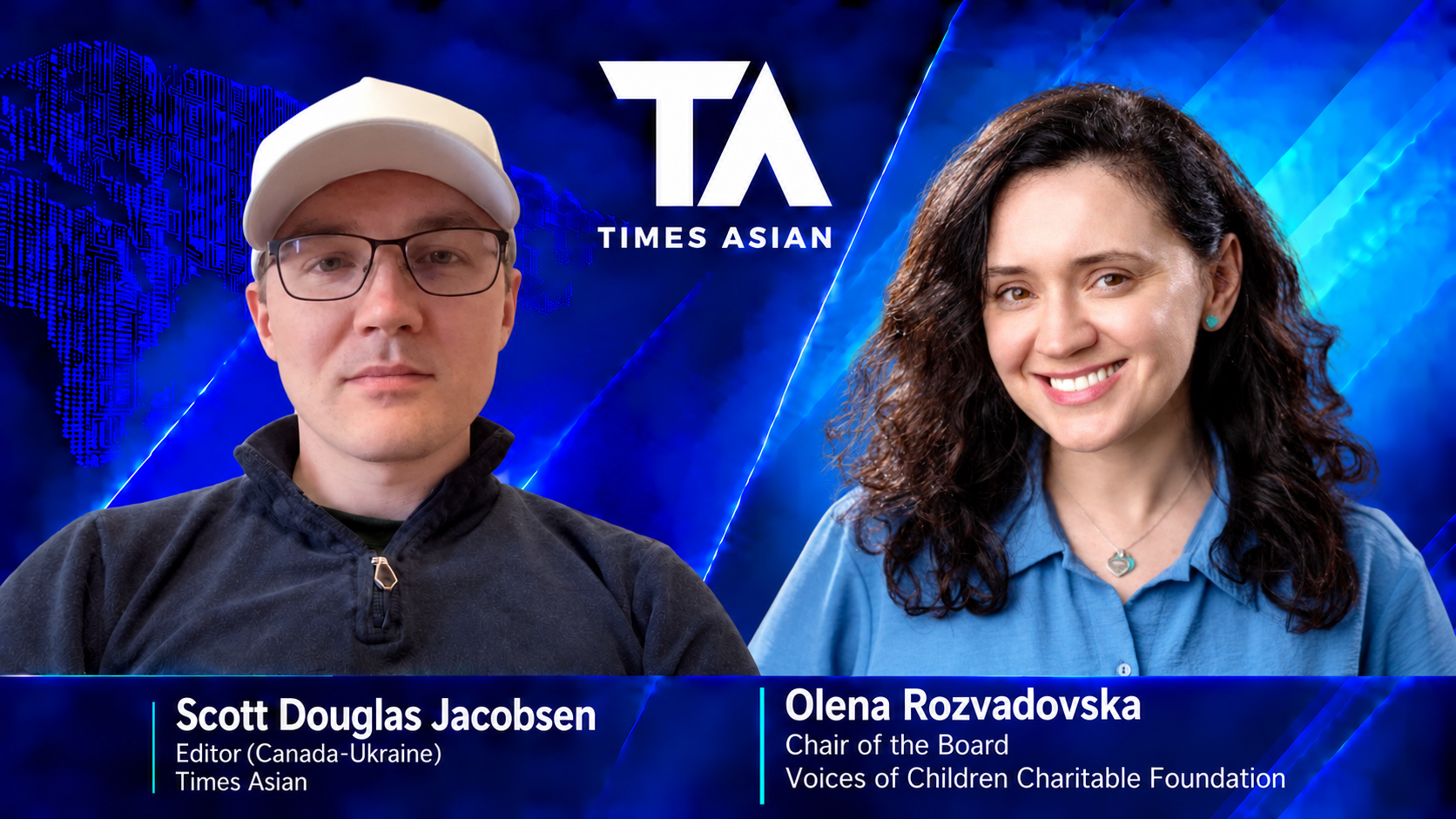
By Scott Douglas Jacobsen
Editor (Canada-Ukraine), Times Asian
Olena Rozvadovska is a Ukrainian children’s rights advocate and cofounder of Voices of Children. Formerly with Ukraine’s Ombudsman’s Office, she began working directly with war-affected children in eastern Ukraine after 2014. Her work focuses on psychosocial support, trauma-informed care, humanitarian assistance, and advocacy for children under occupation, displacement, and bombardment. She has become a leading Ukrainian voice on protecting childhood amid Russia’s war, emphasizing safety, dignity, play, education, and recovery.
Scott Douglas Jacobsen interviews Olena Rozvadovska, cofounder of Voices of Children, about children’s rights during Russia’s war in Ukraine. Rozvadovska explains why safety, life, education, play, peer connection, and development remain essential in wartime. She discusses psychosocial support, therapeutic recreation, CBT, trauma-informed care, grief support, specialized child psychology, camps, regional centres, online services, and the risks faced by therapists helping children near front-line areas.
Scott Douglas Jacobsen: In a war context, there are different types of rights for children under the Convention on the Rights of the Child, yet the emphasis on particular rights will differ depending on the context. In a war context, which rights of children tend to be most front and center, although obviously all of them matter?
Olena Rozvadovska: The rights that usually come to the front in every war are safety and the right to life. But it is difficult to separate children’s rights from one another. Sometimes people think that in war, the most important needs are home, food, water, and safety. Those are essential, but for children, development is also essential.
Children are at an age when they are developing, exploring the world, and learning. Education is a basic need. It is not only education in the narrow sense of lessons or schoolwork. It is also learning through communication with peers, being in an environment with other children, making friends, exploring, discovering, and having a place to play.
Before the full-scale invasion, I lived in Sloviansk, in the Donetsk region. I worked in villages directly on the front line, many of which no longer exist. Villages near Bakhmut are one example. At that time, Bakhmut was, for me, a peaceful city.
I would drive about 20 kilometers toward the front line, where sometimes only five children remained in an entire village. People would ask me, “Why do you go there? Did you bring them food?” They assumed that delivering food was enough.
But their greatest need was something else. They had bread and water. What they wanted was to play. They wanted to communicate with someone. They did not want to remain isolated. They wanted to discover new things. They simply wanted to be children.
For me, that was shocking. I realized that while there are obvious necessities children need and other things that can wait until the war is over, childhood itself cannot wait. As adults, we understand what it means to postpone things and make long-term plans. Children do not have that luxury because the ages of five, six, or seven will never come again. A child who is seven today may be eighteen by the time the war ends, and those years cannot be recovered.
Those years are precious. Even amid war, children naturally want to communicate with their peers, play, create art, and have a space where they can simply be children.
Sometimes I would think, “This is not the first priority. They need doctors and schools.” But I came to understand that, in some situations, the first thing a child needs is an adult who sees them as a child and, despite everything happening around them, helps preserve time for play, discovery, and exploration.
For me, that is an essential need. In the language of charities and NGOs, we call it psychosocial support or therapeutic recreation. Those are our professional terms. Simply put, every child wants to be a child, no matter what is happening outside.
That is why one of the main priorities of our foundation is providing psychosocial support in the broadest sense. We want to create spaces where children can continue to have a childhood, no matter the circumstances. For me, this is one of the most fundamental rights that deserves to be placed at the forefront.
Jacobsen: What evidence-based forms of psychosocial support work best for children? Is it essentially the same support that adults receive but adapted for different ages, or is it an entirely different system and approach?
Rozvadovska: It is different. Child psychology is a specialized field, and every psychologist or therapist who works with children should have specific training and expertise in child development and child-focused therapeutic approaches.
This means the instruments used with children are different from those used with adults. In our foundation, we hire psychologists and psychotherapists who specialize in working with children.
Children have different needs, and even within the broad category of children, there are distinctions. Some therapies work only with adults or with teenagers, for example, those aged 13 and older. Other therapies can be used with children who are four or five years old, because their developmental needs are completely different. So, even within child-focused work, the requests and instruments vary. Specialization is essential.
In terms of evidence-based approaches, we use crisis intervention and psychological first aid. These are well-known international protocols for crisis support, including the instruments and rules for providing immediate psychological support and working with grief.
For example, we are also developing and using protocols for grief support. If a child has lost a father, that child needs specialized grief support.
Many of these instruments and programs are based on Cognitive Behavioral Therapy, or CBT, and trauma-focused therapeutic approaches. Our programs are also based on trauma-informed care.
There are many evidence-based instruments that we use in individual work and in our group programs. Our therapists, psychologists, facilitators, and assistants in group sessions all go through training, and they are professionals.
For example, we work with children who have experienced deportation or life under occupation. Every group of children has specific needs. Each therapist or professional may say, “I work only with this group.”
A therapist herself may have lost her husband in battle, for example, if he served in the army. She may say, “I want to work with women who have had this experience, and I want to support them specifically in this area.” Or she may say, “I do not want to touch this topic. I will not take these requests or these clients, because this situation is too traumatizing for me.”
Another therapist may work with suicidal thoughts because she knows the relevant protocol and has training in that area. Another therapist may say, “I do not work with this type of request because I do not know how to work with it.” But she may still work with children experiencing anxiety, depressive episodes, eating disorders, or other issues.
There are many instruments and programs. The strength of our foundation is that we have professionals in many fields, and we work through different forms of support. We have regional centers where children and families can receive psychological support on the ground. We also provide online support, so children and families from other cities can receive help without being physically present in one of our locations.
We also have camp programs. They are not only summer camps. Some last seven days, and others last 14 days. Each program has its own aim. We also have different rehabilitation programs, including psychosocial rehabilitation programs for mothers with children. We use different instruments depending on the specific needs of each group.
For Ukraine, the greatest challenge is not the lack of professionals or evidence-based instruments. Our professionals are highly trained, and we know how to provide this support. The greatest challenge is the unsafe environment. My team members working in places such as Sumy or Kharkiv are themselves in danger while providing support to children who live there.
The most vulnerable children often live in territories where air-raid alerts can last more than 10 hours, close to the front line. They are still there, and they need support. We understand that they need help and a safe place to go, but sometimes even operating such a place is unsafe.
These therapists and psychologists also need support, supervision, and basic human support. That is part of the difficulty of working in Ukraine. There is constant danger, and many of the places where we work are themselves dangerous for the people providing help.
Jacobsen: Thank you very much for the opportunity and your time, Olena.
Scott Douglas Jacobsen is a Canadian journalist and publisher who serves as Times Asian’s Editor for Canada and Ukraine Affairs and writes on international affairs.


