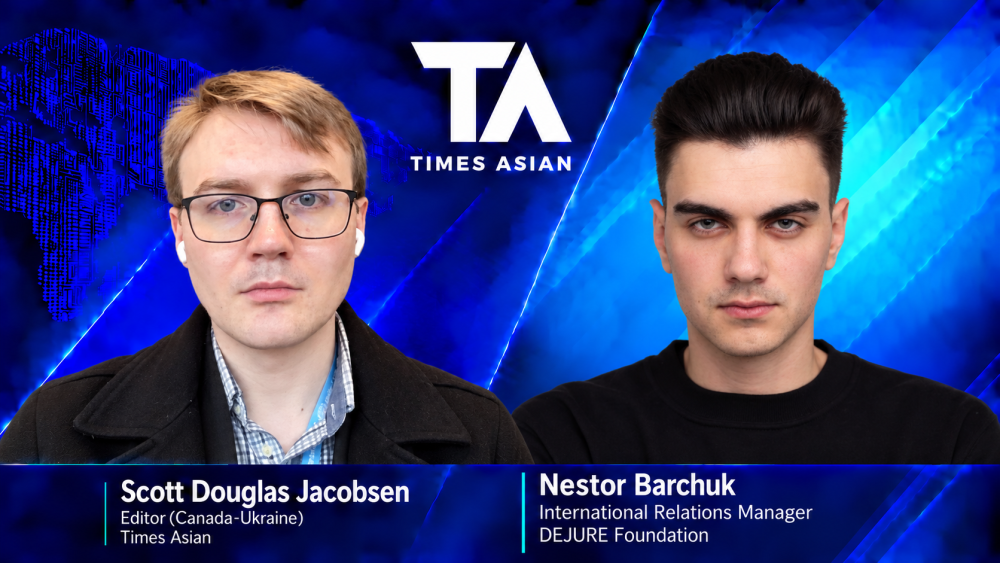
By Scott Douglas Jacobsen
Editor (Canada-Ukraine), Times Asian
Nestor Barchuk is a Ukrainian junior sergeant representing the Strategic Communications Unit within the First Corps of the National Guard of Ukraine. His work focuses on international relations concerning Ukrainian prisoners of war in Russian captivity, including Azovstal defenders and Azov servicemen. He addresses torture, incommunicado detention, family intimidation, prisoner exchanges, and the failure of international humanitarian law enforcement, arguing that documentation must be matched by practical measures to stop ongoing abuse.
Scott Douglas Jacobsen interviews Nestor Barchuk about Russia’s open violations of international humanitarian law, Ukrainian POW torture, and the suffering of Azovstal families. Barchuk describes beatings, starvation, medical neglect, electric shocks, family threats, transfers, and Gulag-like practices. He argues that international institutions document atrocities but fail to stop them, while Russia exploits weak enforcement, propaganda, and indifference toward its own captives to continue systematic abuse against Ukrainian prisoners of war and families.
Scott Douglas Jacobsen: Geopolitically, is the big orientation of the autocratic regime to display strength, whether or not it actually has it?
Nestor Barchuk: Right. In a normal country, prisoners of war are treated under the Geneva Conventions and other relevant international legal standards.
Jacobsen: He was telling me that essentially every line of these conventions has been violated by the Russian Federation. What does this state openly from the Russian side about international law and international humanitarian law? Also, what does it signal about the effectiveness of enforcing international law?
Barchuk: Regarding the first part of the question, why do they do this? They do it openly. The current war is the best-documented war in human history, and we see that Russia does this openly. It does this to show that it can.
As we talked about yesterday, the main problem with international humanitarian law is the lack of enforcement mechanisms. The main logic of international humanitarian law regarding prisoners of war was: I treat your prisoners of war well because I want you to treat my prisoners of war well. That was the system of checks and balances, or the logic that could have restricted violence against prisoners of war.
However, Russia sees that Ukraine treats Russian prisoners of war properly, while Russia can do anything it wants to Ukrainian prisoners of war, and no one can do much about it.
That is the first point. The second point is that Russia is not very interested in its own prisoners of war because a large proportion of Russian soldiers are representatives of small nations and conquered peoples that Russia absorbed through its imperial history.
There is a much higher percentage of them in the Russian army, and in Ukrainian captivity, than their percentage of the Russian population. It is also a way for Russia to reduce the numbers of these smaller nations that it absorbed throughout its history. Of course, Russia is not interested in them, because why would it need them back?
Russia is also not interested in foreigners who fought for Russia. Ukraine has some of them in captivity. Recently, the Coordination Headquarters for the Treatment of Prisoners of War launched a project publishing profiles of foreigners held in Ukrainian captivity.
That is why Russia does not want them back and why Russia treats them badly and openly. However, this is part of a bigger problem because, as I said, there is no enforcement mechanism in international humanitarian law. The ICRC has no access to Ukrainian prisoners of war. Russia simply denies access. It can do that, and there is little that can be done about it.
Jacobsen: A major point from last night was not just the 700 Azov prisoners of war, but the wider network of wives, children, mothers, fathers, and possibly grandparents. There is a much wider net of effect among people who know and love those in captivity, and who go through long periods of uncertainty, very likely not knowing where they are or whether they are alive or dead.
Even if they are dead, can the family get the body back? It is a much more complicated affair in terms of getting some knowledge and, if they are dead, processing that grief without a proper burial. What context did you pick up from last night’s presentation about the effects on the networks these people were, or are, part of?
Barchuk: There is a well-known NGO, the Association of Azovstal Defenders’ Families, which gathers relatives of the Azovstal defenders. You see rallies organized by that NGO every Sunday in Kyiv and other cities in Ukraine, and sometimes abroad.
Even when servicemen come back from captivity, they join those rallies. I think it is very important for civil society to show that prisoners of war are not forgotten. It is also very supportive for the families of those who are still there, showing that their relatives are not forgotten.
As you said, relatives are also targeted by Russians. I know of cases where Russian officials, guards, or others tried to contact relatives and recruit them to do something.
They often say that relatives have to pay a certain amount of money for the torture to stop, so that they will not torture their loved ones. There are other methods as well. This is another part of the torture mechanism directed at relatives who are here, or civilians who are not in captivity.
Prisoners of war, the servicemen in captivity, are also pressured by guards, who tell them,
Barchuk: They tell them, “We know where your family is, and we know that your daughter is in that particular school.” So this is another part of it.
Jacobsen: Like the threats about not attacking Russia with deep strikes, are these threats similarly empty?
Barchuk: No. I do not know of particular cases, but I think it is more part of the psychological pressure.
Jacobsen: When you are inside captivity, you do not know anything about the outside world.
Barchuk: An information bubble.
Jacobsen: What do prisoners of war report as the hardest part of captivity?
Barchuk: It differs from place to place. We can also see a trend: when Ukraine is fighting back and having successes on the battlefield, prisoners are treated worse than when Russia has successes on the front line.
So it differs. It is very individual for different prisoners of war. However, the most common things are beatings. Russians usually beat prisoners of war every day, and they try to hit the same places they hit the day before, so that the bruises become more and more traumatized. Then a prisoner can lose a limb because of necrosis and similar injuries.
Also, many prisoners of war come back 40 or 50 kilograms lighter than they were before, so starvation is one of the most common conditions.
Many prisoners of war are forced either to sit for the whole day, without being allowed to stand up, or to stand in front of a camera without being allowed to sit down for 16 hours. For the remaining eight hours, they are allowed to sleep.
We talked about medical care yesterday, and that is also a serious issue because there are still heavily wounded and seriously ill prisoners among our 700. More than 100 of them are very badly wounded and have received no medical care for nearly four years. As one of the panel representatives said, tuberculosis, being unable to move, and severe diseases are among the most common conditions in Russian captivity.
Russians also transfer prisoners of war frequently from camp to camp, or from place to place, so that their traces are lost and relatives or Ukraine cannot track them.
There is also a very well-known practice called “admission.” This happens when a prisoner of war is transferred to another colony or pretrial detention centre. During these transfers, prisoners are often subjected to severe abuse.
One of the most common tools used is the so-called tapik. A tapik is a Soviet field telephone used to apply electricity to limbs, genitals, or other parts of the body.
Jacobsen: I have heard of cases of individuals having their testicles electrocuted, in more direct terms, after which they could no longer reproduce. So this is involuntary sterilization.
Barchuk: Also, during the presentation yesterday, Oleg Gushchin from the Coordination Headquarters said that the current system in Russia is very reminiscent of the Gulag prison system. You have probably heard about the Gulag.
Jacobsen: The Gulag Archipelago, yes.
Barchuk: Many people in the West have heard about it because a lot of time has passed since then. However, these practices are current and not so well known, even though they are similar to those used in the Gulag system. These practices go back to the Soviet Union.
Jacobsen: In the Center for Civil Liberties report, they had one doctor, aged 34, whose nickname was “Dr. Evil.” These were very serious pain inductions. What else should we discuss?
Barchuk: We just presented a book about Olenivka during the Book Arsenal. Olenivka is a colony in Donetsk region where Azov prisoners of war were placed or transferred after the defence of Azovstal. Then, one of the barracks in Olenivka was blown up by Russian forces. Fifty-three people were killed instantly, and more than 130 were wounded.
We presented the book about that, and there is a very interesting thought in the book: the current war is the most documented war in human history.
Jacobsen: Also, probably more lies have been told about this war than any other war.
Barchuk: Because information media work both ways.
Jacobsen: Yes.
Barchuk: I read a book by Peter Pomerantsev recently. He had another interesting thought: when the internet was invented, everyone thought we would now know the truth.
Jacobsen: We did for a bit. Then social media and algorithms destroyed that.
Barchuk: Yes. Now there are so many different pieces, points of view, and forms of propaganda using the internet.
Jacobsen: Cultish spiritualists, and so on. They are all taking advantage of it, from Alexander Dugin to Tucker Carlson to Candace Owens.
Barchuk: Today, the truth is buried beneath so many layers of misinformation and disinformation that it has become increasingly difficult to find.
Jacobsen: I would say that is too extreme. Truth is muddled. It can be found, but with more effort than in the 2000s.
Barchuk: Yes. However, there is a common saying that truth is somewhere in the middle, which is very dangerous.
Jacobsen: The question is: between what two poles?
Barchuk: Yes. If one person says killing the innocent is bad, and another says it is good, the truth is not in the middle.
Jacobsen: Kremlin propaganda. I want to make a distinction between culture and state policy. Kremlin propaganda would not simply say murder is good. It would ask, “Who says they are innocent?” They are actually quite good at propaganda. This has been acknowledged by Ukrainians.
I have had pro-Russia people come at me sometimes. It is like a firehose of nonsense. When you make a valid point, they bypass it and go to the next point. When they finally get one point, it is treated as a goal. They say, “See, you do not even want to admit the truth.” You are only a foot away from the issue, metaphorically speaking.
It was funny, actually. In some reports, it was difficult to verify unlawfully transferred children. This individual kept referring to them as stolen children and said, “I just think they are stolen, and they cannot even verify it.” Other reports said verification is difficult because the Russian Federation is not cooperating in any way with international bodies, including the Independent International Commission of Inquiry on Ukraine.
I think I closed off that conversation by saying, “Why do you not ask sensible questions to the ICC, if you are really keen?” They said, “I am not interested in them, and they are not interested in me.”
In other words, an intelligent person did not want to put their ideas into a forum where they could be properly challenged. They wanted to convince me. They did not want to engage with relevant subject-matter experts. It was a very different way of going about it. So, yes, it is very clever.
Barchuk: Yes. One last thing: I was thinking about the book on Olenivka. The current war is so well documented. The reason for that, from my point of view, and I totally agree with the authors, is that the international community and the international humanitarian law system established after the Second World War cannot save people or do what it was designed to do.
Jacobsen: International institutions were not prepared for the betrayal of states.
Barchuk: Yes. There is a question with no answer that I hear very often: How many more reports about torture should we see or read before the situation changes?
The international community and international organizations established to protect those people cannot protect them now. They are trying to do at least something by producing dozens of reports about torture. However, they are concentrating on that because they cannot do anything to stop it. I think this is some kind of escapism.
They are trying to document it and gather evidence for Ukraine, perhaps in the very distant future, to obtain reparations or achieve some form of justice.
Jacobsen: The reason I can even do interviews like this is because people are dying on the front line. I am very well aware of that.
Barchuk: Instead of producing dozens of reports about torture, which is already very well known, we have to think about ways to actually stop that torture. Today is the Ukraine Recovery Conference in Rome, which is very important. Important things are being discussed there. However, the name of the conference already frames the topics and everything discussed there as recovery.
People are talking about recovery there. However, before recovery, we have to stop the war somehow, so we need to focus on that before thinking about recovery. Of course, recovery is important. However, it would be better to provide more arms to Ukraine.
Jacobsen: Even the idea of discussing victory was controversial. Before, it was simply, “How can we get supply lines?” There was a common complaint when I was here before: Why are we not framing anything around helping Ukraine actually win?
Barchuk: True, that is probably it.
Jacobsen: Thank you very much for the opportunity and your time, Nestor.
Scott Douglas Jacobsen is a Canadian journalist and publisher who serves as Times Asian’s Editor for Canada and Ukraine Affairs and writes on international affairs.


