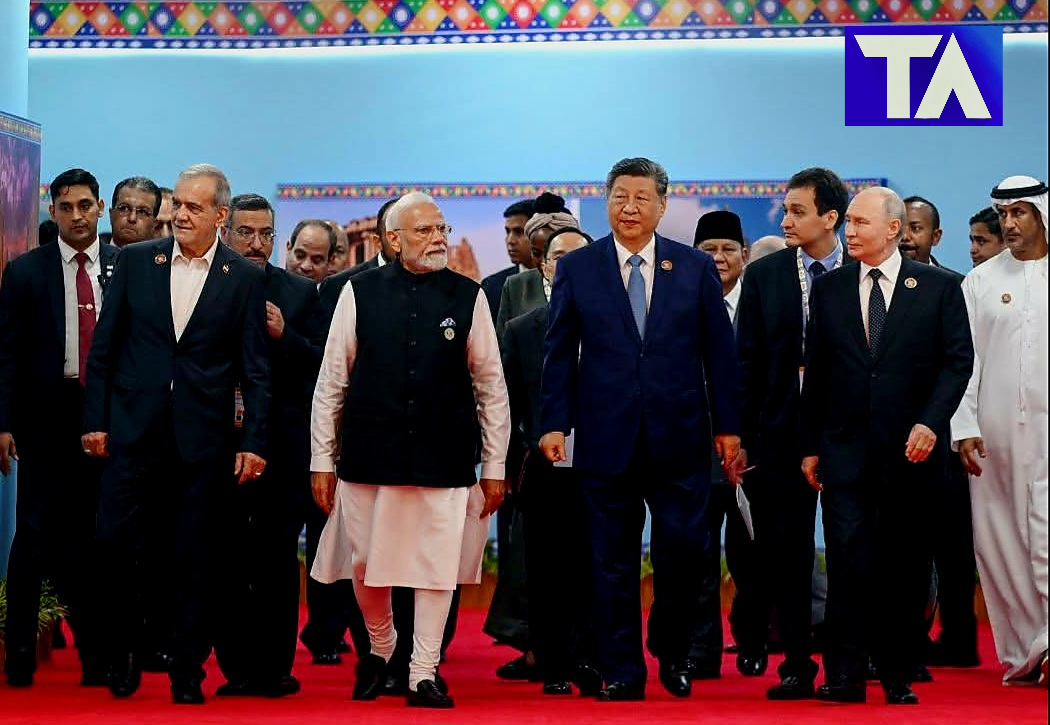
NEW DELHI, September 13, 2026 — By Raju Lama
The 18th BRICS Summit in New Delhi has placed the Global South at the centre of an increasingly fragmented international order, with leaders seeking greater representation in global institutions, deeper economic cooperation and a stronger collective response to geopolitical and economic instability.
Hosted by India on September 12–13 under the theme “Building for Resilience, Innovation, Cooperation and Sustainability,” the summit comes at a pivotal moment for BRICS. The grouping has expanded considerably beyond its original five members and now includes 11 countries, representing a substantial share of the world’s population and economic potential.
A call for reform of global governance
One of the strongest messages emerging from New Delhi is the demand for reform of international institutions, particularly the United Nations system.
India used its BRICS presidency to argue that developing countries must have a greater role in international decision-making. The New Delhi Declaration reaffirmed the group’s commitment to a more representative, equitable and accountable multilateral system.
For the Global South, this is more than a diplomatic slogan. Countries across Asia, Africa, Latin America and the Middle East increasingly argue that the institutions created in the aftermath of the Second World War do not adequately reflect today’s distribution of population, economic power and political influence.
India-China engagement becomes a major story
Perhaps the most consequential bilateral development surrounding the summit was the meeting between Indian Prime Minister Narendra Modi and Chinese President Xi Jinping. Xi’s visit to India was his first in seven years, and the two leaders discussed improving economic and transport links, resolving trade-related concerns and maintaining peace along the disputed Himalayan border. Bilateral trade reached a record $155.6 billion in 2025, although India’s trade deficit with China remains extremely large.
Times Asian Analysis: The significance of the Modi-Xi engagement goes beyond bilateral relations. If India and China can manage their strategic competition while expanding economic cooperation, BRICS could become a more effective platform for the Global South. If tensions again dominate their relationship, however, internal divisions could constrain BRICS’ ability to act collectively.
BRICS and the changing financial order
The summit also advanced discussions on reducing the costs and risks associated with dependence on existing international financial systems.
The New Delhi Declaration welcomed work by the BRICS Payment Task Force on cross-border payment mechanisms and encouraged further discussion of trade settlements and investment using national currencies. However, the summit did not establish a common BRICS currency.
This is an important distinction. Rather than attempting an immediate replacement for the U.S. dollar, BRICS appears to be pursuing a gradual approach: strengthening local-currency transactions, improving payment interoperability and expanding alternative financial mechanisms.
Times Asian Analysis: The practical question is whether these initiatives can move from political declarations to functioning systems that businesses actually use. Differences in financial regulations, exchange-rate risks, capital controls and the very different economic structures of BRICS members remain significant obstacles.
West Asia tests BRICS unity
The continuing conflict in West Asia has presented perhaps the most difficult diplomatic test for the expanded BRICS.
The New Delhi summit produced a collective call for restraint, protection of civilians and respect for sovereignty, while members expressed concern over the broader regional conflict. Iran and the UAE—despite their sharply different positions in the regional crisis—also participated in the diplomatic process.
The ability of BRICS to keep countries with competing strategic interests around the same table is itself significant.
But unity should not be confused with complete agreement. BRICS contains countries with different relationships with the United States, Europe, China, Russia and regional powers.
AI, technology and the Global South
Technology and artificial intelligence have also emerged as important areas of cooperation.
The New Delhi Declaration supports broader access to AI and emphasizes trustworthy, inclusive and energy-efficient technologies suited to the needs of developing countries. India promoted initiatives involving digital public infrastructure, health training and industrial competencies.
For developing countries, the AI debate is increasingly about more than technological innovation. It concerns access to computing power, data, digital infrastructure, education, jobs and the ability of developing nations to participate in setting global technology standards.
BRICS is not simply an anti-Western bloc
An important message from New Delhi is that BRICS should not automatically be interpreted as an anti-Western alliance.
Prime Minister Narendra Modi has emphasized that BRICS is not directed against any country, while India continues to maintain important economic, diplomatic and strategic relationships with the United States, Europe, Russia and other major powers.
Times Asian Analysis: This may ultimately be India’s most important contribution to the BRICS debate. India appears to be attempting to position BRICS not as a military or ideological alliance, but as a platform through which emerging economies can obtain greater bargaining power while retaining strategic autonomy.
The bigger question: Can BRICS deliver?
The New Delhi summit demonstrates that BRICS has become considerably more influential since its original formation. But expansion has also created a more complicated organization.
The group contains different political systems, competing regional interests and divergent foreign-policy priorities. Its members do not necessarily agree on wars, trade policy, relations with Washington or the future of the international financial system.
Therefore, the future credibility of BRICS will depend less on the number of countries joining and more on whether it can produce practical results.
These could include:
• more efficient cross-border payment systems;
• increased trade and investment among developing economies;
• greater local-currency settlement;
• stronger infrastructure financing;
• cooperation on AI and emerging technologies;
• coordinated positions on global development;
• and meaningful reform of international institutions.
A new phase for the Global South
The New Delhi summit nevertheless represents an important moment in the evolution of BRICS.
The organization is no longer simply a grouping of five emerging economies. Its expansion reflects a wider desire among developing countries to have greater influence over the rules governing global finance, trade, technology and diplomacy.
The challenge now is to convert that political momentum into institutions and policies capable of delivering tangible benefits.
For the Global South, the central question is no longer whether the international order is changing.
It is whether developing countries will have a meaningful role in determining what comes next.
Times Asian Analysis: New Delhi suggests that BRICS wants to be one of the principal platforms through which that new global balance is negotiated. Its success, however, will ultimately be measured not by declarations, but by implementation.
#Writer is International President of the SAARC Journalist Forum


