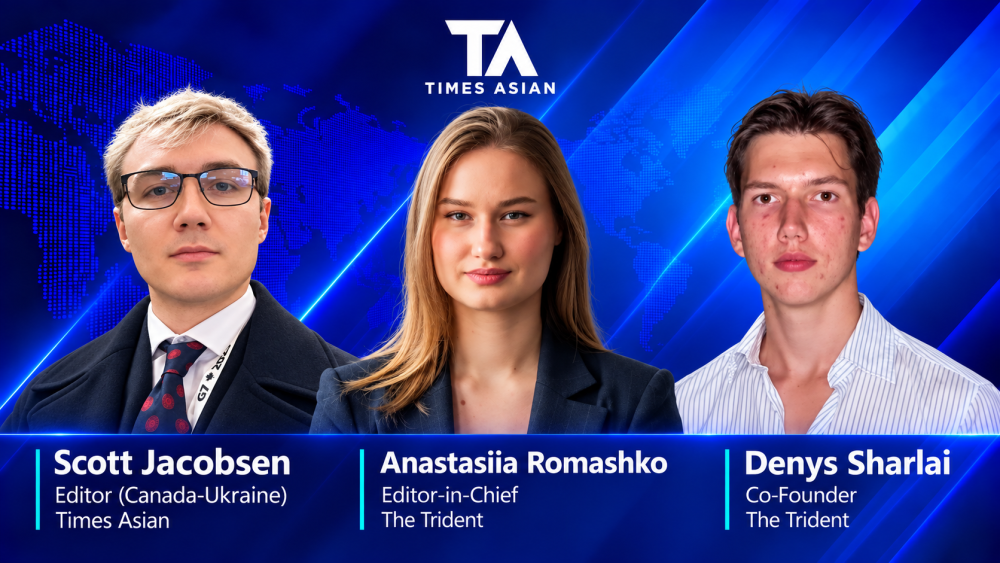
By Scott Douglas Jacobsen
Editor (Canada-Ukraine)
Times Asian
Anastasiia Romashko is a Ukrainian journalist and media professional based in Canada. Her experience spans radio, social media, reporting, and television production in Ukraine and Canada. She has worked with Kontakt Ukrainian Television Network and now co-founded The Trident, where she serves as Editor-in-Chief and develops bilingual, community-focused journalism today.
Denys Sharlai is a Ukrainian journalist and television host based in Toronto. He previously worked in online journalism for ICTV in Ukraine and later joined Kontakt Ukrainian Television Network in Canada. As co-founder of The Trident, he focuses on diaspora reporting, community connections, Ukrainian affairs, and accessible audiovisual journalism today.
In this interview, Scott Douglas Jacobsen speaks with Anastasiia Romashko and Denys Sharlai about founding The Trident, a Ukrainian-Canadian media project. They discuss bilingual journalism, diaspora coverage, Ukraine-focused reporting, short-form video, audience engagement, Canadian media integration, professional experience, Ukrainian businesses, and strengthening connections between Ukraine and its Canadian diaspora communities.
Scott Douglas Jacobsen: All right. Today we are here with the co-founders of The Trident, Anastasiia Romashko and Denys Charlai. Thank you very much for joining me.
Anastasiia Romashko and Denys Sharlai: Thank you, Scott, for inviting us.
Jacobsen: I want to ask you: why go independent in terms of media production, specifically in the audiovisual sphere?
Romashko: The reason why we decided to create The Trident is we wanted to found a new Ukrainian-Canadian media project focused on connecting Ukrainian-Canadian audiences through relevant, timely, and engaging journalism. Our main mission is to cover the life of the Ukrainian community in Canada, developments in Ukraine, international affairs, and issues that connect Canada and Ukraine.
We aim to help audiences better understand not only what is happening, but also why it matters to Ukrainians in Canada. Rather than replacing existing media, we aim to complement the media landscape by bringing our own approach, topics, and formats. The Trident enters this landscape with a fresh perspective, exploring new ways to tell stories and engage with the Ukrainian community.
Toronto has a long-established Ukrainian media community, with outlets that have built their own traditions, audiences, and editorial identities over the years. We want to create something special and modern that will also appeal to the new wave of Ukrainians who have come to Canada in recent years.
Jacobsen: How many Ukrainians are coming to Canada now?
Sharlai: There are about 1.26 million people in Canada who reported Ukrainian ethnic or cultural origins in the 2021 Census. Since Russia’s full-scale invasion, roughly 300,000 people have arrived in Canada through the Canada-Ukraine Authorization for Emergency Travel measures.
Jacobsen: How will this be special and culturally appropriate within the Ukrainian-Canadian media space?
Romashko: We cover community events and initiatives that reflect the experience of Ukrainians living in Canada. That is the foundation.
We also focus on major developments in Ukraine, including political, social, and cultural issues, which I would say are somewhat lacking in Ukrainian media in Canada right now because there is more concentration on cultural events happening here in Canada. However, the broader international context of what is happening in Ukraine, in greater detail, is not really highlighted. That is our point: to connect with people in Ukraine, bring their perspectives, and show them to Canadian audiences as well, because we also produce bilingual content.
Our content is either in Ukrainian or English. We are trying to cover topics that are particularly important, such as international affairs, political changes, and the war and other developments happening in Ukraine. This allows Canadian audiences to understand and see what life in Ukraine is like right now, which is important to showcase, including how daily life continues and how political changes are taking place.
International news helps our audience understand the broader context of events affecting Ukraine and the Ukrainian diaspora. It also helps people in Canada better understand the Ukrainian diaspora, especially people who have arrived recently because of the full-scale invasion.
Jacobsen: What did your prior media experience teach you for this current project?
Romashko: From my perspective, we are trying to create a modern and up-to-date visual experience for every person who finds our page or sees our content on social media. People are very responsive to the visual presentation of media today, and we are trying to make it distinctive and engaging.
That helps us communicate what we want to tell Canadian audiences and Ukrainians living here. From the statistics we have seen, shorter videos with less dense information tend to perform better than videos with a lot of text on screen or longer formats.
For example, we produced material from Vyshyvanka Day. That video received more than half a million views in roughly a week, perhaps even less. The editing was very simple. It mainly showed how the event went, with people wearing vyshyvankas, some simple music, and text at the bottom.
That video performed very well. Other videos still receive views, but compared with half a million, the numbers are lower. They usually receive around 5,000 to 15,000 views, sometimes 20,000 or 30,000, depending on the occasion or the topic we highlight.
It is harder for people to consume videos that contain more information or require more time to watch from beginning to end. That is why we try to make the most important topics short but still concise. People do not have to spend a lot of time watching something, but they still receive the same amount and quality of information.
Recently, for example, we produced videos from a festival where we conducted interviews and highlighted Ukrainian businesses launching in Canada. We made short videos with them, usually around a minute and a half long. I would say that this is a format people accept and enjoy watching.
Jacobsen: Denys, what did your prior Ukrainian media experience set you up for when working in the English-language space in Canada?
Sharlai: It is complicated for me to explain what I feel about doing journalism in English because my English level is not yet where I want it to be. However, I have substantial journalistic experience in Ukraine. I worked as a journalist for ICTV, one of Ukraine’s major television channels, and that experience now helps me do journalism in Canada.
I am also a TV host with Kontakt Ukrainian Television Network. At the same time as a Partnership and Media Host within our project I continue to build connections with the Ukrainian Canadian Congress, people in government, and leading members of the Ukrainian community. All of that gives us the experience we can apply to our project because those connections, that knowledge, and meeting different people help us to find, produce and cover important topics.
Anastasiia mentioned earlier that we are also trying to help Ukrainian businesses in Canada become better known. That also helps us gain more views because the Ukrainian population and diaspora in Canada already know some of these businesses, such as Nova Post. That helps us reach more people and become better known. It is a good collaboration for Ukrainian businesses and for us as we build our presence in Canada.
All of that background, including both my and Anastasiia’s experience in journalism in Ukraine and Toronto, helps us. Anastasiia was also part of the Kontakt team. She did a lot of work on Instagram and knows how to edit videos and produce strong content.
I really appreciate that Anastasiia is part of The Trident team. It is very good for us as we are trying to do something new and show our audience something more modern.
Jacobsen: Anastasiia, as the Editor-in-Chief, what is the level of responsibility in terms of the tasks you are taking on here? What is your vision for moving this project forward?
Romashko: In general, we divide our work across three or four main areas: communication and partnerships, filming and hosting, content production, and editing and distribution.
Denys takes care of most of the filming and hosting, although I also take on those roles depending on the topic we are covering.
As Editor-in-Chief, my main responsibility is to oversee the project’s brand identity, the visual appearance of our social media platforms, and the consistency of how we present information across our content. I am also primarily responsible for editing our videos, as well as coordinating and editing content for our other platforms.
When it comes to the vision, our main goal is to create distinctive, engaging journalistic content that brings together different formats from lighter, entertainment-oriented stories to more in-depth political coverage, current affairs, and stories about the Ukrainian community.
We want The Trident to become a recognizable and trusted media platform that connects Ukrainians in Canada and Canadians with Ukraine and the wider world. It is important that we not only inform people but also create a space for meaningful conversations, different perspectives, and stories that genuinely matter to our audience.
Ultimately, we want to build a strong identity and establish lasting recognition and trust among both the community and the institutions we work with, while continuing to grow our reach and the impact of our journalism.
Jacobsen: Thank you very much for your time today. Have a lovely day. Be safe.
Scott Douglas Jacobsen is a Canadian journalist and publisher who serves as Times Asian’s Editor for Canada and Ukraine Affairs and writes on international affairs.


