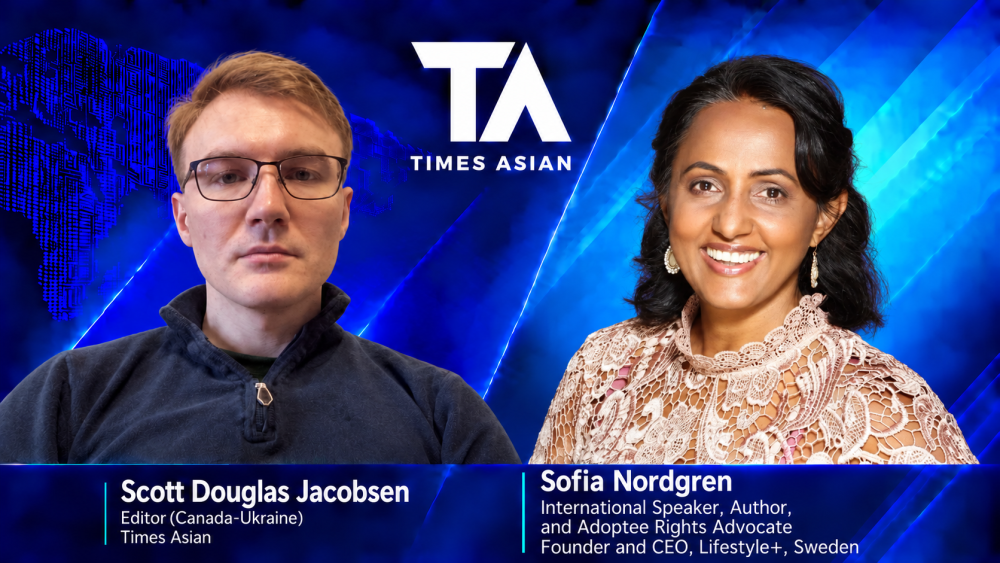
By Scott Douglas Jacobsen
Editor (Canada-Ukraine), Times Asian
Sofia Nordgren is a Swedish public speaker, survivor advocate, nurse, coach, and performer whose work addresses adoption, identity, trauma, and justice. Born in Bangladesh and adopted into Sweden, she has spent decades searching for her biological roots, confronting missing records, institutional silence, and emotional displacement. Through public speaking, advocacy, and testimony, Nordgren gives voice to adoptees affected by irregular or illegal adoptions and supports broader efforts for truth, documentation, family reconnection, healing, and accountability worldwide.
Scott Douglas Jacobsen interviews Sofia Nordgren about illegal and irregular international adoptions, missing records, and the difficulty of accountability across jurisdictions. Nordgren explains why global estimates remain uncertain, describes Sweden’s incomplete response, and calls for coordinated research, resource centres, DNA support, psychological care, and family-search funding. She reflects on public speaking, reunion with her biological mother, and the painful realization that finding family begins, rather than ends, healing after decades of separation and uncertainty worldwide.
Scott Douglas Jacobsen: The Congress was primarily focused on Belgrade and Serbia, although the implications clearly extend beyond one country. Your own story emerged from Bangladesh, which illustrates how widespread these concerns may be. Human trafficking is a significant global problem, and cases involving missing children and questionable adoptions represent one aspect of that larger issue. How large is this problem? Do we have any reliable assessment of its scale? And do we have legal frameworks that allow people to pursue justice when these cases cross international jurisdictions?
Sofia Nordgren: I have asked researchers and adoption experts in Sweden many of these same questions. The reality is that there are no definitive public figures regarding the number of illegal adoptions worldwide. There are estimates regarding the total number of international adoptees, but the number of potentially illegal or irregular adoptions is much harder to determine.
One reason is that many older adoption cases were poorly documented. Records are incomplete, missing, or inaccessible. In some cases, archives were not maintained properly. As a result, many of the numbers remain uncertain.
That uncertainty is part of the problem. We do not have a clear accounting of how many adoptions involved falsified records, coercion, trafficking, or other irregularities. Because of that, there is no simple answer. In my view, the lack of reliable records is itself a symptom of a broken system.
Jacobsen: Are there any legal mechanisms that can help establish accountability or provide justice internationally? Some countries have stronger institutions and better human rights records than others. Do international frameworks exist that can investigate these cases and help people find answers?
Nordgren: That remains one of the major challenges. Many cases involve multiple countries, multiple legal systems, and events that occurred decades ago. Even when people discover evidence suggesting wrongdoing, pursuing accountability can be extremely difficult because the relevant institutions may no longer exist, records may be missing, and statutes of limitation may apply.
As a result, many adoptees and families spend years searching for answers with very limited legal pathways available to them. That is one reason why advocacy, research, public awareness, and international cooperation remain so important.
Jacobsen: Some countries may have stronger legal frameworks and institutions capable of investigating these cases, while others may not consider them a priority at all. As a result, many cases may simply disappear into the historical record. There will inevitably be differences both in the accuracy of estimates regarding the scale of the problem and in the ability of legal systems to respond.
Nordgren: Exactly. It is a difficult question, and I want to be careful in how I answer it. I am speaking as an adoptee, not as a legal expert or government official.
That said, some countries have begun responding to concerns about illegal or irregular adoptions. A few governments have issued formal apologies, established resource centers, funded investigations, or provided support services.
Countries such as Australia, the Netherlands, France, and Switzerland have taken steps in this direction. If you would like specific examples, I can send them to you later. Different countries have implemented different measures, but some have made at least limited efforts to address historical adoption injustices.
In Sweden, for example, a major investigation was completed in 2025. However, despite the completion of the investigation, there is still no clearly defined action plan or long-term structure in place.
As part of that process, the government invited responses from a wide range of stakeholders. Adoption organizations, public agencies, researchers, adoptees, and other groups were given opportunities to submit comments and recommendations. I also submitted a response.
Although substantial input was gathered from many sectors, there is still no concrete roadmap outlining what actions will be taken, when they will occur, or how they will be implemented.
I am also involved with a coalition of adoption organizations in Sweden. Together, we drafted a document that was submitted to the Ministry of Social Affairs, the Prime Minister’s Office, and representatives of multiple political parties.
Our goal was to encourage concrete action. We advocated for measures such as a resource center, psychological support, funding for family searches, assistance with travel to countries of origin, access to DNA testing, and other practical forms of support for adoptees and biological families.
Many countries still lack structured legal or restorative frameworks to address these issues. There is often no coordinated effort to determine how many illegal adoptions occurred, how they happened, or what forms of accountability and support are appropriate.
What I would like to see is a more international approach. Because these adoptions occurred across many countries and decades, the issue cannot be fully understood within national boundaries alone.
If we could collect information globally and compare patterns across countries, we might gain a clearer understanding of how these systems operated. South Korea, for example, has large numbers of international adoptees and has developed more resources and support structures in response. Other countries have taken similar steps.
What is missing is a global effort to identify patterns, assess levels of corruption or misconduct, and develop coordinated approaches to justice and support. That remains a major gap.
My hope is that future initiatives will provide meaningful assistance not only to adoptees, but also to biological mothers, families searching for missing children, and others whose lives have been affected by these practices.
Jacobsen: When you speak publicly about these issues, what are the key messages you want audiences to remember?
There is a common joke in public speaking: first you tell people what you are going to say, then you say it, and then you tell them what you said. By the end, the message feels familiar because it has been repeated often enough to be remembered.
The takeaway message is usually the point that has been emphasized the most because it matters the most. What would you say is your central message?
Nordgren: I have several messages that I try to communicate. I am not sure whether all of them will remain in the final version, but they are important to me. I do not know whether you noticed this during the conference, but the schedule was very compressed. It was running late, and there were many speakers. The organizers asked me to shorten my presentation. Instead of the fifteen minutes I had prepared for, I was asked to speak for approximately ten minutes.
That affected me more than I expected. Partly, it was a practical issue, but it also touched on deeper feelings connected to my own experiences of abandonment and rejection. When I prepare a presentation for a specific length of time, I become attached to the structure. Suddenly having to decide what to remove and what to keep can be difficult.
There were also technical changes. I had expected to use a microphone that would leave my hands free, but instead I had to hold a handheld microphone. At the same time, I was carrying my notes, which meant I could not easily refer to them during the presentation.
As a result, I felt stressed. That is a side note, but it is the truth. I had prepared one version of the speech and then had to create a second version on the spot. Much of it became improvisation.
In addition, I had originally been scheduled to speak earlier in the program, but changes were made and I ended up speaking much later, near the end of the event. Of course, these things happen. Programs change and organizers have many considerations to manage.
My original plan was to begin with my personal story. As a speaker, I know that personal stories help audiences connect emotionally. That is why I intentionally used very few PowerPoint slides. I wanted people to connect with me as a person and follow my journey from childhood through adulthood.
I wanted the audience to understand what happened during my early years and what motivated me to begin searching for my biological parents. I wanted them to understand why the search became so important to me.
Another key message was how alone I felt during much of that journey. I wanted to illustrate the courage required to continue searching despite numerous obstacles. There are many barriers involved in searching for biological parents, especially when corruption and missing documentation become part of the story. In some ways, not knowing that corruption exists can become an additional obstacle because you do not understand why things are not making sense.
That was one of the central messages I hoped to communicate. I wanted the audience to travel through the story with me emotionally as well as intellectually.
I also wanted to discuss the Swedish Adoption Centre, the lack of support I experienced, and broader systemic issues surrounding adoption practices. My goal was to place my personal experience within a larger global context.
Even though I did not have enough time to discuss every aspect of those broader issues, that was acceptable. The Congress may simply have required a stronger focus on my personal story.
Ultimately, I wanted to share both the challenges I faced and the ways I worked through them. I wanted to communicate the determination, pain, longing, trauma, and desire for justice that motivated my search and inspired me to tell my story publicly.
As someone who has worked for more than three decades in health, coaching, leadership, and personal development, I also understand that healing is rarely a single event. Healing is usually a process. Finding my biological mother was deeply meaningful, but it did not erase the effects of separation, loss, identity questions, or the emotional impact of adoption. It simply opened a new chapter that required understanding, patience, continued healing, and the gradual building of a relationship after decades of separation.
I also wanted to inspire other people by showing them what that struggle looked like and by sharing the most significant moment of my journey: meeting my biological mother and confirming our relationship through DNA testing.
However, I also wanted to communicate another important lesson. Finding my biological mother was not the finish line.
For many years, I believed that finding her would solve everything. I thought it would resolve the trauma, answer all my questions, and provide closure. Instead, I learned that reunion is not the end of the story.
Today, I understand that reunion and healing are not the same thing. Reunion may provide answers and connection, but healing often continues long afterwards.
We still speak different languages. She lives in poverty. She does not own a mobile phone. Communication remains difficult. In many ways, despite being biologically related, we are still strangers getting to know one another.
I believe that message came through as well. Reunification is important, but it is not a magical solution. It does not instantly heal decades of loss, separation, confusion, and unanswered questions.
I suppose I once imagined that finding my biological mother would be the secret ingredient that would make everything whole again, the final chapter that would resolve the story. Instead, I learned that it is only one chapter in a much longer process of understanding, healing, and connection.
Jacobsen: Like the idea that there is a secret formula or a final answer that will suddenly make everything complete.
Nordgren: I think my story revealed that reality as well. Even after finding my biological mother, I discovered that we were still strangers trying to build a relationship with one another.
For many years, I believed that finding her would be the complete solution. Now I understand that I remain somewhere in between worlds. I do not feel entirely Swedish, but neither do I feel that I fully belong in Bangladesh with my biological roots. We have been separated for too long.
I was raised within a Christian and European cultural environment, while Bangladesh is predominantly Muslim and culturally very different. Those differences shape how we see the world and how we relate to one another.
Perhaps that was another message I tried to communicate during my presentation: the solution is not always as clear or simple as people imagine.
Jacobsen: What else should we discuss?
Nordgren: One thing that helped me was speaking with a French woman who had also found her biological mother. She told me that when they first met, they felt like strangers to one another. Hearing that was reassuring because it reflected my own experience.
She also told me that she had traveled to Serbia approximately thirty times, often visiting twice a year. I realized that her situation was somewhat different because France and Serbia are geographically much closer, making frequent visits easier.
At the same time, no one had told me that rebuilding a relationship with a biological parent would require such a long process. I was insecure about how to proceed. I believed the key was simply finding each other. I thought that once we met, we would live happily ever after and that the emotional journey would be complete.
Instead, she explained that after years of visits, if I remember correctly, perhaps five or even ten years, they finally began to feel genuinely connected.
That realization was both helpful and disappointing. I understood that we were essentially strangers who needed time to build a relationship. It required effort, patience, and commitment.
People often ask whether I should learn the language. Perhaps I should. However, Bengali uses a different alphabet, my mother is elderly, and I do not know how much time we have. The situation is complex.
I know I will return to Bangladesh, but I do not yet know when. I have not made concrete plans for my next trip.
Jacobsen: Thank you very much for the opportunity and your time, Sofia.
Scott Douglas Jacobsen is a Canadian journalist and publisher who serves as Times Asian’s Editor for Canada and Ukraine Affairs and writes on international affairs.


