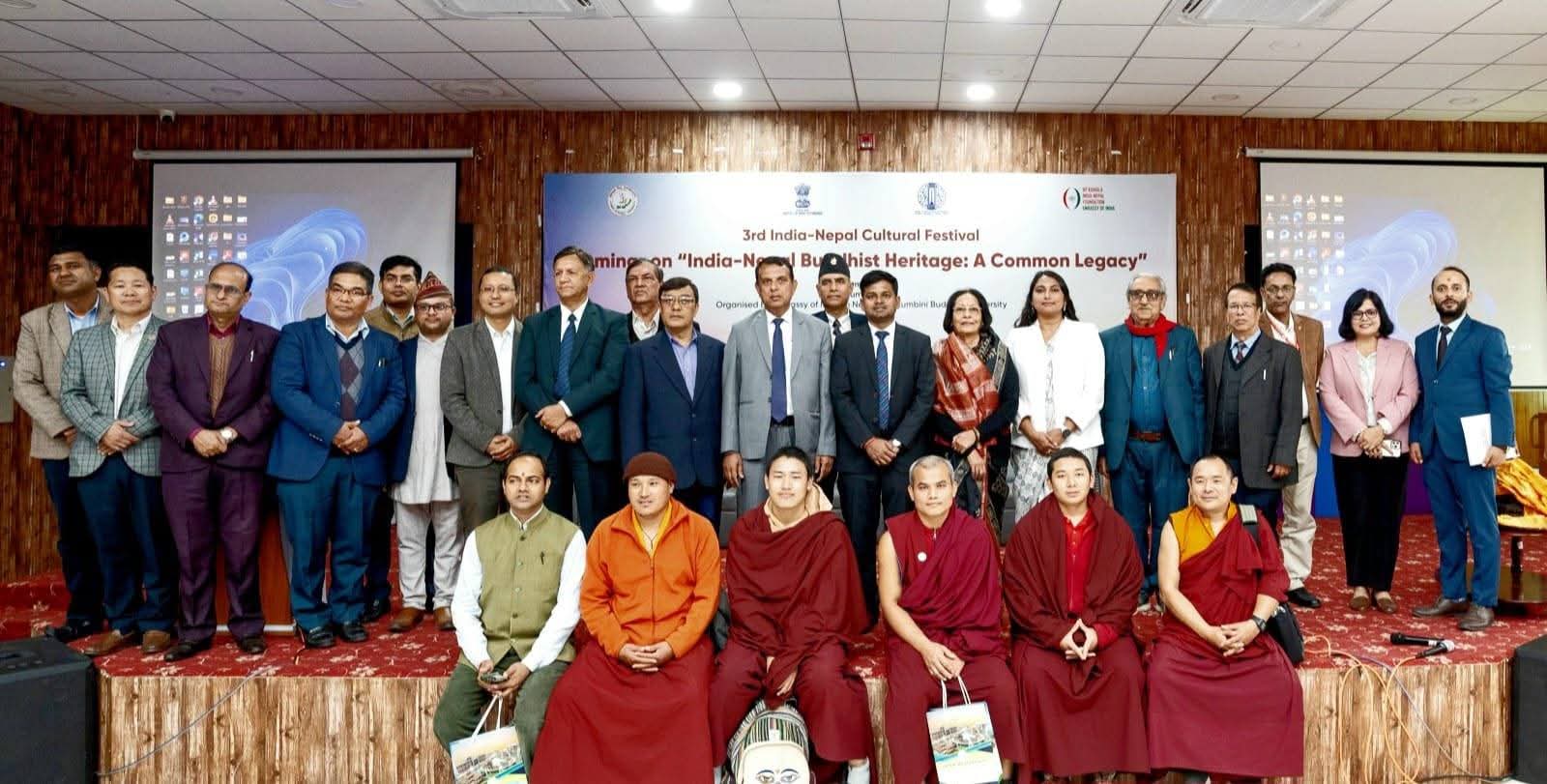
Lumbini. An academic symposium on “India–Nepal Buddhist Heritage: A Common Legacy” was successfully organized at Lumbini Buddhist University, bringing together eminent scholars, monastics, researchers, heritage experts, and students for a day of in-depth discussions on the ancient Buddhist civilizational links that unite India and Nepal.
The symposium highlighted how the Buddhist cultural and spiritual landscape, stretching across the sacred geography associated with the life of the Buddha, continues to bind India and Nepal in a timeless partnership. Speakers reiterated that this shared heritage remains one of the most powerful expressions of friendship between the two nations, rooted in Mettā (Loving-Kindness), Śānti (Peace), Karuṇā (Compassion), and the values of the Dharma (Dhamma).
The event opened with Lamp Lighting and Homage to the Buddha Statue, followed by Buddha Vandana by Vajira Bhante, symbolizing the spiritual unity of both nations.
Dr. Acharya emphasized the enduring spiritual bond between India and Nepal, noting that Lumbini, as the birthplace of the Buddha, remains a universal symbol of peace. He underlined the importance of academic collaboration to safeguard and promote the shared Buddhist legacy.
Mr. Basist Nadan, First Secretary, Embassy of India highlighted Buddhist heritage as a cornerstone of India–Nepal cultural diplomacy. He reiterated India’s commitment to supporting heritage preservation, scholarly dialogue, and people-to-people connectivity as pathways to global peace inspired by the Buddha’s teachings. Prof. Yuvraj Sangraula underlined how Buddhist heritage functions as a strategic pillar for enhancing bilateral ties through the middle path and principle of Sila. He stressed cultural diplomacy as a vital tool to promote trust, cooperation, and shared civilizational values.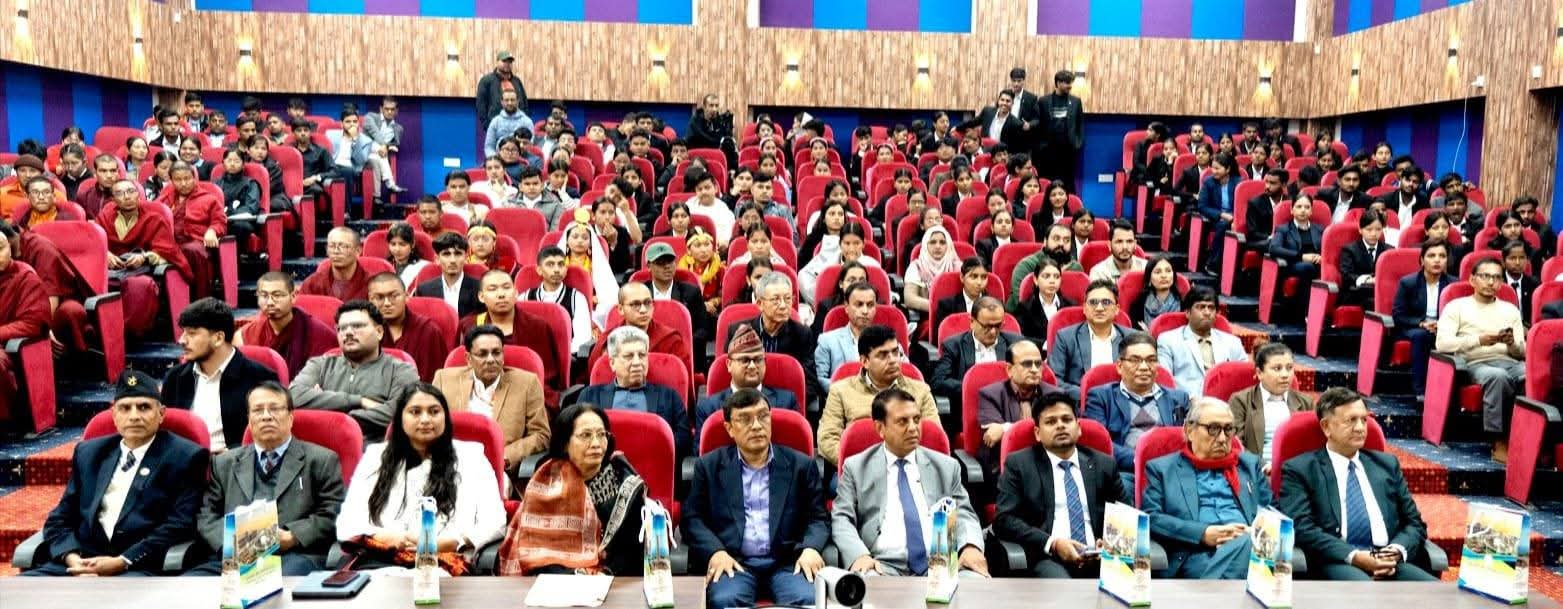 The first academic session was moderated by Dr. Basanta Poudel begins with Prof. Subhra Barua Pavagadhi, India’s presentation emphasized the interconnected sacred landscapes, shared monastic traditions, and textual exchanges that have historically formed a civilizational bridge between the two nations followed by Dr. Nir Bahadur Gurung of LBU who focused his presentation on Chhuksang and Muktinath through the lens of Guru Padmasambhava, presenting Mustang as a vital spiritual corridor linking Indic and trans-Himalayan Buddhist traditions. Next speaker Dr. Dayanidhi Gautam, LBU highlighted how Buddhist principles can guide global diplomacy, conflict transformation, and sustainable peace-building.
The second academic session was moderated by Dr. Shree Prasad Bhattarai and in this session Dr. Elora Trivedy, Nalanda University mapped the historical pilgrimage routes connecting India and Nepal, showing how shared sacred sites foster a living cultural continuum whereas Dr. Nyima Sherpa presented architectural, textual, and ritual continuities that demonstrate India’s foundational influence on Buddhist monastic culture in Nepal and Tibet.
The last speaker Mr. Sanjay Shakya discussed early Nepalese Buddhist artistic expressions and their connections with broader Indian Buddhist aesthetic traditions. Dr. Manik Ratna Shakya, Chair of the concluding session, praised the symposium for strengthening academic cooperation and reaffirming Buddhist heritage as a shared responsibility. Prof. Gitu Giri, Director of Research, LBU, offered the Vote of Thanks, acknowledging the Embassy of India, ICCR, scholars, and participants.
A special highlight of the academic symposium was screening of a documentary film on the upcoming India International Centre for Buddhist Culture and Heritage at Lumbini Monastic Zone, Lumbini, offering participants a glimpse of India’s major cultural initiative in Lumbini. The event drew around 200 participants, including scholars, faculty members, administrators, and students from PhD, graduate, and undergraduate programs.
The symposium was anchored by Mr. Rajendra Ghimire and team, while Prof. Arvind Kumar Singh, ICCR Chair to Dr. B. R. Ambedkar Chair for Buddhist Studies, supervised the entire proceedings on behalf of the Embassy of India, Kathmandu. The symposium reaffirmed that India-Nepal Buddhist heritage is not only a shared civilizational inheritance but also a guiding force for peace, understanding, and cooperation in the 21st century. As both countries continue to strengthen their cultural and spiritual partnership, this shared heritage stands as a radiant pathway for regional harmony and global goodwill.


