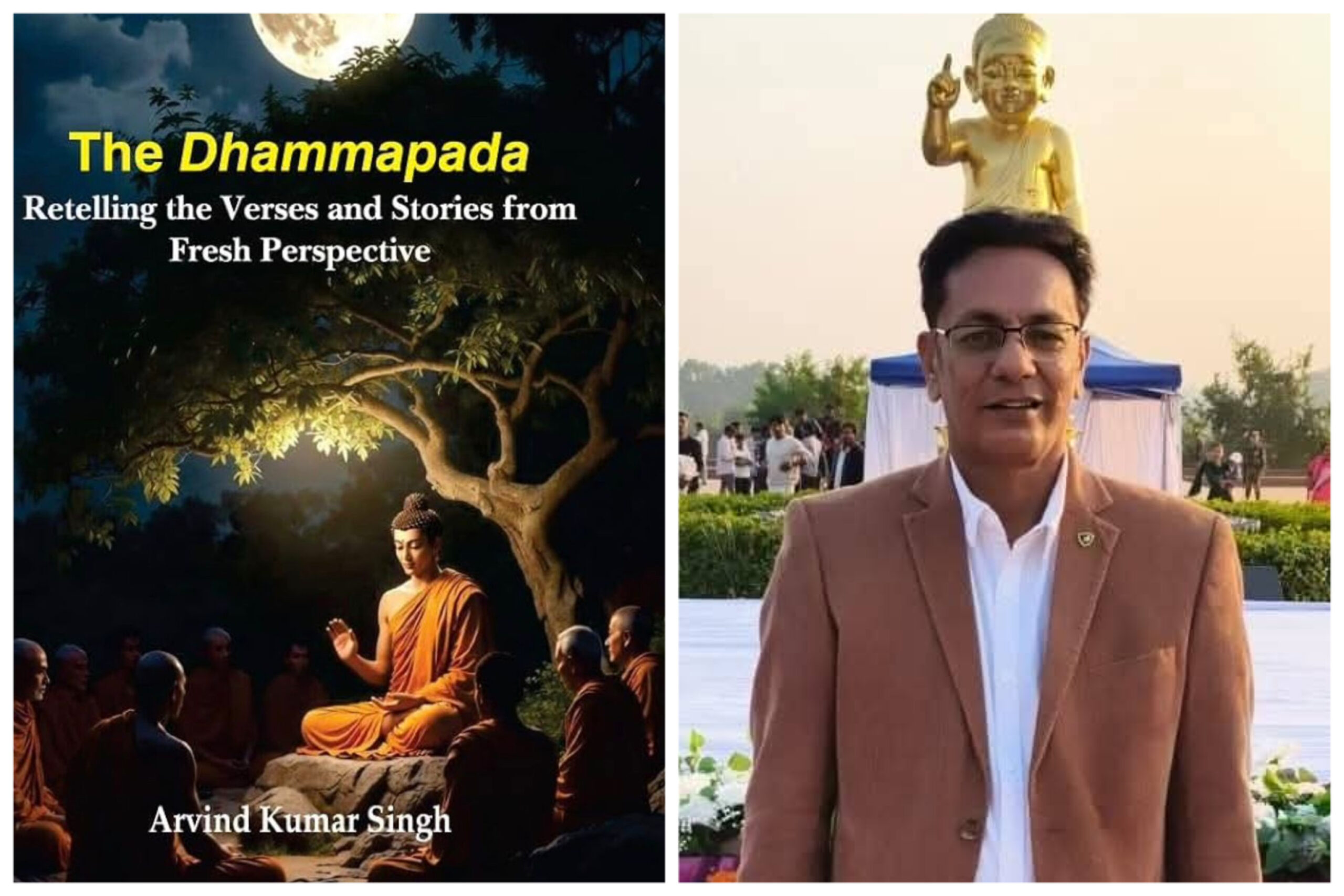
A new book titled The Dhammapada: Retelling the Verses and Stories from a Fresh Perspective presents a poetic and contemplative interpretation of one of the most revered texts in Buddhist literature. Drawing upon the timeless teachings of Gautama Buddha, the book brings the classical Pāli verses into dialogue with the ethical and psychological concerns of contemporary life, making ancient wisdom accessible for modern readers.
The original Dhammapada, a foundational text in the Buddhist canon, comprises 423 verses arranged across 26 thematic chapters. These concise teachings encapsulate the Buddha’s insights into mindfulness, ethical conduct, mental discipline, and the path to liberation. In this new retelling, the structure of the classical text is carefully preserved by retaining the original Pāli chapter titles—such as Yamakavagga, Appamādavagga, and Bhikkhuvagga—while transforming the verses into flowing meditative poetry.
Through this literary approach, the book gives renewed emotional resonance to the teachings while maintaining their philosophical depth. The poetic rendering allows each verse to unfold with clarity and reflective intensity, enabling readers to engage more personally with the profound insights of the Dhammapada. By combining fidelity to the traditional framework with a contemporary narrative voice, the work successfully bridges classical Buddhist philosophy with present-day realities.
Spanning 272 pages in its first hardcover edition, The Dhammapada: Retelling the Verses and Stories from a Fresh Perspective highlights the enduring relevance of the Buddha’s message in a world often marked by stress, social conflict, and moral uncertainty. The book explores how the principles of the Dhammapada can guide individuals toward greater clarity, compassion, and ethical awareness. It underscores timeless truths: that the mind shapes human experience, that virtue nurtures genuine happiness, and that liberation arises through mindfulness, wisdom, and self-mastery.
The volume also reflects on universal human aspirations—truth, virtue, happiness, and inner freedom—inviting readers to reflect deeply on their own lives and ethical choices. By presenting these insights through contemplative poetry, the book encourages readers not only to understand the teachings intellectually but also to internalize them in their daily conduct.
About the Author
The book is authored by Arvind Kumar Singh, an internationally recognized academician in the field of Buddhist Studies. He currently serves as Visiting Professor under the prestigious Dr. B. R. Ambedkar Chair for Buddhist Studies at Lumbini Buddhist University, Nepal, under the aegis of the Indian Council for Cultural Relations (ICCR). His deputation by the Government of India aims to strengthen India’s cultural diplomacy and deepen Buddhist scholarly engagement in South Asia.
His appointment to the ICCR Chair in Lumbini represents an important step in fostering academic collaboration between India and Nepal while promoting global Buddhist scholarship. A native of Bodh Gaya, the sacred site associated with the enlightenment of the Buddha, Prof. Singh holds a Ph.D. in Buddhist Studies from the University of Delhi where he began his academic career later joined Gautam Buddha University in Greater Noida, where he played several significant administrative and academic roles. During his tenure at Gautam Buddha University, Prof. Singh facilitated international academic collaborations by spearheading memoranda of understanding with leading Buddhist institutions in countries such as South Korea and Thailand, and by organizing international conferences that enhanced the university’s global academic engagement.
A prolific scholar, Prof. Singh has published more than 100 research articles and authored or co-edited six major books. As an academic mentor, he has supervised 10 Ph.D. scholars, 26 M.Phil. dissertations, and 38 M.A. theses, with several of his students publishing monographs based on their research. His contributions to Buddhist scholarship and education have received international recognition.
Among other honors, he has been awarded the Mahatma Buddha Peace Award (2020) and the Dr. S. Radhakrishnan Best Faculty Award (2021). Prof. Singh has also delivered lectures at international academic forums, including conferences of the United Nations Day of Vesak held in countries such as Vietnam, Thailand, Cambodia, Sri Lanka, Russia, and Nepal. He also serves on advisory and editorial boards of academic journals and institutions in New Zealand, the United States, and India.
The book is going to be a Bridge between Ancient Wisdom and Modern Life. With The Dhammapada: Retelling the Verses and Stories from a Fresh Perspective, Prof. Singh offers both a tribute to the classical Pāli tradition and a practical companion for readers seeking ethical clarity and spiritual insight. The work invites readers to internalize the Buddha’s teachings, cultivate mindful and ethical living, and gradually move from the restlessness of the untrained mind toward the serene wisdom of the awakened one. This volume stands as an important contribution for students of Buddhism, spiritual seekers, and readers interested in the enduring philosophical insights of the Dhammapada.


