By Raju Lama
International President, SAARC Journalist Forum
The 2026 Shanghai Cooperation Organisation (SCO) Summit in Bishkek has once again demonstrated that the geopolitical centre of gravity is gradually moving beyond the traditional centres of Western power. As the world confronts wars, economic uncertainty, energy insecurity, climate challenges and growing divisions within the international system, the SCO is emerging as an increasingly important platform for countries of the Global South.
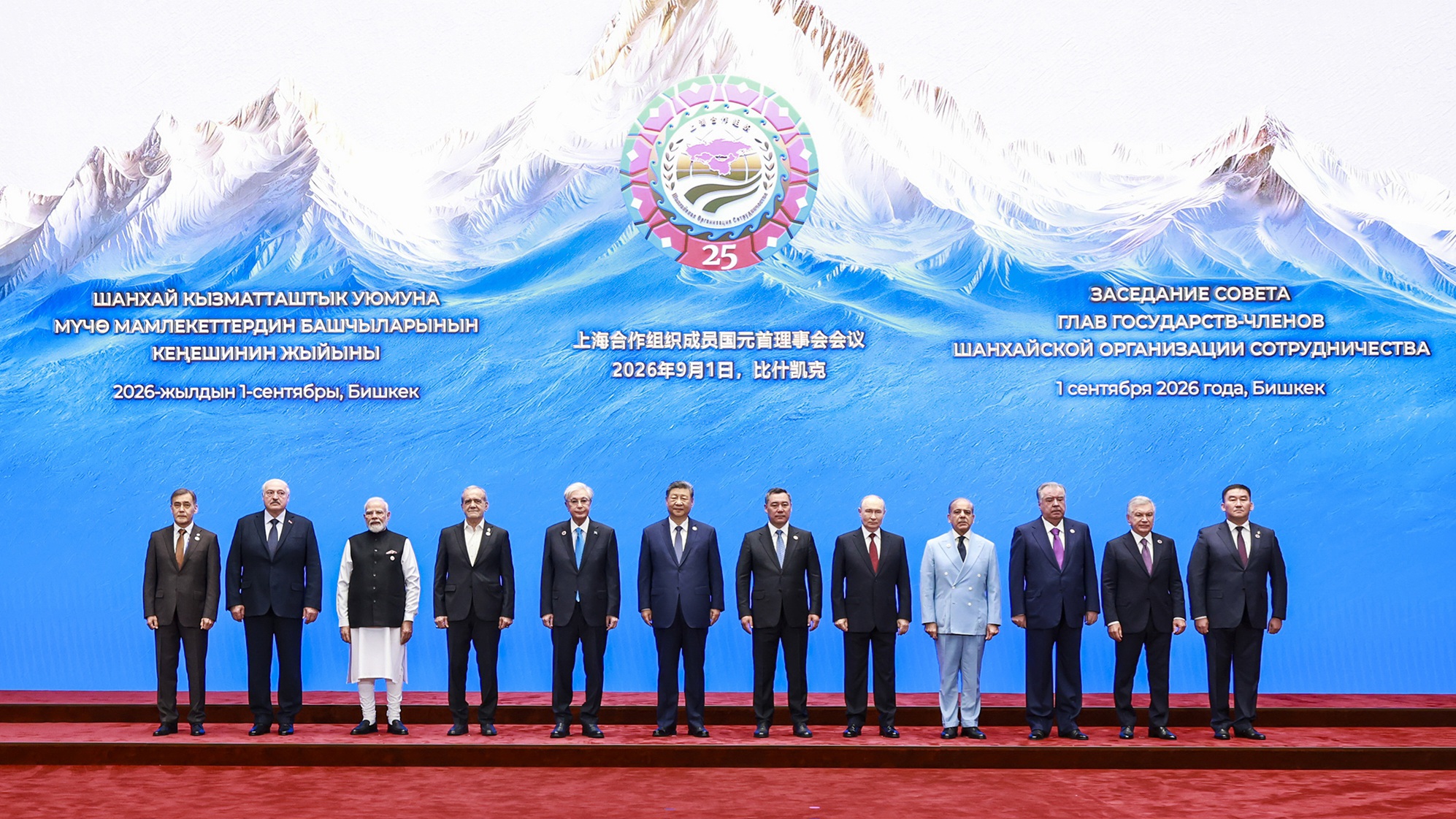
The summit, held in Kyrgyzstan on August 31–September 1, marked the 25th anniversary of the SCO and brought together leaders from China, Russia, India, Pakistan, Iran, Belarus and Central Asian states, alongside representatives and partners from a wider group of countries. The organisation now represents around 43 percent of the world’s population and roughly 23 percent of the global economy.
Beyond a security organisation
When the SCO was established in 2001, its primary focus was regional security and combating terrorism, extremism and separatism. Twenty-five years later, its agenda has expanded considerably—to economic cooperation, connectivity, energy, digitalisation, development and international governance.That transformation is important for the Global South.
The countries of Asia, Africa, Latin America and the Middle East increasingly want an international system in which their interests are not determined exclusively by a small group of powerful states. The SCO’s foreign ministers recently acknowledged the growing strength of Global South countries and called for a more representative, inclusive, just and multipolar international order, with the United Nations retaining a central coordinating role.
This does not necessarily mean replacing one bloc with another. Indeed, the SCO formally maintains that it is not directed against other states or organisations. Its stated principles include sovereignty, non-interference, equality and cooperation rather than military alliance politics.
The Global South wants development, not confrontation
One of the most significant messages emerging from Bishkek is that the Global South’s priorities cannot be reduced to great-power rivalry. Developing countries are seeking affordable energy, food security, infrastructure, technology, investment, trade access, debt sustainability and greater representation in global institutions.
They also want conflicts resolved through diplomacy rather than becoming prolonged wars that disrupt supply chains and economies. Indian Prime Minister Narendra Modi stressed at the summit that conflicts should be addressed through dialogue and diplomacy, warning that regional wars can have global consequences for energy security, maritime trade and supply chains.
This approach reflects a broader sentiment across the Global South: security and development are inseparable.
China, Russia and India: cooperation amid differences
The presence of Chinese President Xi Jinping, Russian President Vladimir Putin and Indian Prime Minister Narendra Modi made the Bishkek summit particularly significant.
China and Russia continue to advocate a stronger multipolar international system, while India has increasingly sought strategic autonomy and a greater voice for developing countries. Yet these three powers do not always share identical interests.
India and China have unresolved strategic differences. India and Pakistan remain divided over security and terrorism. Russia has its own confrontation with the West. These differences demonstrate both the strength and limitation of the SCO.
The organisation’s future success will therefore depend on whether it can manage differences without allowing disagreements to destroy cooperation.
SCO Plus and the wider Global South
Perhaps the most promising development is the growing importance of the SCO Plus format. The SCO already maintains dialogue-partner relations with countries including Nepal, Sri Lanka, Türkiye, Saudi Arabia, the UAE, Qatar, Egypt, Maldives and others. Afghanistan and Mongolia have observer status.
This creates the possibility of a much broader network connecting Asia, the Middle East and other parts of the Global South.
At the SCO Plus meeting, Togo’s President Faure Gnassingbé called for a more equitable world order, reform of the United Nations and stronger financing capacity for developing countries. Such demands are increasingly common across developing nations.
What does it mean for Nepal?
For Nepal, the evolution of the SCO deserves close attention. Nepal is already an SCO dialogue partner, a country situated between China and India, Nepal has a natural interest in regional connectivity, infrastructure, tourism, trade, energy cooperation and balanced diplomatic relations.
Shanghai Cooperation Organisation
Kathmandu should therefore view the SCO not simply through the lens of China-West competition, but as one of several platforms through which Nepal can advance its own economic and diplomatic interests.
Nepal can potentially use its dialogue-partner position to advocate for mountain economies, climate-vulnerable countries, sustainable tourism, cross-border connectivity and development financing. At the same time, Nepal’s foreign policy should remain independent and guided by its national interests.
A multipolar world—but with responsibility
The emergence of a multipolar world does not automatically guarantee a fairer world.
Multipolarity can create opportunities for developing countries, but it can also produce competing spheres of influence, rivalries and fragmentation. The challenge is therefore to ensure that multipolarity becomes multilateralism rather than another form of power politics.
The SCO has an opportunity to demonstrate that major countries with different political systems and strategic interests can cooperate without demanding complete political alignment.
Its greatest test will be whether declarations can be converted into practical results: greater intra-regional trade, easier connectivity, development financing, technological cooperation, energy security, climate action and peaceful conflict resolution.
The road ahead
The 2026 Bishkek Summit comes at a moment when the traditional global order is under significant pressure. The wars in Europe and West Asia, economic fragmentation, sanctions, energy insecurity and disputes over global governance have strengthened calls for a more representative international system.
The SCO cannot solve all these problems. Nor should it be portrayed simply as an alternative to the United States or the Western-led international system.
Its real significance may be different. The SCO represents an experiment in whether countries of different sizes, political systems and strategic interests can build cooperation around common interests rather than ideological uniformity.
For the Global South, this is an important opportunity. The objective should not be to create another exclusive bloc, but to ensure that Asia, Africa, Latin America and the Middle East have a stronger voice in decisions affecting the entire world.
The future international order should not be defined by a choice between East and West. It should be defined by cooperation between North and South, East and West, developed and developing countries.
The message from Bishkek should therefore be clear: the Global South is no longer merely an audience in global affairs. It increasingly wants to be a participant—and ultimately a co-author—of the international order.


