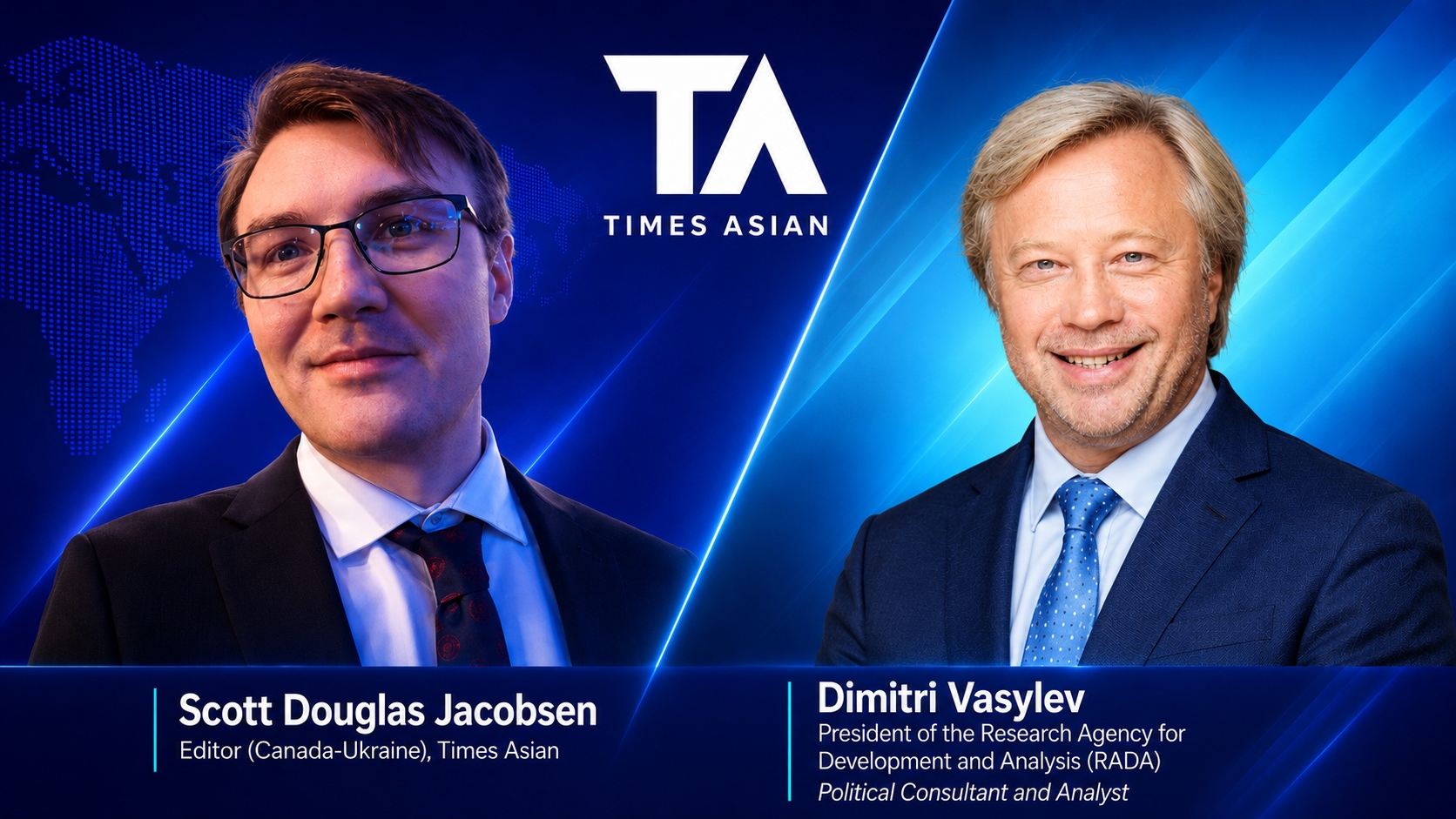
By Scott Douglas Jacobsen
Editor (Canada-Ukraine Affairs), Times Asian
How do Dimitri Vasylev’s music and political analysis reflect Ukrainian identity, democratic resilience, and cultural resistance during Russia’s war against Ukraine?
Dimitri Vasylev is a Ukrainian political consultant, analyst, public communications specialist, and musician. He leads the Research Agency for Development and Analysis (RADA), working across political analysis, governance, development, and public communication. Born in Kyiv during the Soviet period, Vasylev served in the Soviet Army before developing a stronger Ukrainian identity. Since Russia’s full-scale invasion, he has combined volunteer activity with music, producing three albums intended to strengthen Ukrainian culture, resilience, and national identity.
In this interview, Scott Douglas Jacobsen and Dimitri Vasylev discuss music, Ukrainian identity, political analysis, cultural resistance, and national resilience during Russia’s war against Ukraine. Vasylev explains how wartime experiences inspired his songwriting, why cultural production contributes to Ukrainian survival, and how RADA connects analysis with public communication. They examine Ukrainian democratic traditions, differences between Ukrainian and Russian political cultures, wartime grief, younger generations, international support, volunteerism, and Ukraine’s struggle to preserve democracy and sovereignty.
Scott Douglas Jacobsen: So how did you get involved in music? And when you finished your first album, what inspired you to do two more?
Dimitri Vasylev: I’ll tell you what inspired me to do the first album. Actually, my first song was called “Unbroken Soldiers.” And in many ways, it was… it was influenced and inspired by Bon Jovi’s song “Unbroken.” [Ed. YouTube channel here.]
As the full-scale invasion began, I felt like I first had to do something to take care of my family and some other things. Then I was volunteering for the military, and I had some extra time, and I said, “What can I do? What don’t I usually do?” I decided one thing I had always wanted to do was improve my vocal skills. I found a teacher.
I started lessons. I listened to Bon Jovi a lot. He was one of my biggest inspirations then. When I heard “Unbroken,” of course, it made me think of the soldiers, the veterans. And I felt like it sounded like something that I had already heard or experienced. I remember that I actually had a project called the Military Verses. So every day, I was composing a verse, four lines. And one of the verses, a previous verse that I wrote, was “Unbroken Soldiers.” I decided I could make something out of it. I did, and I liked it. I showed it to my teacher, and she told me, “Try to go to the recording studio, record the song, and see what you have there.”
I did. I was absolutely surprised by what I had done. It was an amazing sound. I didn’t believe I was the one who wrote and sang the song. And that’s it. Then I couldn’t stop. I continued to make music.
Jacobsen: Does your political, analytical perspective or work get fed into any pieces of music?
Vasylev: Yes, sure. For me, the song is the message. What I feel about what I’m doing with the songs is that it’s my mission to create a Ukrainian cultural project, a product. And that’s important for our resistance. It’s important for our survival as a Ukrainian nation. I felt I could contribute.
I know how to do this. So I decided that’s my mission. I have to do it. I’ve invested my money, time, energy, and resources, and I’m doing the right thing. Now I have a good result. I have three albums. I cannot stop.
Jacobsen: Do you consider music your first passion, or RADA, in its emphasis, your first passion?
Vasylev: This life is the passion, and anything you can do in this life contributes to widening your passions. And first of all, this life is beautiful. It doesn’t matter what is going on. Second, I feel lucky to have been born at a time of so much change. Usually, people don’t like to be born in times of change. But for me, it was a great time to have been born. I was born in the Soviet Union, in Kyiv.
I actually got a good education, a pretty good education. I had a chance to play hockey. It was a great opportunity to train. During the Soviet period, I had a great opportunity to study music, and I did. But then those changes began, and they began when I was finishing school. What I needed to do was to develop Ukrainian identity here in Kyiv and Ukraine. When I went into military service, I served in the Soviet Army. I served in Dumbol. Now it is Russian territory. Once, I had an experience that changed my perspective in many ways. I had to fulfill some task and bring something, bring some message to some division.
And when I came there, there was one guy. He looked different from anybody else. He was a soldier, but he looked different, and in his space he was alone, doing something, listening to Ukrainian music, Ukrainian songs. I was absolutely fascinated, and I asked, “What is this?” And he told me it was Kvitka Cisyk.
Kvitka Cisyk was an American singer of Ukrainian heritage. She worked professionally with many prominent American musicians and producers, including artists associated with Michael Jackson, and became especially well known for her studio vocals, commercial jingles, and recordings of Ukrainian music. But she felt Ukrainian. She felt she needed to contribute to Ukrainian culture and the Ukrainian nation.
She and her husband invested a lot in the Ukrainian album of her songs. This album has been a pillar of Ukrainian identity and independence for years and decades. When I listened to this and learned it was Ukrainian music by Kvitka Cisyk, who lived in America, my perspective changed completely. It’s the first time I felt I’m Ukrainian, and that was in Russia.
Jacobsen: Since the invasion and annexation in 2014 forward, what would you consider some of the more substantial political, cultural even, divergences between the Russian Federation and Ukraine?
Vasylev: People in the Russian Federation are afraid to do something that could land them in prison or cause them problems. Usually, they say, “I’m not interested in politics. I’m just doing my stuff.” This is something they are trained to do by the Russian government and by Russian political culture. They are trained not to be socially active, not to be politically active. So they decided that the nation, or the people, is something separate from the government, and the government is the king. That’s how they feel.
Ukrainian people, from their origins… Actually, going back in history, Ukraine had one of Europe’s earliest constitutional documents: the Constitution of Pylyp Orlyk of 1710. That constitution was an early example of a document establishing principles concerning government and political authority.
Ukraine also had a tradition of electing hetmans, and if people did not like them, they could seek to replace them and elect a new one. So there is a strong tradition of participatory political organization and horizontal management of society during important periods of Ukrainian history.
And that’s the main difference between Ukraine and Russia.
Jacobsen: On the expression point, what about even in things like music? Not even necessarily as blunt as the glorification of war and dying for a national war cause as an aggressor state. I mean, more in terms of the things people are willing to state with an instrumental.
Vasylev: Actually, when you’re talking about songs during the war, I don’t think that in Ukraine it’s about glorification of the war. It’s definitely sometimes the glorification of some people, a person, or a group of people, but it’s definitely a reflection of the war. It’s not glorification of the war. We hate the war, but when the circumstances are there, we have to reflect on and describe them.
That’s what it’s about. It’s more about description or reflection, not about glorification. That’s first. Second, it’s about sending a message to different people during this time of war to stay strong, keep going, and stay united.
It’s also a powerful message for the future because future generations will learn about this period, and they will wonder how people survived and stood strong for so long under these kinds of circumstances. The songs, films, poems, and other cultural products will give future generations a clear understanding of how people felt, reflected, and thought during the war.
And that’s one of the reasons why I’m writing the songs. I want future generations to know about the war from me, from what I’m writing.
Jacobsen: Tens of thousands of civilians have been killed or injured, including those verified by international monitoring and likely many more. A large number of servicemen and women have also been killed. Is music a way for Ukrainians to grieve together in song?
Vasylev: Of course. Some songs are for grieving. There are famous songs that were often sung during the Maidan in 2014, when the Revolution of Dignity happened and when the first Russian invasion began, with the annexation of Crimea and the war in Donbas. But Maidan was the start, and there were the Heavenly Hundred who died.
She and her husband invested a lot in the Ukrainian album of her songs. This album became a pillar of Ukrainian identity and independence over the years.
One of the songs Pikkardiyska Tertsiya performed was on it. It was a sad, special song with a strong spirit that people sang during those times and later during the war, because it is a song of sadness and mourning. It is “Plyve Kacha.”
Jacobsen: Where do you see your own music and the work of RADA in both cultural preservation, archiving for the future, and wartime resistance to cultural imposition by the Russians?
Vasylev: You’re talking about RADA. It’s basically my organization, called the Research Agency for Development and Analysis. When you make an abbreviation of this name, you get RADA. And “rada” is an important word for Ukrainians throughout history. We’ve been talking recently about radas, when people came together and decided to elect a hetman, the leader of the Cossacks.
And there is the Verkhovna Rada, the parliament of Ukraine, which is also an important name. The word “rada” means “council,” and it carries the idea of consultation with each other and, on that basis, making decisions.
So when I’m talking about my organization and political analysis, or let’s say analysis of any area of development, like local governance, renewable energy development in Ukraine, or any other area, we’re talking about analysis and, based on that analysis, recommendations for future development.
And when you compare that with the songs, in many ways it’s the same because what I do with the songs is analyze the current situation, put my conclusions from this analysis into the message of the song, and then send this song as a message out to the public.
So that’s the same process, but just in a different way, with different instruments. But the idea is the same.
Jacobsen: Who inspires you?
Vasylev: The Ukrainian nation.
Jacobsen: What does music leave among younger generations? Those who have grown up and, for a substantial portion of their lives, this is all they’ve known. So even among younger generations, even younger artists, there are those who, for most of their lives or a substantial part of their lives, have only known the war, from 2014 forward, and they’ve basically only seen it ramp up since 2022 as well. Who inspires you among younger people?
Vasylev: The young generation. Actually, I’m inspired by the young generation as a whole. When I look at the people and how they accept and perceive the situation, they go on. They keep studying, no matter what.
It’s one of the most difficult times for a young person to develop because, first, there was the war that began in 2014 with Russia’s occupation and annexation of Crimea and the fighting in Donbas. Then they had the problem with COVID, and all of a sudden they couldn’t study in groups, which is important for anybody, but especially for young people, to be in society. They had to study online.
They were being kept in their flats, many people in small flats, with whole families and sometimes several generations together, which is psychologically incredibly hard. Then, in 2022, we had Russia’s full-scale invasion of Ukraine and the full-scale war.
It’s incredible. These people sometimes don’t sleep at night, but they have to wake up and go to school in the morning, or even go to work when they’ve already graduated from secondary school or university.
And they go on. They continue to meet each other. They stay interested in this life. I can imagine how hard it is for them, but they go on. I see their creativity, their happiness, their ability to stay young. They don’t forget that they are young and that, when you are young, you don’t want to miss this period of your life.
And they try their best. So I’m inspired by these people. Of course, they’re different. Every personality is different and original. But when you’re talking about the society of young people, I am amazed by them, by their resilience, their wisdom, and their will to be young people and not to miss their youth.
Jacobsen: Thank you for the opportunity and your time, Dimitri.
Scott Douglas Jacobsen is a Canadian journalist and publisher who serves as Times Asian’s Editor for Canada and Ukraine Affairs and writes on international affairs.


