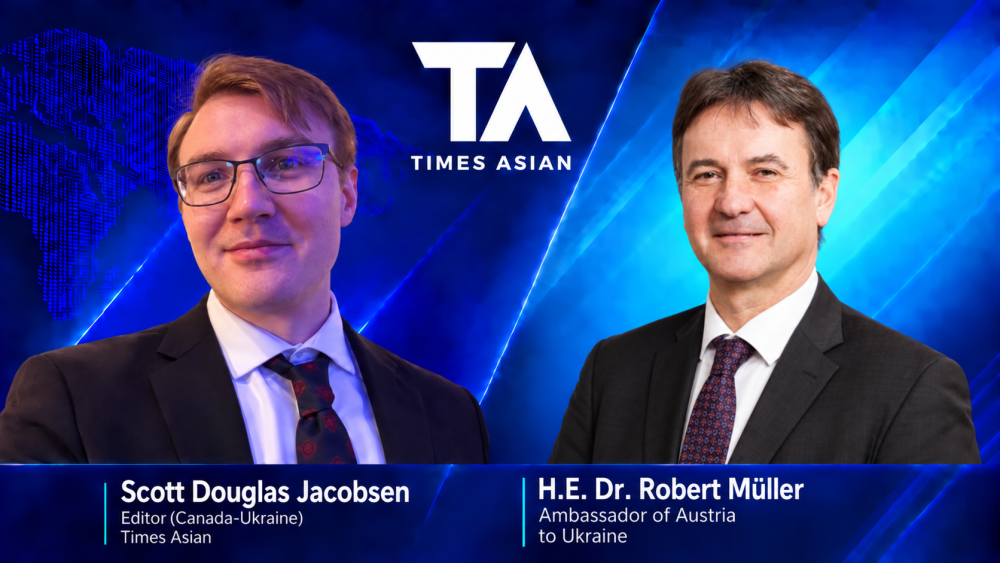
By Scott Douglas Jacobsen
Editor (Canada-Ukraine), Times Asian
How can credible diplomacy support peace in Ukraine while addressing lost trust, European integration, and demographic decline?
Dr. Robert Müller is Austria’s Ambassador to Ukraine, serving since May 2025. Born in Graz, he studied history, geography, and philosophy at the University of Graz, earning a doctorate in history. He completed diplomatic training in Vienna and previously also worked with Amnesty International and the Austrian Information Service for Development Policy.
Scott Douglas Jacobsen interviews Austrian Ambassador Robert Müller about Ukraine peace negotiations, failed ceasefires, Russia’s erosion of trust, and credible mediation. Müller discusses Ukraine’s European integration, democratic resilience, demographic decline, displaced citizens, and reconstruction, emphasizing the human consequences of territorial concessions and the importance of supporting Ukrainian identity and return.
Scott Douglas Jacobsen: That is a good lead into geopolitics. In the international and geopolitical context, we are seeing attempts to negotiate with Ukraine and Russia through the United States. We are also seeing a pattern, even recently, of attempts to bypass Ukrainians when discussing ceasefires, peace deals, and other arrangements. What are your thoughts on this?
Amb. Robert Müller: Overall, we welcome initiatives and try to be helpful.
When we talk about the current US initiatives, it is important to keep the dialogue open. We have the impression that some of these talks focus heavily on economic aspects as a way out. That might be too narrow, because you also need to look at the many political aspects to find a solution.
We wish this track every success. So far, it has not produced a lasting ceasefire or a peace agreement. The talks have enabled some humanitarian exchanges that may be linked to these formats.
Some exchanges of prisoners of war and returns of children or detained civilians also take place outside the US-led track. Austria is active in this area, including efforts to bring children back. The Pathways to Peace conference in Toronto was also important to us.
I do not want to seem to criticize the ongoing negotiations. But, living here in this country and seeing the suffering of Ukrainians, I feel that people want quicker and tangible results.
There is always talk about limited ceasefires in particular areas. Still, even these do not materialize—the latest proposals concern attacks on energy and other critical infrastructure, or shipping in the Black Sea.
People know that the Ukrainian side has, overall, been very cooperative and ready to say, “If it is a real ceasefire, we are ready to go along.”
The Russians have, most of the time, given these initiatives the cold shoulder. Now, with the attacks on energy infrastructure, Ukraine has again signalled its readiness, not for the first time. But how can you take it seriously if attacks on energy infrastructure and other critical infrastructure in this country continue?
Jacobsen: As a professional diplomat and an expert in this area, what do years of conflict and repeated failures of good-faith and bad-faith attempts at limited ceasefires concerning energy infrastructure, civilians, and military targets do to future diplomatic efforts?
They create a track record of failure. Does that poison the well in future negotiations, not only between the parties involved, but also for those who enter the process later?
Müller: The lack of trust is the most important issue here, and I fully understand it.
If you look back at the Budapest Memorandum and also at bilateral agreements, Russia committed to respecting Ukraine’s territorial integrity and sovereignty, then massively violated those commitments beginning in 2014. As a consequence , You can see a complete erosion of trust on Ukraine’s side.
On the other hand, all conflicts end one day. You need a third party to help find a way out. I do not see any chance of reaching an agreement if only Ukrainians and Russians are sitting at the table without third-party involvement. I see no chance of that. You need credible partners there.
We remember also initiatives from outside the United States and the European Union, involving a broader coalition of countries.
I would say the Ukrainians welcomed the overall initiative, but they did not consider the proposed mediators neutral enough. That is always the problem: the third party must be seen as capable of bridging the gap between the two sides.
Initiatives emerged in Türkiye early in the full-scale invasion. The UN was also involved in some limited aspects, including the Black Sea Grain Initiative, which operated for a time. But these were only partial agreements.
The longer the conflict lasts, and the higher the civilian casualty rate becomes, the more trust is eroded.
I think the Ukrainians would be ready to sit down with the Russians despite the ongoing massive attacks. They are also ready to discuss internally some difficult decisions about how to end this conflict.
But you need the other side to commit as well, saying, “Look, it is no longer our goal to eradicate Ukraine from the map. We are ready to settle for something.”
But it has to be realistic and based on what they have actually achieved militarily. So far, Russia’s demands remain unrealistic.
Behind this, there is always the threat that an agreement would be only a first phase, while the broader attempt to wipe Ukraine out or reduce it to something small remains part of the debates in Moscow. There are all kinds of threats, and sometimes they extend beyond Ukraine. In this atmosphere, it is difficult to build trust with Russia.
If the Russians could at least tone down this rhetoric, that would be welcome, because they control their public rhetoric. At times, I am shocked by the debates and escalation I perceive there.
Jacobsen: Three thoughts come to mind based on that.
First, if this continues for a decade from the full-scale invasion, rather than from the annexation of Crimea, it could approach a Pyrrhic victory or a loss for both sides. Economically, both countries are losing.
Some expert colleagues suggest GDP growth of roughly 0.5 to 1.5 percent, essentially stagnant. Some of their projections put growth at 5 to 5.5 percent by the fourth quarter of 2027, if conditions improve through the fourth quarter of this year and the first quarter of next year.
Second, when I interviewed Oleksandra Matviichuk from the Center for Civil Liberties, she noted something relevant to the realism question you raised. We talk about territory in a way that can be too abstract. For many Ukrainians, territory means people. It is a much more personal issue, not just about culture.
The third point concerns what I have noticed in some of the analysis. Beyond media freedom and corruption, the two societies at war have also diverged culturally.
For instance, we can look at two legislative developments. Russia decriminalized the first instances of non-aggravated domestic battery in 2017, while Ukraine criminalized domestic violence and expanded protections for victims.
Russia is pursuing a strong anti-LGBTQI+ campaign through public rhetoric and federal legislation, including expanded bans on so-called “LGBT propaganda.” Kazakhstan has adopted similar restrictions.
On the Ukrainian side, we have KyivPride, and younger generations tend to be more cosmopolitan in their views on these matters.
The war affects trust and other factors I am sure you encounter on the diplomatic side, making your work more difficult. Are you seeing these changes in society affect its orientation towards EU values, while retaining Ukrainian characteristics?
Müller: Absolutely. You mentioned this in the context of EU accession. We see society moving further and further west mentally, in many ways, and shedding post-Soviet legacies that are still present. The speed of this transformation is quite impressive overall.
You also rightly mentioned that Ukraine cooperates with international organizations and accountability mechanisms investigating international crimes, and allows monitoring visits. The ICRC is active here, as are UN monitoring mechanisms. Ukraine cooperates with them. By contrast, Russia has not cooperated with the international monitoring mechanism.
Ukraine wants to be part of a group of nations that comply with international law, and it cares about its reputation.
Russia country seems to have given up on that, at least to some extent. Its reputation in certain circles is already spoiled, so why cooperate or work towards transparency?
Jacobsen: I can add one footnote to that. When I interviewed Vrinda Grover, a member of the UN Independent International Commission of Inquiry on Ukraine and an advocate practising before the Supreme Court of India, she said the Commission had sent more than 30 formal communications to the Russian Federation, seeking its input. It had received no response to any of them. That speaks to your point about non-cooperation.
Müller: Even under the martial law in place here, there is a lively political debate overall. There is criticism, particularly from online media that are critical of the government. Anti-corruption institutions are doing their work.
There is a lot that other countries can learn from Ukraine in this field, even under these difficult circumstances. When it comes to EU accession, sometimes we think the political machinery in parliament and the administration seem to be working slowly. But through the prism of the ongoing war, you could also say they work extremely fast compared with other countries that approached the European Union in peacetime, under much easier conditions than Ukraine faces today.
Russian aggression also pushes the country much further west in many different ways. In this sense, you could say that Russia has lost Ukraine, or at least a huge part of the Ukrainian population.
Jacobsen: One comment that is probably relevant concerns Thucydides’ maxim. We are seeing whether that maxim plays out in this particular war, given the disparity in economic size and population between the two countries. How do you see this strange democratic moment about the future of an open society in Ukraine, and potentially even Russia?
When I talk to North American, Western European, and Eastern European colleagues, I use different historical examples. Since the full-scale invasion, this war has lasted longer than the American Civil War, World War I, American participation in World War II, and the Soviet Union’s war against Nazi Germany. Each provides a relevant historical analogy for different colleagues.
This is already a long war. It will be in the history books as the strange wheel on which many of these questions are turning against what people wanted. Do you have any thoughts about the historical moment we are living through?
Müller: Several aspects come to mind. One takes us back to the economic issue. You are right that, overall, it is not good for the people. It is not sustainable economic development, either here or in Russia.
On the other hand, certain groups always benefit from war and aggression, particularly in Russia, which has transformed into a war economy to a certain degree. Some people are benefiting from this. I agree that, overall, it is also a big loss for the Russian people and their future, because investment in the war economy does not support sustainable development, and they also have a huge death toll.
But coming back to the Ukrainians, I also think they are debating things here in an extremely civilized way overall.
I see a lot of hope for the future in this country, with the prospect that we could help bring Ukraine up to the level Poland has reached. Twenty/ thirty years ago, Poland was also in a difficult economic situation. It has developed dramatically and is now among the world’s 20 largest economies. Ukraine has the potential to do the same.
But that is what Russia does not want to see: a flourishing, economically successful, and democratically functioning country. Given the proximity of these countries, Russians will always watch closely. If they see Ukraine eventually doing better economically and having a much freer society, it could destabilize Russia itself.
Putin and his entourage are very aware of that. That is why they have an incentive to keep destabilizing Ukraine. I hope a different generation will one day come to power in Moscow, so this will no longer be a main motive in bilateral relations.
I also see an incentive in Russia to do anything it can to prevent a successful Ukraine from developing on its doorstep. That will also be factored into the negotiations.
You were also referring to the future. The demographic future is a problem here.
Jacobsen: That is another question as well. According to Pew Research, demographic decline was already an issue before 2014 for the Russian Federation and several wealthier societies, including European and Eurasian countries.
But Russia’s annexation of Crimea and the early phase of the war, followed by the full-scale invasion, have accelerated demographic pressures in both societies. It shows up in all sorts of ways.
Constant stress can aggravate skin conditions, including immune-mediated conditions such as psoriasis. These can produce inflamed patches or bumps on the skin and require treatment.
It also shows up in birth rates. There may be no one to settle down with, or few economic prospects to provide stability. There is also the question of wanting to bring new life into this context. Many individual issues feed into these demographic questions, alongside the Russians sending so many men off to die essentially.
That is one significant demographic issue that will probably have effects echoing through at least another generation. Another line of questioning concerns the sustainability of an economy with that decline.
Societies such as Japan have long faced lower birth rates, but they have put a lot of buttresses into their systems and how they do things. I interviewed the president of the UN Women National Committee in Japan in 2024. She noted that Japan has known about this issue for a long time and has introduced measures to address it.
But no complete solution has been found, whether in theocratic, democratic, or autocratic societies. War makes it even more significant. Do you have any thoughts on this?
Müller: On what you mentioned earlier about territory, I learned a lot more when I started living in this country. When you are abroad, you look at the map and say, “Why don’t they give some away? It is a pretty big country by European standards.”
But then you realize this country isn’t empty. People live there. What does it mean to give up everything you have always worked for, your home, your life, and leave it to somebody who takes it through aggression?
This is a huge moral issue. Ukrainians must find a solution, but we have to remember we are talking about territory and people, millions of people. That has a huge demographic impact.
I was at an event with Unicef last week discussing the new statistics. The total fertility rate is 1.13 children per woman, which is far too low. The other figure I remember is that the share of households with children dropped from 31% in 2012 to 22% in the 2025–2026 survey.
More and more households consist of one person. That can mean an older person living alone, needing care, and lacking sufficient financial resources. Poverty among older people living alone is a considerable concern.
We now have millions of Ukrainians living in Western or Central Europe. For us, they mustn’t lose contact with Ukraine. It is , of course, always an individual choice. Some people want to stay there.
It is possible to help reconstruct Ukraine, and it is important to offer people opportunities to return.
Returns will probably be more to the western and central parts, unless there is also a political solution in the east, and hopefully an end to the war as soon as possible. But Russia’s current campaign against infrastructure and this country’s economic livelihood makes these returns harder, especially during the winter.
We still try to support Ukrainian Saturday schools and encourage Ukrainian studies at universities. Ukrainian history is not an appendix of Russian history. It stands on its own. We want to increase awareness of the cultural differences between Ukraine and Russia and help build Ukrainian identity. Russia’s aggression also contributes to this, of course.
Canada has one of the world’s largest Ukrainian diasporas. It will also be important to mobilize them to help rebuild Ukraine.
Jacobsen: Thank you very much for the opportunity and your time, Robert.
Scott Douglas Jacobsen is a Canadian journalist and publisher who serves as Times Asian’s Editor for Canada and Ukraine Affairs and writes on international affairs.


